Software
Houzz Logo Print
rafugate1

Baking soda in compost

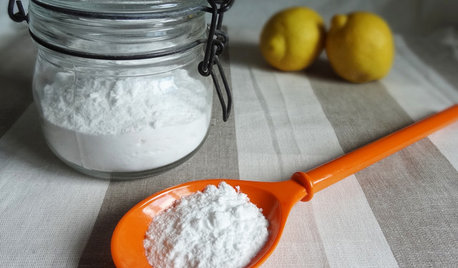
I keep a coffee can in my kitchen that I put food scraps, egg shells & used coffee grounds in for my compost pile. I sprinkle a little baking soda in the bottom of the can each time I dump it to eradicate the smell. Will the baking soda cause a buildup of salts in my compost (which harms plants)OR an excess of calcium, which I'm not sure the effect of excess calcium in plant soils?

Comments (5)

  • 5 years ago

    The small amount you are using will have no measurable effect. It is fully water soluble and will precipitate out with rain. And baking soda is sodium bicarbonate and contains no calcium.

    Rebecca/N. IN/z6A thanked gardengal48 (PNW Z8/9)
  • 5 years ago
    last modified: 5 years ago

    I'm afraid it's one of the myths that the makers of baking soda like to perpetuate. Baking soda is alkaline, so it will neutralize acidic smells (gasses). But there are very few of those "acidic gasses" (rancid butter/butyric acid is one I can think of). So it has little to no effect on eradicating smells in compost. You can accomplish that by keeping a supply of "browns," such as dead leaves, dry grass, etc. to add to your kitchen scraps.

    I don't know what effect baking soda has on turning your compost alkaline -- is it going to neutralize and damage the humic acid in the compost? That would be bad! I'll let our resident chemists tackle this.

    Rebecca/N. IN/z6A thanked JoJo (Nevada 9A)
  • 5 years ago
    last modified: 5 years ago

    JoJo said: "I don't know what effect baking soda has on turning your compost alkaline -- is it going to neutralize and damage the humic acid in the compost? That would be bad! I'll let our resident chemists tackle this."


    I'm riding the upshot to the top as I rambled a bit here with some research: "So, definitely don't bother. Skip it--Rebecca, you probably won't notice a scent difference, but if you do, try putting your used coffee filter atop the mass. That'll block the scent better anyway. Or just dump the can at that point and start over!"


    That's the whole chemical mess in fifty words or less.


    Given the descriptor of "a little," I'm thinking a very light layer? If so, I'd discontinue use, but not worry overmuch about past usage.


    Baking soda reacts slowly in damp reasonably open-air conditions to form sodium carbonate (washing soda), carbon dioxide, and water (the same decomp it undergoes in heat; an easy way to make washing soda if you're out, recipe online). Yes, this happens to some of us; I use it to make laundry soap every five years or so when I run out of my huge batch. :-)


    Sodium carbonate has a higher pH (for obvious reasons, having lost that one -carbonate that was helping outweigh that really alkaline sodium ion), but also washes out pretty easily.


    It'll react with any acid it can find as well to form a salt,

    [ETA: I misspoke a little here. It's already a salt, so water-soluble all by itself, and will undergo salt metathesis potentially with any salt or acid in solution to form another salt. It's just a basic principle of chemistry, ions have been told by their mommas that they better shop around. /ETA]

    and there are certainly plenty of those in the initial decomposition process, not to mention just the leftovers themselves*. So I'm going to tentatively state (without sitting down and calculating the actual electronegativity) that by the time we've got appreciable humates in the mix, the sodium carbonate is long gone. Last added compost atop the bin might leach a little humic acid from the mix, but the stuff's just not that reactive to begin with and will have already generally found an ion it likes anyway (although sodium's ability to convince others to join the flock is not to be underestimated).


    I'd also have to look at the comparative solubility of the HA when bound to sodium. It doesn't seem to be greatly impacted--shorter chains are more soluble, longer chains are less soluble in acid to neutral pH. Binding does not matter as they dissociate in the proper solution. Since sodium carbonate could toss the water solution towards the basic (possible albeit I'm going to say unlikely due to reacting with any acids in the mix, and hopefully there are enough to neutralize an 11.6 [at 0.1 N] pH solution), humic acid might become slightly soluble and be slightly lost.


    Fulvic acids are more soluble along the entire range and will leach regardless but the curves I'm seeing do tend to favor basic pH at longer molecular chains, so make of that what you will.


    (Interestingly, I found a great paper where there are indications that it'll knock ions out of exchange bonds and replace them with sodium; not really what you want in your soil, so definitely another reason to discontinue the practice).


    This is also oversimplified; as we get into colloids and everything else, the situation just becomes so much more complicated. But suffice to say that this is just adding extra steps that really don't help and add expense for no real advantage.


    * There are other influences going on here, but I don't think there's time for them to act before the can hits the pile.

    Rebecca/N. IN/z6A thanked User
  • 5 years ago
    last modified: 5 years ago

    Just rinse the can out after you empty it.

    Rebecca/N. IN/z6A thanked floral_uk z.8/9 SW UK
  • 5 years ago

    Thank you all. Maybe its influenced thinking but once I started using the baking soda in my can, I did notice a reduction in the stink. But could be, as Morpheus stated, eradicated by the presence of my used coffee filter. Either way, I’ll stop using the baking soda. I generated enough compost last year that it formed a (+or-) 6 ft. W x 4ft. T heap. Yay me!! :0)

Sponsored
Custom Home Works
Average rating: 4.6 out of 5 stars10 Reviews
Franklin County's Award-Winning Design, Build and Remodeling Expert