Software
Houzz Logo Print
brooklynnewyork

Noisy flue pipe

5 years ago
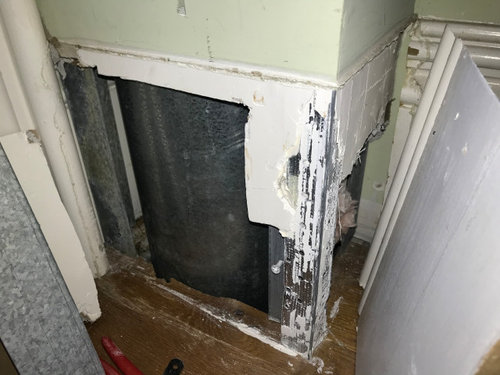
I have a flue pipe running through a chase in the corner of my bedroom that makes knocking noises every time the boiler turns on, loud enough to wake us at night. This is in a three story row house. There is a gas boiler (175k BTU) for heat, and two water heater tanks, located in the cellar — all three are connected to the same exhaust flue pipe, which runs straight up to the roof through all three stories above. I believe the flue pipe is 8-inch B-vent galvanized steel. The heating system is hot water radiators. Whenever the heat is turned on, the knocking in the flue starts, most loudly on the top floors closest to the roof (and unfortunately where my bedroom is located).

I suspect the noise is due to thermal expansion in the flue pipe. I opened a hole in the drywall in my bedroom and saw that there was a tight fit between the flue pipe and the floorboards. I sawed away the floor enough to leave a slight gap (see attached photo), thinking it would give the pipe more room to expand, but this didn’t alleviate the noise.

Any ideas on how to address this? Perhaps the cold air from the roof meeting the hot exhaust will cause noisy thermal expansion no matter how tightly or loosely the flue pipe is held in place?


Thank you in advance for any input.


Comments (14)

  • 5 years ago

    How old is the house? 19th century?

  • 5 years ago

    Yes, the house was built in the 19th century. But we gut renovated down to the studs eight years ago, which included replacement of all mechanicals (including installation of the heating system, and the flue in question). This problem has existed right from the start.

  • 5 years ago
    last modified: 5 years ago

    You have correctly identified the noise source as thermal expansion of the flue pipe. The flue pipe expands and contracts lengthwise as it heats and cools and any physical restriction to the pipe movement will cause it to creak and pop as it overcomes this resistance. Unfortunately, as the bottom of the flue is fixed at the boiler (it doesn't move), the maximum movement is occurring at the top where your apartment is. Assuming that the boiler is a mid to standard efficiency unit, some quick calc's estimate that at your apartment the flue is moving vertically as much as 0.7" to 1.1" as the boiler cycles. To minimize the noise, you could theoretically loosen any physical restrictions on the pipe at floors, within walls, or at the roof but this may be hard and/or inappropriate (code violation?) to do. Otherwise, insulate the walls as best you can and add mass to the walls by putting multiple layers of drywall with Green Glue noise proofing between layers to minimize what you can hear.

  • 5 years ago

    Thank you, that is very helpful information. Yes, the boiler is standard efficiency - 82.2%. I believe the pipe is also fixed in place at the roof (how could it not be?), and it would be nearly impossible to access the pipe within the walls at any point other than the top floor (the site of my bedroom where the noise is an issue). Unfortunately, the pipe/chase is situated right next to a window, which will severely restrict my ability to add multiple layers of drywall or do other soundproofing measures that would involve adding thickness.

  • 5 years ago

    Maybe trim back the window trim molding to allow more drywall thickness?

  • 5 years ago

    That might be my only option. As it stands now, I have less than an inch between the flue pipe and the window trim (the existing single layer of drywall fits between the pipe and the window trim by a hair).

  • 5 years ago

    If the flue pipe is expanding in vertical direction and is fixed at the top, then maybe you need a way for the pipe to expand to relieve the pressure. One way to do this would be to added a flexible connection in the basement right before the long vertical run. Take a look at this flexible type B vent. It may have enough flexibility to reduce the noise.

  • 5 years ago

    Are you occupying this entire building, or are there other apartments below you? Since you did the gut renovation, you should have some knowledge of the structure of this chase. Could it be opened up on the lower floors also, and the flue replaced with some other kind? Is it supported at several locations between the basement and roof? You said it is rigidly attached to the boiler in the basement. Could that attachment be modified to allow movement there? Have you talked to the heating contractor who made the initial installation?

  • 5 years ago

    Flexible piping is an intriguing possibility -- I will have to look into that.


    But I don't know whether the pipe is rigidly attached at any other point or points along its three-story length inside the chase. I own the entire house and my family occupies the 2nd and 3rd stories and we rent out the ground floor apartment. I would prefer to avoid opening the chase on the other floors at all costs, since one of them is rented out to a tenant and the other one has built-in cabinetry surrounding the chase that would have to be torn apart in order to access it.


    This issue didn't become apparent until the first winter following the renovation, and we had parted ways with our contractor on terms that left us not wanting to follow up with them about it. We've just suffered through sleepless nights every winter since then, but we've finally gotten fed up enough to try to do something about it. I'm trying to explore options and find potential solutions before hiring a professional (or, ideally, finding a DIY solution).

  • 5 years ago

    You say your family occupies the 2nd floor as well as the 3rd, right? How is the room around the chase on the 2nd floor used, and are the noises heard there also? If the flue pipe is attached at the bottom, is it free to move up and down it's entire length? Just thinking...

  • 5 years ago

    On the second floor, the chase is inside a built-in pantry cabinet in the room that is our kitchen. We hear the banging there also, but it doesn’t bother us because we don’t sleep there :)


    My tenant says he does not hear the noise on his floor (and the chase is in his bedroom), but I can certainly hear it in the cellar below him. The chase on his floor is bigger than on the top floor because the window placement didn’t cause the same space restriction, so perhaps the chase on that floor has better sound insulation or maybe the flue pipe is not as tightly squeezed into the chase on that floor.


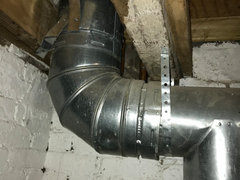
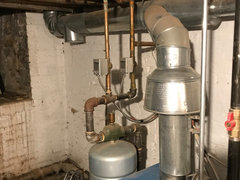
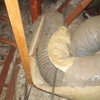
    In the cellar, where the flue meets the boiler, the banging doesn’t sound quite as loud to me as it does on the top floor, but it’s hard to tell for sure—it’s not an apples to apples comparison, because down there it’s an exposed pipe not encased inside a chase. It’s attached to the boiler (and two water heaters) via a 90 degree elbow, and screwed to the wood joists with metal clips in a couple of places (see attached photos) — I’m not sure how much flexibility of movement that allows.


  • 5 years ago

    I would be willing to try to soundproof the flue on third floor if there's no easy way to stop the noise from occurring, but, as mentioned above, the location next to a window limits how much sound-insulating thickness I can add around the flue.


    Before the renovation, there was a forced air system, and I believe the flue was a masonry chimney located elsewhere in the house. We put in this flue and the entire hot water radiator heating system that's in use now.

  • 4 years ago

    mtvhike - I have an insulated pipe that was encased in masonry. That was removed and the clicking from the attic is heard in the kitchen. The contractor just sealed the space around the pipe at the floor of the attic and I’m hoping I can’t hear it when I reinsulate the attic. Now that it’s been sealed from gaps at the attic floor, I hope the sound doesnt continue through the wall. ughh. Was there a specific thought you had about the masonry being removed? My pipe is attached to my furnace, but I do not currently use the furnace so I’m thinking expansion/contraction is a result of the attic not being insulated and the cool night air meeting the hot pipe.