Software
Houzz Logo Print
blakrab

Bamboo Variety?

5 years ago
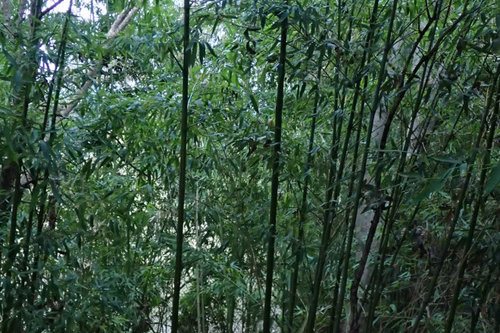
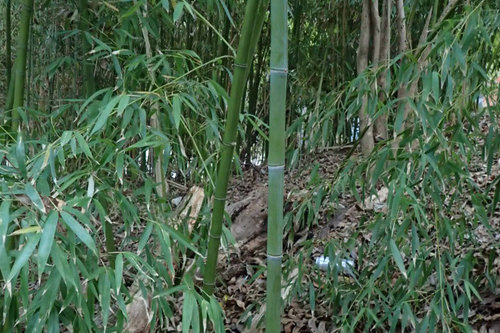
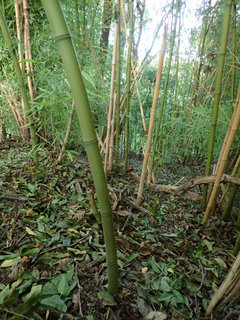
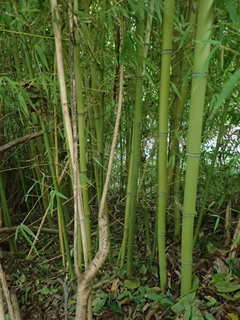
These Bamboo were found in Dallas, Texas along a paved trail. They were about 1.5" thick on average and a cool green. Any idea what variety they are?


Comments (19)

  • 5 years ago
    last modified: 5 years ago

    Are you thinking they are native, or planted or escaped? Were there any grooves in the sides of the culms? Any presence of zig-zaggy culms near the bases?

    Bamboos can be difficult to tell apart. Some of the most common would include Arundinaria gigantea and Phyllostachys aurea or Phyllostachys aureosulcata. So you might start there.

    blakrab Centex thanked Dave in NoVA • N. Virginia • zone 7A
  • 5 years ago
    last modified: 5 years ago

    Shape looks like the running bamboo our neighbors had for decades on the other side of the fence and retaining wall. Our experience was it can make a nice semi-evergreen hedge as a good neighbor where root barriers and disciplined maintenance keep it contained. Though can be a headache when it escapes where not wanted or spread is not limited by hard boundaries. Not so popular now, but was once used quite a bit around Dallas.

    blakrab Centex thanked bostedo: 8a tx-bp-dfw
  • 5 years ago

    One asked about is a Phyllostachys. Identification of examples of individual kinds not already recognizable to the observer in some other way is based on characters of culm sheaths,

    blakrab Centex thanked Embothrium
  • 5 years ago

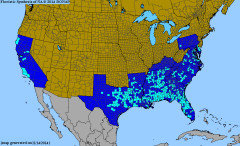
    I think it's Phyllostachys aurea. It would help to show older canes that have changed color, when submitting bamboos. P. aurea is green when young. P. aureosulcata is more yellowish with stipes running up the culms, and also all Phyllostachys observations on I nat, for Dallas, are for P. aurea, and there are no observations for P. aureosulcata.

    blakrab Centex thanked Jay 6a Chicago
  • 5 years ago

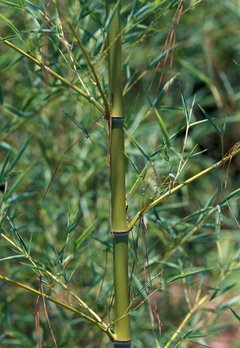
    I agree it may be a Phllostachys, but I'm dubious that it's aurea based on the nodes. In my experience, Ph. aurea has more pronounced nodes, like this:


    I'm thinking possibly Ph. bambusoides.

    blakrab Centex thanked kudzu9
  • 5 years ago
    last modified: 5 years ago

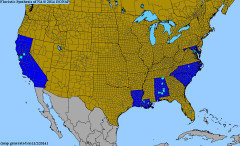
    P. aurea is the only naturalized invasive bamboo in the DFW. The culms vary.

    https://www.google.com/search?q=phyllostachys+aurea+culm&client=ms-android-verizon&prmd=isvn&sxsrf=ALeKk03pF8jQWLg7eccGVecKRv0t7lJc5g:1608738347369&source=lnms&tbm=isch&sa=X&ved=2ahUKEwjhreytueTtAhXHLc0KHYvTBo0Q_AUoAXoECAkQAQ&biw=320&bih=563

    No I nat. observations for P. bambusoides in DFW.

    Phyllostachys bambusoides
    Phyllostachys aurea

  • 5 years ago

    Randomly encountered individual patches do not automatically equate to a state of naturalization or weediness resulting in appearances on nation wide mapping systems.

    In this instance we do not even know if there used to be a habitation on the site or if the patch got there as the result of other human activities. For instance years ago I drove to a rural roadside site known to bamboo enthusiasts in the county south of me and dug up some Sasa palmata. It appeared that the establishment of this species there was the result of dumping.

    Golden bamboo is a sort of tortoiseshell type producing a percentage of culms with short, swollen internodes. There are typically enough of these variant stems present for nursery sized potted specimens to be displaying at least one.

    blakrab Centex thanked Embothrium
  • 5 years ago

    I'm not basing my assumptions entirely on bonap. I have a friend in the DFW area who's a botanist, and that's what he says, and you know, he's always out exploring the surroundings. I did come up with aurea all by myself before asking him. Obviously there certainly could be random patches of other species. There could possibly be a random patch of bambusoides that's gotten out of control? This bamboo looks similar to P. nuda, which I grew several years ago, because it's extra cold hardy. Mine could have easily escaped my yard and kept going. This is interesting. I also find it peculiar that there are no visible swollen nodes visible anywhere. But it's basically a close up just 1 culm. I noticed bambusoides has vertical stripes on the culms too, or at least some of them do. And how reliable are google photos anyway? Wish there were more photos. I wonder if the previous year's culms would still be golden and shiny, or would they all be looking very weathered like the one in the pic. I put more faith in i nat than I do in bonap, and there are so many people out there doing observations it's mind boggling.

    kudzu9, you sound like you've grown P. aurea. Have you?

    blakrab Centex thanked Jay 6a Chicago
  • 5 years ago
    last modified: 5 years ago

    Yes, I’ve grown Ph. aurea... and over 100 other bamboo species, but I’m not an expert in ID. It’s just that the OP’s photos don’t look like aurea to me. And every grove of aurea I’ve ever inspected has at least some culms with compressed nodes at the base, which I also can’t see in the OP’s photos. I would have posted a picture of my own grove of aurea, but it’s cold out and I was lazy, so the photo I used was from the web site of a bamboo nursery I trust. ;-)

    blakrab Centex thanked kudzu9
  • 5 years ago
    last modified: 5 years ago

    Thanks kudzu9! I'm trying to dig deeper, to know for sure.

    Blakrab, maybe start recording GPS. That grove, could be on I nat, and I wouldn't know without a more precise location.

    blakrab Centex thanked Jay 6a Chicago
  • 5 years ago

    I would never attempt to ID bamboo, but it does look very similar to what I‘ve seen next door in Fort Worth at the Japanese Gardens.

    blakrab Centex thanked Jilly
  • 5 years ago
    last modified: 5 years ago

    Jinx-

    There are over 1000 species of bamboo that people grow, and many of them — particularly green Phyllostachys — have great similarities, making ID from photos or in person for those types hard. There could be at least a dozen species in the Japanese Gardens that “look very similar” to the OP’s photos.

    blakrab Centex thanked kudzu9
  • 5 years ago

    Noted. Thank you.

  • 5 years ago


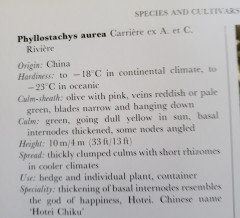
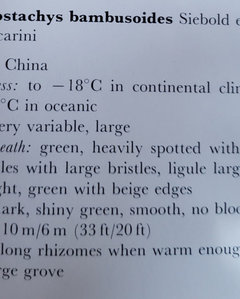
    I forgot that I had a book on bamboos.

    blakrab Centex thanked Jay 6a Chicago
  • 5 years ago
    last modified: 5 years ago

    What kinds are in commerce with links to photos of many of them (scroll down to Phyllostachys).

    BambooWeb - Bamboo Species List

  • 4 years ago

    I believe the only native American bamboo is Arundinaria sp. (River Cane)...which I think doesn't get thicker than maybe around crayon-width?


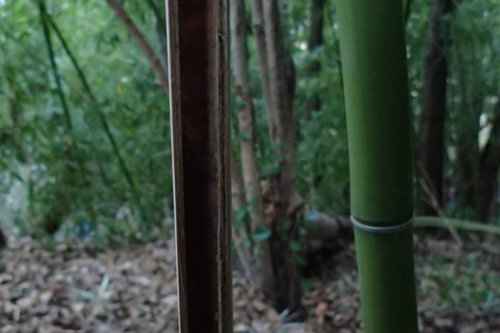
    Anyways, here's a few more photos of this particular bamboo, that probably grew up to about a ~2" width and maybe ~17' tall?


  • 4 years ago

    Still need to be showing springtime culm sheaths


  • 4 years ago

    It's peculiar that Jay's book seems to think they will be hardier in oceanic climates.