Software
Houzz Logo Print
lorraineg570

I know indoor herbs are tough to keep going?

5 years ago
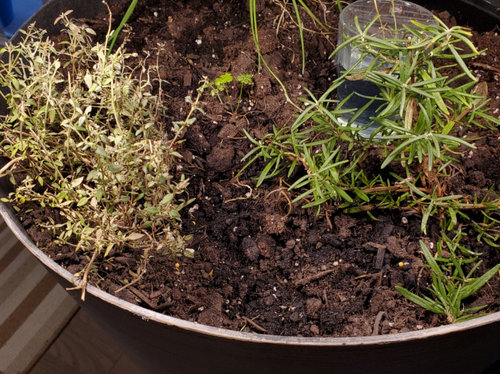
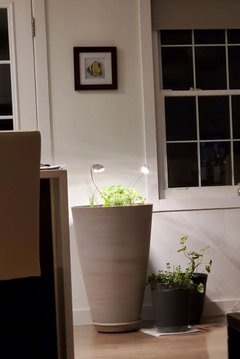
I'm just trying to get them to survive until spring here. This planter looked amazing last summer when it was outdoors. Indoors I'm having a terrible time. The soil drains quickly which from what I've read is good for what is in there (Basil died so now I've just got thyme, rosemary, garlic chives and a tiny sprig of parsley coming back after the rest of it withered away). Not sure if it'd draining too quickly. I have a tendency to overwater so I'm hesitiant to give it a good drenching like it would get outdoors in the rain so I'm leaving a good bit of the soil unwatered and watering around the actual plants. I cut the thyme back a good bit today. It doesn't look like it's dying but it is a bit dry so I'm trying to not overwater it. It's not brown but it's not a vibrant green either. I fertilize once a week or week and a half with miracle grow all purpose. Any tips would be greatly appreciated. I also have a grow light on it 12 hrs a day. SW PA is very sun deficient this time of year...actually about 6 months a year, sadly.


Comments (26)

  • 5 years ago
    last modified: 5 years ago

    I think you're doing about the best you can under the circumstances (eastern PA here). What's the wattage of the grow light and what kind is it?

    (I don't mean to set off much of a conversation about grow lights here as those can go on for days and get pretty heated--pardon the pun--but most high-light plants are going to want the most light they can get, and the most enhancement they can get. I keep part sun plants under 40 watts of LED grow light, wide spectrum plus some special banding), plus on southwestern windowsills. With the LED adjusted to 4" from the leaf canopy).

    That works out to the equivalent of 240 watts of incandescent lighting (which would sear the leaves) or about 200 watts of fluorescent (probably ditto).

    Definitely water sparingly, keeping the soil damp to moist, like a very well wrung-out sponge. Don't be afraid to let the top dry out just as long as it's a little damp an inch down.
    I'd either discontinue feeding during the winter or cut back to a very gentle feeding no more than once a month (quarter strength or less). Winter plants don't feed heavily and the salts build up in the soil.

    If you can give this a southern window, so much the better. If not, do what you can and step the light up to 15-17 hours a day. When I start seedlings, I use a minimum of 16 hours a day of light under fluorescent wide-spectrum (split-spectrum, long story) tubes, 180 watts per shelf.

    Parsley is a biennial, not a perennial, so that's a consideration here. Basil's a really short-lived perennial and I've always found it to be rather touchy, so I just treat it as an annual anyway. Certainly others might have overwintered basil, it can be done, but I've never found it easy or worthwhile in Pennsylvania.

  • 5 years ago
    last modified: 5 years ago

    Thanks for the input. Here's the lamp I'm using.


    Amazon.com : Abbicen Grow Light Clip on Indoor Plant Grow Light with Flexible 360 Degree Gooseneck, Full Spectrum, Timer Setting, Dimmable Brightness for Plants Hydroponics Greenhouse Germination : Garden & Outdoor


    I can't remember when we last had a sunny day here. I have the lamp on auto for 12 hours a day. I can try upping that but I'll have to turn it on/off manually, I think 12 is as high as it goes. I'm willing to just replace the plants a few times through the winter. I use the fresh herbs enough to make it worth the minimal expense. The rosemary looks great although it doesn't seem to really grow much. I haven't had luck with rosemary from a cutting but the Basil seems to be starting. The only place to purchase plants here is the grocery store/Walmart and they are usually leggy or not in great shape when you buy them. Selection is pretty slim too. The stores here apparently think people don't do any indoor gardening bc you can't find anything here this time of year.

  • 5 years ago

    Herbs are difficult to get to thrive indoors especially in winter. I can usually keep them alive but I have found I have better luck taking cuttings.


    It's usually better to have each plant in it's own container rather than several different types in one container.

  • 5 years ago

    You should stop fertilizing for now. Your goal is to keep them alive, not force them to grow when they are taking a break. If you want to continue using Miracle Grow (later in the season), please get the MG for Vegetables and Herbs, not the regular MG.

    If you are using fertilizer often, while not watering much, all those unused salts are not washed out of the pot through draining holes, so they will accumulate in the soil and burn the plants.

    If for some reason you feel you need to fertilize, please use fish or kelp emulsion, more diluted than it's normally recommended. It's a bit stinky but very gentle and won't burn your herbs.

  • 5 years ago
    last modified: 5 years ago

    @gjcore, all the ones in the planter seem to do well under similar circumstances. It did amazingly well out on the porch last summer. Yes, I am trying to start cuttings now. Thanks!

  • 5 years ago

    @JoJo (Nevada 9A), I will give the fertilizer a break. Thanks for the input.

  • 5 years ago
    last modified: 5 years ago

    Mines thrive under lots of light and warm temps. 65 or above. Or they thrive in a very cold porch with 12 hours of light.

    I have variegated lemon oregano, lemon balm, lavender, and rosemary)

    Don't over water, keep in a very porous mix, and try not to wet the leaves too often. Lots of air movement too from a fan. Spray for pests once a month.

    A mix with lots of peat will certainly kill them eventually

  • 5 years ago

    So I've ended up replacing the herbs that needed it. Now I'm wondering if self watering stakes might be a good idea? If so, would drip ones (like the globe thingies) be better or the terra cotta stakes? TIA!

  • 5 years ago

    Neither :-) You need to be able to judge watering needs visibly or manually rather than leaving it up to some ineffective instrument to decide for you. It is also important to group or plant the herbs by water needs. Mediterranean herbs like rosemary, thyme and lavender need only enough water to keep alive whereas herbs like parsley, chives or basil will need regular irrigation.

    I'd also question the suitability of the potting media. The Mediterranean type herbs want a very fast draining, lean soil so something like a cactus mix or the gritty mix would be most suited to their needs, while other herbs prefer a more typical container or houseplant potting soil.

    Since minimal growth will be occurring in winter even indoors, watering will be infrequent at best and no need to fertilize at all until spring. At which time, they should be moved outside if at all possible.

  • 5 years ago

    No, no, no, no, no! 😟 You need to water by hand when they need it, not to a timetable and not constantly. There aren’t any shortcuts. Few culinary herbs hail from habitats that are perpetually moist. Read meyermike’s tips again. Porous mix, lots of light, lots of air and judicious water.

  • 5 years ago

    Oh my god. I’m not sure if anyone had asked. But let’s be honest. Do you most them?
    Let’s us know please
    Mike

  • 5 years ago

    Kitasei, remind me of your climate? Was it NY state?


    Did you leave your bay outside until the last possible minute ie after a couple of frosts? And what‘s the weather like now? How big is it?

  • 5 years ago

    Well, I'd use a mixture that holds just a touch more water to avoid the dry up and die thing. Gritty mix just leads to something that dries too fast. Nothing extreme, just a bit more water-retaining than that if they're drying up and dying, particularly given the below. Because if they're doing that, you have a problem. I'm not at all disagreeing with Floral, I'm simply saying don't make work for yourself here. Bay's not going to enjoy my standard "plop it in Miracle Gro Moisture Control," but don't drop it in pebbles and sand, either.


    Sigh. And frankly, after yesterday, I'm expecting a fight on that one from the usual suspect with the reading problem.


    And yes, you're going to need light for most herbs. Keyword: most. But bay is listed as full sun to part shade. It comes at a cost...and not just electricity. Full sun is actually the equivalent of about 10,000 lumen per square foot. You can get away with about 3,000 for part shade.

    We can't do that in our homes, but we can add what's possible and extend time up to about 16-18 hours a day (I never go to 24 due to some hormonal keys only happening in the dark on some plants; bay doesn't happen to be touchy, but there's also no need).

    We can also tune the spectrum a little bit to make up for what we can't do in intensity. Choose warm white bulbs (LEDs) for electrical efficiency and spectral efficiency (they output a spike of deep blue as their native frequency that plants favor, plus a wide output in the orange-red band. Visually, they're pleasing to us as well and make the plant look natural and attractive. Contrary to other opinions, the other parts of the spectra are used by helper pigments in the plant (at lower efficiency, which is fine). The lower-efficiency lights aren't absorbed by the top leaves and penetrate to deeper ones or to stems, activating cells there. So that helps; deep leaves are mostly seeing yellow and green light, which they do use, just at around 20% efficiency (depending on the plant).


    With bright light comes a lot of water use...and waste heat. And again, potential winter bugs with no controls, so keep an eye out for that. Bay will also benefit from being sprayed with water regularly to control some of said bugs and keep the moisture levels up in the leaves (it's one of those where the "myth" is not a myth, it's rather demanding--but most other plants really don't care).

    Hence the reason to use a just slightly more water-retaining mix and, instead of relying on your mix to do the watering work for you, do it manually.

    Alternately, simply water more often. Twice a day? If it's wilting like that, you may have to.


  • 5 years ago

    Sorry. That was suppose to say ‘ Do you mist them at all ?? Sorry

  • 5 years ago

    Yes, Floral, New York zone 6b (same as OP’s). I did not wait for a couple of frosts to hit it before bringing it in. I brought everything in several weeks before we turn the heat on (around Oct 15) because I thought things should get gradually acclimated to dryer air. I presume this was mistake number 1. Then I was so afraid of overwatering that I must have let it dry out in the cactus mix. It was too late when I tried to revive it by misting and tenting. And then there’s the light. I won’t give up. I am determined to learn how to keep Rosemary and bay. This one was about 18 inches tall.

    On a completely unrelated topic, Floral- how did the wedding flowers turn out?!

  • 5 years ago
    last modified: 5 years ago

    Sadly, there has been no wedding yet. It’s been postponed three times so far. We had a total lockdown with no weddings allowed at all. Then partial easing with only 15 people allowed, including the couple and the registrar which didn’t even leave enough for direct family. Then another lockdown with no weddings. Then only 6 people allowed and no reception. And now another lockdown. No weddings at all allowed here at the moment. Plus the groom’s family are in Italy and gave them been able to travel. Now a tiny ceremony is scheduled for May but we’re not banking on it. And we have a date for a bigger do in 2022. But I honestly don’t know when it will happen.

    The flowers I grew were great ..... but useless.


    Bay can take the occasional 23f so it can stay outside until it gets really quite cold. Round here they grow like weeds and self sow. And they often grow in shade. Rosemary needs much more light.


    There was going to be a lot of bay and rosemary in those flower arrangements! 😒

  • 5 years ago
    last modified: 5 years ago

    No, I have not been misting them.

    They are in soil that drains very well, maybe too well. I have to water a tiny bit at a time or it just runs straight through. I have a tendency to overwater and have resorted to not watering my basil until it starts drooping, so I don't kill it. I don't baby these at all in the summer. The planter sits on my back porch and gets watered when it starts looking droopy or when it rains and it looked like a jungle. The planter is a good 18" across so I can wet the different herbs at different intervals, they're in separate areas of the planter. I just thought with my tendency to overwater, the drip thing might be best but I guess not.

  • 5 years ago

    And we're starting to see why the general recommendation is, "Don't bother to overwinter."

  • 5 years ago

    “it just runs straight through.“


    And so it should. Put the pot in the sink and water copiously. Let it drain and replace where it normally lives. To be brutally honest with you an 18 inch container is nothing like big enough for all those different herbs if they really were doing well. The rosemary, for example, if it was growing well, would fill the pot by itself. If you can keep it all alive until spring I’d do what was recommended by ghcore right at the start and give each herb its own pot. Then they’ll have space and a watering regime to suit their differing requirements. Start the parsley and basil again from seed. You’ll need to do it every year.

  • 5 years ago
    last modified: 5 years ago

    Can you come put this in my sink? : )


  • 5 years ago

    Haha! Of course you don’t need that depth for herbs. I hope you have a plastic insert that can be removed snd taken to the sink.

  • 5 years ago

    The insert is about a foot and a half deep and it's wedged in there tightly, it's not coming out. There are holes in the bottom of the planter so drenching it when it's outside isn't a problem. I have to be more prudent with the water with it on the hardwood. There is a tray under it but it won't hold much.

  • 5 years ago

    Ha ha! I didn’t realise it was so tall. It’s a lovely container but you’ve made it hard for yourself to grow your herbs successfully. Meanwhile can you find a bigger drip tray?

  • 5 years ago

    Oh, I love that pot! But yeah, it does make life more difficult than it needs to be what with the wedged-in aspect...

  • 5 years ago

    I find bay leaf plant one of the easiest and forgiving plants to take care of. I have one that is 10+ yrs old. It is in 511 mix. Outdoors I keep it in open shade that gets about an hr or two of morning Sun. Indoors I keep it in a spot which gets some indirect lights from my led panels. The room is on the cooler side. It can get to 45F over night if it is really cold outside. When the soil is quite dry (I just lift the pot and feel the weight) I water it very well and leave it alone. I think I may have seen some scale once. No other pests or disease. In winter it basically does not grow till about March when some growth will resume. I try to keep it on the small side with regular pruning. In Summer produces a ton of new leaves and harvest is big enough that we can distribute to our neighbors and friends.

    Rosemary, I find to be trickier indoors during winter. It needs a very cool very bright spot and fairly dry soil during winter. Does well in gritty mix and treated like a succulent. Outdoors, in our zone, needs good protection. South facing spot next to house wall is a good location for the hardier varieties. A wind barrier will help a lot to prevent branch die-back. Thyme, oregano also likes similar conditions. I grow them in gritty mix. Not sure about Parsley - I do not grow them. I do not like it either.

    Basil, I find to be even more difficult to over-winter indoors. Most varieties wither away very quickly indoors. Some varieties fare a little better. The most I managed was 3 years tending an African basil. It is a white fly magnet. End of winter it looked miserable but outdoors it will bounce right back and become a monster plant. Last fall I decided it was not worth bringing it back indoors again. This was in a 511 mix and needed a bit more watering than other herbs.

    lorraine: That is a nice pot. I would echo floral regarding a larger saucer. I bet you can take out the plastic pot wedged inside. Let the soil dry out a little. Lay the pot on its side. Use a rod/stick inserted through the bottom drain hole and tap the bottom of plastic pot. Do not try to push it hard. Just tap the bottom 10+ times. The vibrations should loosen it enough that you can slip the pot out. You may have some soil spill out too. I have large clay pots (not as tall as yours though) that I use outdoors mainly. I slip some of my plants in plastic pots in those. By the end of Summer they get wedged in well. I sit them on my bench which has hole just for the purpose of inserting a stick to loosen the plastic pot.

    For some of the heavier pots I insert pieces of styrofoam blocks and adjust the height so that the plastic pot sits just below the rim without wedging itself. Bricks are better than blocks if you suspect it has a tendency to tip over.