Software
Houzz Logo Print
webuser_324790799

Mature Green Gage Tree Doesn't Fruit

5 years ago

Hi
English Greengage question please.
I live in a part of the UK that doesn't get frosty weather. Temperatures rarely drop below zero. Temperate climate. Good loamy soil, pH around 6.5.
In only 4 of the last 15 years has it borne fruit and then only around 20 or so. It also shows few flowers. Yet most fall, unpollinated, or are pollinated but fail to swell into fruit before dropping as tiny 4 to 5mm fruit.
Yet, flower abundance is also not as I'd expect even to start with.
The tree is over 20 feet tall, and I have, over the years, tried pruning hard, pruning lightly and not pruning at all, or merely shaping to eliminate dead or crossing branches. The shape is good, open as it should be.
Nothing has changed. It grows healthily in a good, non-exposed spot. No sign of disease of any obvious significance over the years.
Nearby is a modest mini-orchard of heritage apple trees, a Marjorie's Seedling plum, a fig tree, a Service Berry, many soft fruits bushes. All of which bear masses of flowers. All, but the Service Berry (3 year old), bear masses of fruit.
Any ideas please?
Thanks.
(Wales, UK)

Comments (13)

  • 5 years ago
    last modified: 5 years ago

    Best guess is that it may need a mate to pollinate if the other plum trees in the area are too distant? As for it producing too few blossoms, do you know if the orchard owner applies nutrients/fertilizers for his trees? Perhaps your tree needs something that your soil lacks?

  • 5 years ago

    Thanks for replying. No, the orchard trees are mine in the same garden. Just a small group of 15 or so trees, some M106 apples, but some dwarf M27 and M9. The plum is also within 30 feet and in the same pollination group. Soil conditions pretty identical It's the constant lack of flowers that always has me puzzled. Not pollination. I wonder if greengage is slightly different to other plums as I'm quite near the coast.

  • 5 years ago

    Can’t offer a solution, but Greengage being a European plum does not need a pollinator so it is something else.

    Full sun? Is too much nitrogen possible?

    Someone more knowledgeable should have a better idea.


  • 5 years ago

    Is there any chance it is not greengage but rather a yellow fruiting Japanese etc?

    Symptoms are similar to a Cerasifera plum here that wouldn’t fruit until I found a correct pollinator for it.

  • 5 years ago

    Thanks for your thoughts fireweed. I bought it as a sapling from a nursery so it's unlikely. I was specifically after an Old English Greengage variety. The few fruit I've had (one year was actually very bountiful), do taste exactly as I remember.

  • 5 years ago

    You're right. It is supposed to be self-fertile. In fact, it's one good year was before I acquired a Marjorie's Seedling, also Gr.3.

    However, it's lack of plentiful blossom does baffle me.

    I just wonder if being near the coast affects greengages differently to other plums.

  • 5 years ago

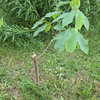
    Greengage left of picture


  • 5 years ago

    "Can’t offer a solution, but Greengage being a European plum does not need a pollinator so it is something else."

    Not all European plums are self fertile. Some are, some are partially self fertile and some require a pollination partner. At best, Greengage is only partially self fertile so will benefit by another European plum as a pollination partner. That may be why any fruit that is being formed is dropping prematurely.

    But even having a pollination partner will have no bearing on flower production. That would be something related completely to growing conditions.......late frosts, inadequate fertility, diseases and/or insect issues, insufficient sunlight, etc.

  • 5 years ago
    last modified: 5 years ago

    I have Cambridge Gage. It took a few years to get going and still fruits variably. Some years jackdaws have eaten almost all the immature fruit. Some years little fruit sets In the first place. But it always has plenty of blossom. Some birds eat flower buds but the traditional culprit, bullfinches, is quite rare these days. Have you noticed any other species in the tree? I have seen wood pigeons shredding the young foliage So they might be destroying flower buds. Does it have flower buds on it now? If you cut a branch and take it indoors to open you can judge whether it has plenty of flower buds. That way you’ll know if the flowers are never setting at all or whether they’re being lost along the way.

    My gage grows on an allotment with plenty of other plums around. Here’s a list of pollinators for Old English: https://www.orangepippintrees.co.uk/pollinationchecker.aspx?v=1249 note that this source says it's not self fertile.

    Fireweed22, its highly unlikely to be a Japanese plum. They don’t grow well in the U.K. and are rarely seen here.

  • 5 years ago

    Hi. It's a magnet for tits and finches, including goldfinches. So that's possible. A few collared doves and sparrows too. So that's possible.

    It's still dormant at the moment. No waking buds at present. I'll keep my eyes peeled.

  • 5 years ago

    @gardengal48 (PNW Z8/9) I had to Google what you said about greengage needing a pollinator as my paper books on fruit claim it to be self pollinating, but you are right. seems about 50% of the sources claim self while the other half’s suggest it needs a pollinator.

    Interesting!

  • 5 years ago

    yes. Also found that.

  • 5 years ago

    ^^^ The compromise is that having a pollinator increases your odds of success.