Software
Houzz Logo Print
ashpip

Street tree help!

5 years ago
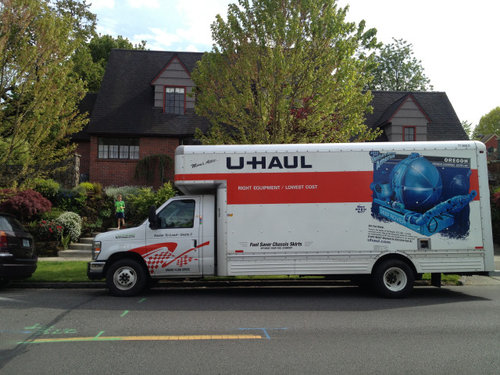
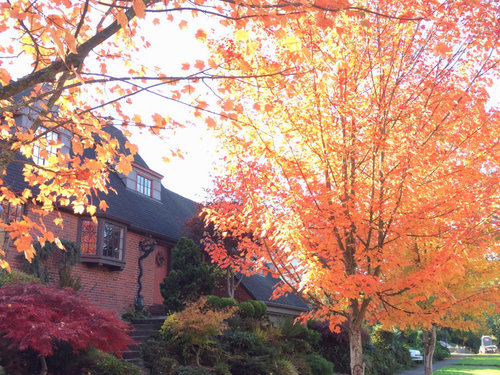
Hello, the city (Portland, OR) wants me to put in a large street tree (between the road and the sidewalk) , 8.5 diameter min. (full grown). The approved list includes oaks, firs, plane trees, ginkgo, sequoia (hey 2021 urban tree of the year!), redwoods, tulip tree. It has to be across driveway from three fantastic maples that are on fire in the fall (no longer allowed in Portland). I’m loving the yellow Spanish fir but won’t it look weird just hanging out by itself? I could take out a lame variety of dogwood I have on the other side of my house and put in another Spanish fir so that there is some continuity? Thank you!


the tree needs to go where the back of this uhaul is.

From the picture, it would be to the right of these trees on the other side of the driveway)


Sequoia (2021 urban tree of the year!)
Yellow Spanish fir
Regular Spanish fir

Comments (18)

  • 5 years ago
    last modified: 5 years ago

    If your first choice is Sierra redwood that will of course completely overwhelm the planting site in time - we are talking about one of the world's very largest growing of trees. And true firs - even a Mediterranean climate adapted species like Spanish fir - deteriorate with age in the environmental conditions of local urban communities. With the 'Aurea' cultivar showing an additional tendency to struggle after a time.

    Your maples look good - and will themselves get a lot bigger later. So why the need to shoehorn in an additional kind? From a list of trees made up mostly of ones that are suitable for acreage but not parking strips?

  • 5 years ago
    last modified: 5 years ago

    From your list of choices I would be looking at the ginko and the tulip tree (liriodendron?) to stick with the deciduous, fall color, upright growth for a limbed up tree form you can do city things under. I hear liriodendron is a nice tree out your way. Here in its native environs it a giant forest telephone pole.

  • 5 years ago

    Unless limbed up, conifers maker terrible street trees!! They tend to block vision, which would be a real hindrance next to a driveway. And limbed up, they look like tree popsicles. I am surprised Portland lists any conifers - other than fully deciduous ones - as suitable street trees. And even those tend to present issues as mature width at the base usually exceeds that of parking strips.

  • 5 years ago

    https://www.portlandoregon.gov/trees/article/743165

    Thanks ya’ll! All great points. Here is the city’s glossy. It really doesn’t make sense, that’s why I was thinking Spanish fir if it is true that they are just 5’ in 10 years. I probably shouldn’t care so much because this is not my forever home, but whatever goes in will certainly drive me nuts until I leave!

  • 5 years ago

    I'd plant a Japanese maple, one that matures at about 12-15'. Make sure it's a nicely shaped one to start with and only prune by someone who knows how to beautify these trees.

  • 5 years ago
    last modified: 5 years ago

    What a disappointment Portland is regarding this. I hold the city in high esteem about environmental issues, but this list of street trees, few of them are native, few of them will support native birds, few of them are appropriate for an urban street tree.

    It might not be your issue, but I'd definitely get involved in having the city choose more appropriate native trees, which will support native wildlife in the city and protest the choices they offer.

  • 5 years ago
    last modified: 5 years ago

    Unfortunately there really aren't any more appropriate native trees - most PNW native trees are conifers and after that we are left with horticulturally problematic kinds like madrona, big leaf maple, Oregon ash, red alder...slow growing Garry oak is okay for a long time but does have the significant drawback of sometimes suddenly losing large branches in maturity. This happens often enough that native peoples tended not to camp beneath them.

    Vine maple is a frequently planted decorative tree that I have seen looking good in parking strips but it is not large growing, is low forking much more often than not. Acer glabrum may have a more suitable branching habit but its jagged leaf edges are not very attractive and again it is not a large growing tree under ordinary circumstances.

  • 5 years ago

    Thank you, Embothrium. It did not occur to me that most native trees wouldn't be appropriate as street trees. It's so frustrating to see huge swaths of forests flattened, then nothing planted but non-native species, on streets and in yards. No place for birds and other critters; from what I see/know it doesn't seem that they adapt to non-natives, they just abandon the area, leaving neighborhoods bereft of anything that was originally there.

  • 5 years ago

    I'm not sure where folks got the idea that non-native species are not attractive to wildlife. One of the issues with the proliferation of non-native species - specially those that are considered invasive or borderline invasive - is due to wildlife consuming the seeds, berries or other fruit and then 'recycling' it all over everywhere.

    There are large swathes of the PNW that offer plenty of native species to accommodate all forms of wildlife. I live surrounded by them! But even when I lived in a very urban neighborhood just a few miles north of downtown Seattle with very few native trees present, there was always plenty of wildlife........all manner of birds, hummingbirds, bats, raccoons, squirrels that were perfectly happy foraging off of non-native plants and trees.

  • 5 years ago

    On the other hand organized observation of native songbird flocks at the Seattle arboretum produced the discovery that non native tree species in the collections there were being less visited, in favor of native ones. Even when both were in the same genus.

  • 5 years ago
    last modified: 5 years ago

    I guess it's controversial and perhaps depends on the species. I don't know if this is happening where you are Gardengal...I would guess the land is too costly, but here there are huge home building companies from texas, I believe, building developments of large, low quality housing, packed in with virtually no yards - blocks and blocks and blocks of them - where they clear cut a forest of native plants. There is barely room for any planting except in the common spaces/lining the streets and they plant whatever is cheapest, I suspect, and it's not ever native species. I occasionally have to enter one of the developments and there are NO birds seen or heard, let alone any other critters, even years after they're first occupied by residents. It's sad and sterile. And these developments are the worst kind of invasive in our beautiful natural world around here.

  • 5 years ago
    last modified: 5 years ago

    That 8.5 diameter minimum you refer to seems to be the minimum width of the planting area for trees on this list not the diameter of the tree! Reread the left top of first page of tree list. I would protest planting any of the trees on list - they are all monstrous size at maturity. Why did city tell you to plant a tree? Were you given a due by date? Seems like PDX has more than its share of other problems to deal with and unless something generated this “request” to you by the city maybe it will be one of those things that escapes notice if you don’t do it? I live just 30 minutes north of you. if you have to plant a tree vote for an Acer Griseum - Paper bark Maple. Gorgeous fall color, peeling cinnamon color bark. Vancouver has them lining streets around town & I had three in my last home close to Seattle. I love that tree.

  • 5 years ago
    last modified: 5 years ago

    Haven't looked at Seattle street tree list in years but it used to be thought that paperbark maple wasn't suitable because of vandals liking to carve messages in the bark. Maybe it doesn't actually happen that often but I have seen when it has and it's not an appealing sight. Or something that can be painted over afterward.

    The noticeably land gobbling redevelopment being seen repeatedly in the Seattle area now is giant often block long mixed use buildings with residential space above and retailing at street level. With maybe some space left for small street trees in front if that.


  • 5 years ago

    Yes KW, my bad on the width. The city came out to permit the removal of another tree that I have. Despite having over 25 trees on my 50x100 city lot, I have to put in another street tree. No deadline so maybe I will sit on this one for awhile. The city asked me seven years ago to do something else on my property and I still haven’t and no one seems to care and everyone remains unharmed.

  • 5 years ago

    ashpip- based on ypur prior experience with a city request, I’d put this tree project on the back burner! Certainly during these awful political & virus times, many things are at the bottom of the priority list. Sounds like you were told what you are supposed to do when you got your required permit but it seems unlikely city staff will actually follow up to check it’s done. And, if they ever do, you’re still deciding because of poor choices of course! That’s what I’d do in you situation. And, from your picture of existing trees, it looks like the next house down doesn’t have a tree in their boulevard space between sidewalk & street either.

    Embothrium, my Paper Barks were in both my front & back yards in my Seattle area home. I couldn’t find a spot for one in my new home here in Vancouver but I was delighted to find so many lining both residential & city streets here. None of them look very old based on size of my my oldest one in my yard. Haven’t noted any vandalism to those trees. That redevelopment you describe is sadly going on in many cities. The very small lot sizes for many new home Developments close in to cities as well. Fortunately I’ve noted the trend for including parks & play areas built within many of those kinds of developments which means some trees & lots of native plants!

  • 5 years ago

    "I'm not sure where folks got the idea that non-native species are not attractive to wildlife." I got religion on this from Douglas Tallamy myself, starting with his important book "Nature's Best Hope." Non-native species may indeed ATTRACT wildlife, but rarely SUSTAIN them through their life cycles, especially insects. In that sense they can be a dangerous tease. Buddleia is a prime example, seeming to support the butterflies that eat the nectar during that brief stage in their life cycle, but not able to host its critical larval or caterpillar stages. Most insects are very host-specific. Without that host you will not have that insect. The insect population has crashed in the last half-century, and with it the birds that rely on them. Yes, birds gorge on the invasive barberries, but they feed their fledglings high protein insects. of which there are increasingly few.

    In my part of the northeast, oak trees are the keystone species, supporting more wildlife, from insects, birds and mammals, than any other. If that's true where you are, that would be my vote.

    Nice neighborhood!

  • 5 years ago
    last modified: 5 years ago

    Similarly Garry oak is a top wildlife supporter here in the PNW also. Meanwhile even in the city I now live in which is itself named after the thousands of oaks that used to be here 3 or 4 a year are being lost to redevelopment. Often consisting of apartment buildings.

    To provide much of a surface for carving graffiti paperbark maples have of course to be of a certain minimum size, with more recent plantings consisting of comparatively small specimens presumably not being as enticing.

  • PRO
    5 years ago

    Pretty decent list of trees to choose from, at least you get to plant in a smaller sapling of 1.5" diameter trunk and don't have to try for a fully mature tree :)