Software
Houzz Logo Print
margaret_adorno

Cutting succulent roots

5 years ago

Sometimes when I make succulent arrangements I need to trim roots to fit the plant into a particular spot. The very fine roots are never a problem to fit in, but some of the more stem-like roots are a problem. Is it OK to trim roots when transplanting (into an arrangement, or otherwise)?

Comments (7)

  • 5 years ago

    Sarah, might I ask you another question about this? This info makes me wonder why it’s possible to take a succulent with just a stem or even with no stem and it will create roots which would similarly not be able to provide all the water the plant needs. thank you again for your very help reply!

  • 5 years ago
    last modified: 5 years ago

    I was going to reply to your post yesterday, but forgot. Succulents are cut all the time for arrangements.

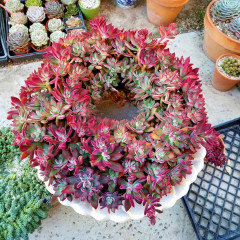
    Like this guy below, not mine.


    They do fine without their roots for a long time because they have the reserves, ie. the chubby leaves and stems. Ime the chubbier the succulent the longer it survives without roots.

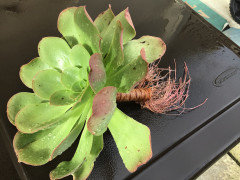
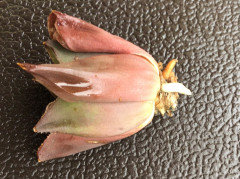
    This Aeonium was cut prob two months ago and has been sitting just waiting for me to plant it. Usually the reserves come from the oldest bottom leaves, and it’s still able to photosynthesize.


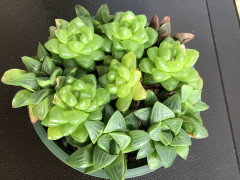
    I have a little pot full of Haworthia cuttings that all rooted within about 2wks. but there was a little guy that fell out. I did not notice till now 🙂. It’s been surviving without roots for I’d say at least three months.


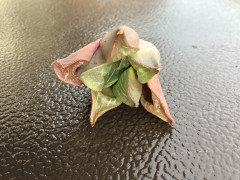
    You can see he is starting to not look so good, like dehydrated and stress red, but once the new roots start doing their job it’ll bounce back.


    Lastly, generally the rule is no roots no water, and keep any rootless cuttings out of strong direct sun or lots of heat because they will fry. It’s also a good idea to let that cutting form a little callus over the cut before putting it in any substrate. Have I broken this rule? Yes, but it def won’t hurt if you let that cut dry out for a couple days.

    Margaret Adorno thanked Kara 9b SF Bay Area CA
  • 5 years ago
    last modified: 5 years ago

    Here is a couple good posts where people have shown a bunch of beheadings😉.

    Behead1

    Behead2

    Margaret Adorno thanked Kara 9b SF Bay Area CA
  • 5 years ago

    Thank you, Kara! I’m hoping the plants I trimmed a lot of roots off of will survive until they can get their next drink of water!

  • 5 years ago
    last modified: 5 years ago

    Hey, @Margaret Adorno! As Kara said, a succulent without roots will use its reserves (stored in its thick leaves) to create more roots and stay alive into the future. (This is what makes them succulents.) From an evolutionary perspective, when succulents are growing in the wild and not being potted and repotted by humans, this makes sense. A little piece of the plant falls or gets broken off, and it creates new roots where it lands. Or an established plant grows somewhere that regularly experiences drought, so it uses its reserves to grow more and more roots to pick up as much water as it can from what little is available. (It'll grow more and more roots until it's getting enough water, whatever "enough" is for that plant in that place, and then it'll grow new roots at a much slower rate. Which is why changing the root structure matters.)

    But the risk to your plant from trimming roots is not that it'll die because it isn't getting nutrients. It just won't thrive. You can see this in Kara's photo of the dehydrated cutting: it could probably last at least 3-4 months (if not 8+) without any water, looking more and more pathetic and growing spindly little roots the whole time, and then when planted it would bounce back and be no worse for wear in the long term. But if you've just placed it in an arrangement, that is probably not the time that you want it to look dehydrated and sad for several weeks.

    But the real risk is in the soil staying too moist, becoming moldy, and your succulent rotting or getting pests. You can think of the soil as being a reservoir for water, and the succulent's roots are the pipes that take water out of the soil. If you remove half the pipes but give the soil the same amount of water as when there were more pipes, more moisture will be retained by the soil itself (unless you have exceptional drainage, like all lava rocks or something like that). That moisture will stay in the soil like a sponge -- even well-draining succulent soil -- and you can end up with mold, rot, or attract pests. This is the much bigger threat. A succulent without roots can survive for a long, long, LONG time with no water, though it won't flourish.

    Depending on the size or your arrangement, you can also end up in a situation where the other plants in it require X amount of water, but the one with the reduced root structure requires more frequent light watering (per my previous post), so either the other plants get overwatered or the root-cut one ends up underwatered. If you're just slightly trimming the roots this is unlikely to be an issue, but if you're making significant root cuttings, it could be more of a problem. This is why I recommended just watering it less and giving your plant a few months to develop a new root structure.

    Something that really helped me in thinking about succulents is to consider where the plant is from in the world. Some come from desert areas where they go for months without water, but then get the occasional deluge a few times per year. Others grow in foggy, rocky mountaintops where they rarely get rain, but the fog condenses on trees and drips down so they get frequent light access to water. People think of succulents as being all the same, and many do have similarities, but a species from a Mexican desert will have different needs from one from the mountains of Peru or the coast of South Africa. This book is a good resource for that: https://www.amazon.com/gp/product/0881929956/ Or if you're new to succulents and would like to learn more, the books of Debra Lee Baldwin are a fantastic resource and a wonderful intro for beginners: https://www.amazon.com/Succulents-Simplified-Designing-Easy-Care-Varieties/dp/1604693932/

    If you have a high-level understanding of how and why the plants flourish in those environments, it can be really useful for allowing you to deduce what will and won't work when you're presented with a new situation (like trimming roots).

    Good luck!

  • 5 years ago

    YOU ARE SO SO WONDERFUL! Thank you so, so much!