Software
Houzz Logo Print
webuser_680880398

Island Range Hood Advice

5 years ago
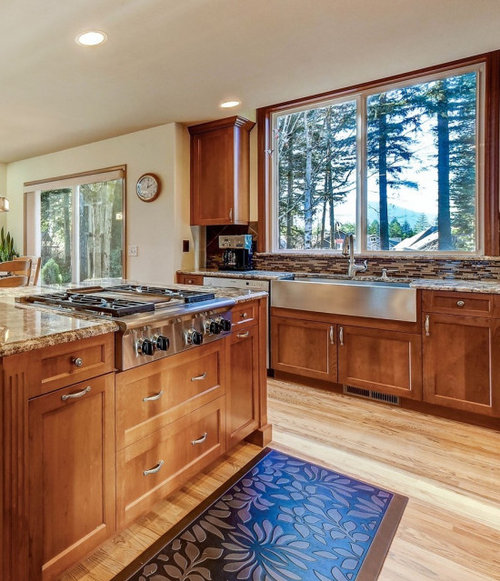
I want to install a range hood above a gas range top on a kitchen island and trying to figure what range hood to get.

Details

- 36" American Range ARSCT-364SGD - 4 gas burners + griddle 85,500 BTU

- Kitchen opens to family room and open doorway to dining room

- Vent out the side of the house between two floors approximately 10' in a box between two floor beams


Questions:

- Do I REALLY need a 850+ CFM range hood? I don't think I ever used more than 3 burners at a time and that happens a few times a year. My typical home cooking is with two burners.

- Are there slim range hoods that provide that much power (potentially through a remote option)

? I like how the Bosch 800 42" looks, but at 600 CFM it's probably under powered.

- Should I be considering a remote blower?


Comments (6)

  • 5 years ago

    First, good for you for putting in an overhead hood! They are far more effective than the almost useless downdrafts.

    Island venting needs stronger/better venting than when against a wall.

    So, start with:

    • At least 6" wider than you rangetop
    • 24" to 27"D (27" would better)
    • You may need a stronger fan to compensate for the more numerous and stronger air currents in an open space


    Perhaps @kaseki will chime in regarding the strength of the rangehood you should consider.

    Keep in mind that you may also need make-up air (MUA)


    Sergei thanked Buehl
  • 5 years ago

    Yes, 27-inches like the (e.g.) Wolf Pro Island hoods.

    With residential hoods the plume velocity determines the air speed into the hood for good capture and containment, and thus the CFM depends on the hood entry aperture area and not how many burners are used at once. We don't get to mask off the parts of the hood not directly impinged upon by the plumes being generated.

    For an entry aperture (excluding light bars, etc.) of 3.5 x 2 ft or 7 sq. ft., say, and a recommended 90 ft/min, the desired (and I would argue sometimes required) air flow rate is 7 x 90 = 630 CFM.

    The blower needed has to move this air flow in the presence of pressure losses which cause blower to move lower CFM than their rating. Ignoring the details, a 900 CFM -- 1000 CFM rated blower (at zero static pressure) should do.

    Note that for an island, there are four hood sides from which plumes can spill, and it takes very little air disturbance from people movement or other air drafts to cause such a spill. If a draft is anticipated, the hood can be offset or made larger, depending on direction. Also, draft sensitivity increases with hood height above the cooktop, and for islands higher makes site lines easier to achieve. So there is a lot working against minimalist hood configurations.

    Given enough duct length, an external blower will be quieter, and quite quiet if you have room for a silencer in the intermediate duct.

    Make-up air (MUA) is needed for some or all of:

    • Code conformance
    • Letting the hood perform restricted mainly by baffle pressure loss and not house pressure loss
    • Keeping combustion appliances, if any, from back-drafting CO
    • Keeping the interior air free of whatever might be pulled out of cracks in the walls when depending on house leakage.

    Search out and read 'MUA' and 'hood' threads here for more perspective and insight. MUA can be difficult to integrate, requiring finding installation space, ducting decisions, and with respect to whether it needs its own blower. In many climes, and by regulation in some northern states, MUA heating is needed.

    Pro style cooking requires pro style ventilation (and consequent sometimes comparable equipment cost).

    Sergei thanked kaseki
  • PRO
    5 years ago
    last modified: 5 years ago

    IMO the minute you put a right angle bend in the venting you need to up the CFM 850CFM is IMO min. with a staright run and 36” gas range. As for what kind oif hood my fave is always vent-a-hood . You will need MUA and If you have not bought the cooktop forget the ridiculous cost of the griddle and buy one that spas 2 burners for $30. IMO to get a 36” range so you can have a griddle is a pure waste of money and honestly if you never use more tahn 2 burners why on earth a 36” range at all. I run acatering biz with a36” range and often have all burners going I have a 1000CFM vent-a-hood and MUA the cost was crazy but I needed it. My hood vents directly up though my roof no bends

    Sergei thanked Patricia Colwell Consulting
  • PRO
    5 years ago

    For that powerful of a gas range, it is more about how much heat the range hood you install can handle and less about the CFM rating. A unit with a 6" duct is only capable of 600 CFM maximum, no matter how powerful the blower. There is a high chance of overheating the blower if you only use a 6" duct. You will need a minimum 8" duct size. Most companies would recommend 800-1000 CFM units due to the size of the blower inside. Larger blowers, when used with a minimum 8" duct size are much more capable at withstanding the heat from hot burners (even if using 2 or 3). A slim unit is not the best choice since they have small blowers (no space to fit a large one) and usually only capable of using a 6" duct size. Our best recommendation is to use a unit with an 8" duct size and 900/1000 CFM rating and a large pyramid style shape. The size of the hood should always be larger than the range for island installations (ex. 36" hood over a 30" range). If make-up air is a concern, it is important to check with an HVAC professional to find out how much CFM would be too much for your space. Some companies (like ourselves) can adjust the CFM on any blower by request and still keep the benefit of the larger motor that can withstand the heat of the gas range.

    Sergei thanked Victory Showroom
  • 5 years ago

    I appreciate all the help here especially @kaseki's detailed explanation. I didn't realize I need to check both the width and the depth of the hoods I'm looking at. I ended up ordering a 42" Zephyr Sienna Pro with my local appliance dealer Arnold's Appliances. They had a super knowledgeable sales guy that helped walk me through the options. He pointed out that installing an external or inline blower can be a giant PIA on a 1st floor kitchen in a 2 story house and steered me away from that route.


    For background on this conundrum @Patricia Colwell Consulting, the cooktop is already the kitchen of the house I'm buying. It's not the cooktop I would have put in, but it's what I'm working with.