Software
Houzz Logo Print
geekygirl007

Mineral Wool Insulation..how do I use this?

5 years ago

I’m new to this and not sure what I’m missing here. I’ve done a lot of research but can’t find an answer to my question online. Most other insulation products I've looked at state “interior/exterior“ on the package or will have separate offerings for each clearly stated on the packaging.


Heres my question: I’m looking at Owens Corning Thermafiber mineral wool insulation. All the bags say “exterior walls” on them. Can these also be used on interior walls too? If not, what can be used?


Thank you to all who help! I appreciate you more than you know!!


Comments (13)

  • 5 years ago
    last modified: 5 years ago

    For residences Owens Corning, makes mineral wool exterior wall thermal insulation called Thermafiber Ultra Batt. For interior wall acoustic insulation it makes mineral wool Thermafiber Fire & Sound Guard.

    The company is not very forthcoming about the difference but they are made in different thicknesses.

    Ultra Batt is made in a 2.5", 3.5", 5.5" 6" and 7.1" thickness.

    Fire & Sound Guard is made in a 2" thickness.

    Tea thanked res2architect
  • 5 years ago
    last modified: 5 years ago

    They also offer, among other variations, a sound attenuation fire blanket in the same thicknesses designed to fit into standard sized stud walls.

    Which product you choose hinges on what you're trying to achieve as the material is essentially the same.


    Tea thanked worthy
  • 5 years ago

    We are in the process of having Rockwool Sound & Fire put inon interior walls. It is approx. 4" to fit in standard size stud walls. We have a few 6" thick interior walls, but did not change the amount of batting for those. All of our exterior walls (6") and rooflines received another type of insulation treatment.

    Tea thanked User
  • 5 years ago

    The Thermafiber SAFB version is rated for use in fire-resistance rated wall and floor/ceiling assemblies which is required between dwelling units in multi-uint housing.

    Tea thanked res2architect
  • 5 years ago
    last modified: 5 years ago

    I was told by an acoustical consultant that the type of insulation in interior walls was not important since it was not thick enough to absorb much horizontal sound but it absorbed sound that traveled vertically from one crack to another through a lot of insulation. He was assuming there would be no back to back electrical outlets or heating vents.

    He also said acoustic insulation would not be effective in a wall that had a door in it.

    Tea thanked res2architect
  • 5 years ago

    Yeah that's why cheap fiberglass is fine for most cases. If you have return vents and hollow core doors, wringing out acoustics from overspending on mineral wool doesn't match the intent. If you are using acoustical sealant top & bottom, putty on boxes, double-layered 5/8" + green glue, then the mineral wool is more consistent with that.

    Tea thanked 3onthetree
  • 5 years ago
    last modified: 5 years ago

    We tried the cheap fiberglass in previous home and it did no good!!! The sound between the laundry room and a guest bedroom was horrendous!

    We are hopeful that the Rockwool will work better. It certainly has the look and feel of being a much denser product. Thicker, also! It does not compact like the cheap fiberglass. In fact, we could already tell a difference in the sound travel when in the house last Friday. And that's without sheetrock or our solid core doors that are not yet installed!

    We mainly wanted it for the walls between laundry and bedroom, and laundry and great room (there will also be a built-in bookcase between laundry and great room that will help absorb sound.) Between the M. bedroom on the main floor, and a bedroom that will be above our closet and bathroom. We also have it between my husbands upstairs office/slash T.V. room and the upstairs foyer so that sound doesn't travel down the stairs.

    We have it wrapped around all plumbing stacks, water lines, plumbing in the ceilings, and the walls in between the M. bathroom and a guest bath. Plus the guest bath and foyer.

    I was wrong about the 6" thick walls. The only thing needed to go in one of those walls was to wrap some plumbing. The other 6" wall, between guest bath and the foyer (it's a stair support wall), received the wider batting. The remaining 6" thick interior wall received nothing. We didn't feel like we needed anything between the kitchen and pantry/mud room.

    Tea thanked User
  • 5 years ago
    last modified: 5 years ago

    A house always sounds quiet when interior insulation is installed and the drywall hasn't. That's because the insulation reduces the reflected sound but it will return to some extent when drywall is installed. It will get quieter again when carpet and furnishings are installed.

    The science of sound control in buildings may seem simple and obvious but it isn't. A great deal of sound transfer between rooms is from poor sealing of the wall system allowing sound paths under sills, and above the ceiling and through penetrations and cracks. The benefit of insulation in walls is overrated and often impossible to measure in the field. However, the worse the construction, the more the insulation helps.

    If you're really concerned about sound transfer, block and seal the joist spaces above, seal the bottom and add a layer of drywall to one side of the wall. Don't expect insulation to make up for the absence of these sound control techniques.

    It seems as if these techniques are forgotten and need to be relearned every 10 years or so.

    Tea thanked res2architect
  • 5 years ago
    last modified: 5 years ago

    As discussed above, flanking sound transmission--through the walls and floors--cancels out most if not all of the minor sound reduction achieved by insulation in the walls.

    Even without real world conditions, scientific testing of STC of various assemblies show an imperceptible reduction by putting fg in the walls.


    California Department of Health


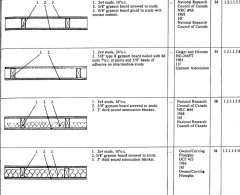
    As for mineral wool, while the manufacturers claim up to 56STC in sales literature, any detailed description includes other measures--resilient channels and additional drywall layers.

    Tea thanked worthy
  • 5 years ago

    A laundry room, with the washing and spin cycle, would be better served by decoupling the wall.

    Tea thanked 3onthetree
  • 5 years ago

    You can absolutely tell the difference if an interior wall is open or insulated. Soundproofing is an entire art that gets more complicated... each piece to the puzzle helps, but just one puzzle piece doesn't solve the problem. There comes diminishing return on investment when you get into this topic.


    All of the thermafiber/rockwool/etc products are the same "mineral wool", it's just the companies branding of that type of insulation. Mineral wool does have better acoustical properties than fiberglass batting in general. Mineral wool is also made in different densities (per the same thickness) so you should be focusing on (probably a 6" cavity thickness) but the density (pounds per square foot) and acoustical rating for this project - ignore the brand name

    Tea thanked sprink1es
  • 5 years ago

    Thank you to all who replied, I really appreciate it! I've learned a lot and this discussion has helped me a huge amount in making my decision!