Software
Houzz Logo Print
webuser_739070037

How would you suggest we prune this lilac

5 years ago
last modified: 5 years ago

Hi there we've got this massive lilac grove here we'd like to know how to trim. I did try googling it but i am still confused unfortunately. How far back do we trim it? Can we somehow keep it's shape? I do love it but there are quite a few branches in there that aredead now and we'd like to keep it health. It's not just one bush it's a bunch. Also, howling til it will flower again? Thanks for at advice!

Comments (23)

  • 5 years ago

    Having a hard time getting photos on here...

  • 5 years ago

    Make you photos smaller. 1600 wide x ?? and they'll work a lot better.

  • 5 years ago

    Addressing the question about flowering .... they'll flower again at the same time they did last year. When that is depends on where you are located, but it'll be in the spring.

  • 5 years ago
    last modified: 5 years ago

    They're asking how long it will be until flowering resumes after a serious pruning. Anyway the simplest thing would be to cut it all down to 18 in. at the end of next winter - unless the planting is located in a place where it is still the end of winter right now.

    If there is a lot of dead wood honey fungus may be possible as lilacs are said to be quite on the menu. In which case pruning will not enable them to shake this off.

    The place I am at now came with a couple lilacs. That I am not interested in. When I was cutting down the one several canes came loose at the base and could be pulled out.

    Honey fungus or maybe root rot. But probably honey fungus. One of the topped orchard cherries here - something else I didn't want - turned out to be full of it. As in up the center of the trunk and out onto the branches - it was Hellish!

  • 5 years ago

    I disagree with chopping it all down to practically nothing. If It were something like a forsythia that would be back in a year or so, sure, but it will take several years to get your clump back if you chop it to knee high.

    I have no idea where in the world the lilac clump in question is, but some dead branches doesn't necessarily mean it's got a disease or fungal infestation. If the copse hasn't been cared for or pruned in a while, it could be overcrowding itself for sun and space. Cold damage can also cause some dieback in lilacs depending on climate, though this is more common with named varieties, where most massive clumps are common lilacs.


    If it's dead, prune it out ... it's not coming back to life, and it's not helping anything. If it's damaged, it should leave, too. As for live stuff, lilacs bloom on "old wood," meaning the flower buds form on last year's established growth rather than this year's new growth, so if you prune in spring, you're apt to be cutting off a lot of your flowers. That being said, gnarly old trunks aren't better than the young plants, generally the opposite ... the flowers will be mostly on young growth (just not this year's growth). You also don't want branches rubbing on one another. So prune out the stuff that's aged to the point that it no longer flowers (that's what you cut to a foot tall) and the branches that are crossing (pick the one that's going the better direction and/or is showing stronger growth to keep and chop the other). Now look at what's left ... this is when you can start worrying about shape and whether it needs a hair cut or thinning or anything like that. If you are trimming, don't just cut of the end of the branch to where you want the outer edge of the clump to be, go back along that branch to see what else is on it ... you want to cut back to a junction/node and not leave a long stump of nothing sticking out and inviting disease. We generally prune lilacs a couple weeks after they bloom, so they can bloom again the next year.


    And remember ... if you mess up, it's like a bad hair cut, it'll grow back ... eventually. Also keep in mind that it may not look like your vision for it this time; it may take multiple years to get the clump fully pruned (unless you're going with Embothrium's technique, in which case it'll be years to get bushes regrown rather than years to get them "trimmed" down).

    HU-739070037 thanked BlueberryBundtcake - 6a/5b MA
  • 5 years ago

    base rule for shrubs .. you prune after flowering ... unless you dont care about the flowers this year and need the job done asap ...


    ergo.. on lilac .. prune after flowering .. lilac set bud last fall... for this springs flowers ... you can see them.. and if you cut them off.. no bloom this year ...


    check out some of the vids here: https://duckduckgo.com/?t=ffsb&q=renovation+pruning+of+lilac&iax=videos&ia=videos


    i agree with cear just above.. a 3 year process ...


    bottom line.. you can barely kill these things .. run them over with the truck a few times if you want ... there is nothing to worry about ... just do it ...


    ken


  • 5 years ago

    18 inches isn't practically nothing. A high proportion of dead canes is not normal for common lilac.

  • 5 years ago
    last modified: 5 years ago

    Ah thank you all so so much for your input! I love how active this forum is. I still can't manage to get a picture up even tho I cropped it. And there isn't that much dead stuff just you can see some dead stuff in there it's probably just cuz it's ancient lol. Also, we are in zone 3b here in northern wisconsin.


    I did read to prune after they flower I think I'll do that, and prune a bit each year instead of cutting it to 18 inches. We will cut some other lilacs we have to 18 inches I think but not this one.


    So take all the dead stuff first, then this fall take whatever didn't flower down to 18, then go from there. I guess. I do wish I could post a picture!


  • 5 years ago

    Oh and can I get some clarification on where exactly to trim the branches? Like what BlueberryBundtcake was suggesting and giving it haircut after initially trimming the obviously bad stuff away? Like if I don't want to take it all the way down and just give it a trim? Or is it either take it to 18 or leave it? Sorry...

  • 5 years ago

    Cropping a pic is sometimes enough but resizing is better. At least for me I bring up the desired photo to full size then right click and a menu comes up and resize is one option. Click on resize then choose "best for messages". My computer then asks where I would like to put the pic as in folder, desktop etc. Hope this helps.

  • 5 years ago
    last modified: 5 years ago

    JFWIW:

    I had 200 ft. of 40 yo common lilac hedge that became filled with debris from a violent storm back in 2010. The east side was cut level with the ground the year before we moved here (2011) and the west side I personally cut level with the ground (2013?).

    Most of the main stalks were 2-3" diameter and many were bent/hanging over into the neighbors yard so something had to be done.

    Just after a couple of years, the hedges were 4 ft high bc of the established root system supplying energy for regrowth. Flowering was profuse and all the regrowth was uniform size and more 'upright' in direction (The new shoots competed with each other for sun).

    The third year, the hedge grew over my head almost like the original hedge but was much nicer to look at (more uniform growth the entire length).

    Just my 2 cents. :-)

  • 5 years ago

    So take all the dead stuff first, then this fall take whatever didn't flower down to 18


    ==>>>

    NO ... dead stuff is always removed whenever found.. its dead.. why leave it ...


    then.. after flowering.. remove 1/3 of the largest trunks/stems to about 6 inches ... not lower.. but a little higher is ok if you cant get the saw in at 6 inches ...


    then next year after bloom.. take the next 1/3 of the olargest.. then the following year.. the last third ..


    and then you will have a REJUVENATED lilac ...


    in the 4th year ... you may or may not now being an expert and all .. lol... you can decide if you need take any more .. just look at the largest ones again ..


    what will result.. is at every cut.. one or 3 dormant buds will break... and young growth will begin ...


    NEVER ... give it a haircut at height ... else.. e.g. at 3 feet .. it will bud out and eventually you will grow a new plant at height.. and it will eventually fall down and break ... just

    NEVER a haircut ...


    watch the vids at the link i gave above ...


    AND.. MOST IMPORTANTLY ... GET A TREE SAW ... like the one at the link below.. it need not be expensive ...


    ken


    generally: https://duckduckgo.com/?t=ffnt&q=folding+tree+saw&iax=images&ia=images


    the 40 dollar one isnt necessarily better than the 15 dollar one .. for this small project .. imo ...

  • 5 years ago

    “then this fall take whatever didn't flower down to 18, then go from there. I guess. “

    No. Branches which didn’t flower are quite possibly new growth which will flower next spring, so don't cut them off in autumn. When we say prune after flowering that means prune stems which have flowered. And do it as soon as the blooms fade.

  • 5 years ago

    Okay, I went and took some pictures from my lilacs that will hopefully explain what I was trying to say ...

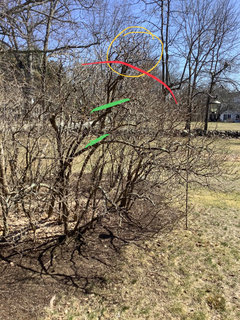
    Here's our big clumps:

    If I wanted to trim out the piece circled in yellow, I wouldn't cut at the red line just because that's the height I wanted, I would go down to one of the green lines, where it branches to cut (it's easier to figure out when you're in there, though you may need a second person outside the clump to confirm you've got the right branch if you've got a really dense/tall clump, since you'll be working when everything is leafed out. (My mum and I do this with some of our forsythias ... one person shakes the branch and the other person cuts or confirms it's the branch to cut.)


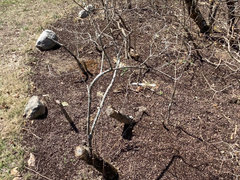
    Here's a picture of some that were cut short, as they were old and getting too far into the yard. The ones in the foreground were cut 2-3 years ago; you can see some of the regrowth.


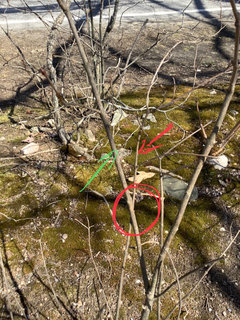
    Here's an example of crossing on a young bush in a different area:

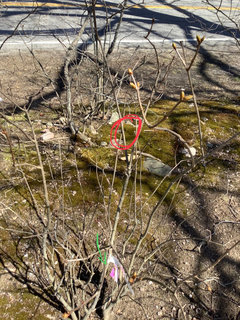
    The spot circled in red is crossing and rubbing ... I will keep the branch in front (green arrow) and remove the one in back (red arrow). It will be cut down lower (green arrow in next picture):


    HU-739070037 thanked BlueberryBundtcake - 6a/5b MA
  • 5 years ago
    last modified: 5 years ago

    Sure would be a lot easier to take it all down to 18 in. than to get caught up in all this. And as described above common lilac looks a lot better when kept consisting of vigorous vertical stems that produce lots of full sized flower heads - flower heads that are pretty much the entire point of the plant. Instead of the shrub being allowed to become all crooked and twiggy.

  • 5 years ago

    Our clumps always have beautiful blooms unless they get snow damaged out of dormancy (Mother's Day freeze last year diminished our bloom). And if you've ever been to Rochester, NY, home of the lilac festival, around May you'll see plenty of large clumps of lilacs with spectacular blooms. Scraggliness is usually a sign of inadequate light. (The town's giant oak tree causes issues for some of our front hedge - to the right of my last pictures. The bushes did great before the tree grew enormous, and they do better the higher we can get away with pruning it up.)

    I just realized my last picture is actually a cultivar ('Sensation') not the species, but pruning is the same ... it just flowers a bit differently.

  • 5 years ago

    Not arguing.

    Here's what mine looked like 4 years after being cut to the ground. Still looking good, just a bit taller. (there's multiple colors down the line).


  • 5 years ago

    Just remember taking care of plants and trees is a continuous job, not something that is done once and forgotten. With the lilac, there will always be some die off that needs to be removed, Occasionally a hole living stem will need to be removed.


    One of the things people do not realize is that it takes a lot of work to keep that "natural" area on your property looking natural, There is always dead wood to remove, trimming to be done, and cleaning up the fallen branches, etc. Every years I have about 10 hours of wood chipping to be done to get rid of the brush that collects from the yard.

  • 5 years ago

    Hmmm well since we have multiple lilac bushes around the property I think I have room to experiment. Some I am going to take the large stems down to 18 and leave the young stuff it does look very nice actually on going vertical stems. The big lilac forest well do some experimenting on. Thank you all very much for your advice, these bushes need invigorating one way or another!

  • 5 years ago

    look 'into' into bills pic.. and note that there are no 2 or 3 inch large thick old trunks ... and that is what he removed.. and that is why his looks so nice ... and also.. he didnt do it at height ... they are all straight and young from down low ....


    its a lot easier to do this when they are leafless.. so you can see whats in there ...


    brilliant on the experimenting.. thats how i taught myself all this stuff ... so two thumbs up ... there wasnt any WWW to look at ... we just hacked the carp out of things .. and then observed the result... and eventually learned what not to do ..


    thats back when we could remember year to year.. lol .. one thing for sure.. you can barely kill old shrubs with pruning alone ... so dont worry about all that ...


    brilliant tutorial bundtcake ... thx for taking the time and effort for posting it .... there used to be a lot of that back in the day on these forums ... and then i stopped doing it.. lol ...whoa.. almost broke my arm patting myself on the back ... not as flexible as i used to be ... maybe ill take the knife out of one of the kids hand.. and ask them to pat me on the back .. lol ... but i digress ... good luck ..


    ken

  • 5 years ago
    last modified: 5 years ago

    I think too there is a difference in pruning a 'clump' and a 'hedge'.

    Trying to prune the large trunks of common lilac, with all the suckering and shoots low on the trunks, works okay for a 'clump' more than it does for a hedge.


    With a hedge, the larger trunks tend to grow more vigorously and tend to shade out lower growth or makes the lower growth grow sideways, searching for sun. And in some cases that may be fine. So yes, experiment for the form and looks that you like.


    I do have lilacs that sucker very little and those can be kept in more of a 'tree' form.


    I cut mine all leafed out, cutting a few at a time, stopping then throwing limbs on a trailer parked next to the work area. Leaves are mostly at the top and suckers towards the outsides so once 'inside' the canopy, you can see to work quite well.