Software
Houzz Logo Print
webuser_282814948

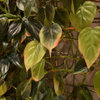
Strange growth on my Philodendron Brasil?!

5 years ago

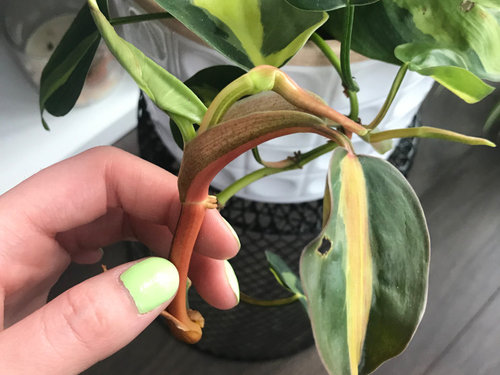
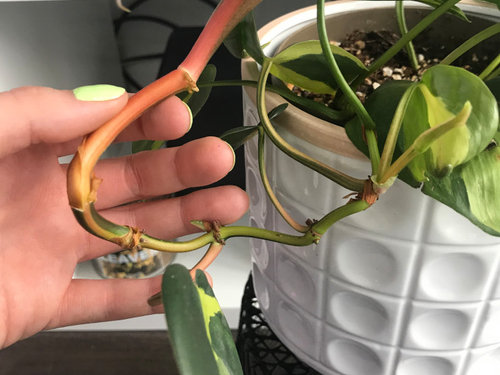
My Philodendron Brasil was growing normally and then one vine slowed down. It started putting out growth from 2 other nodes but didn't produce a leaf at the main growth point. The vine doubled in width and started growing upwards. It put out a cataphyll at the next node but no air roots and no leaf. The next node had air roots and again no leaf. Finally she put out a leaf but it has a hole in it, the tip is twisted and the cataphyll is attached to the petiole. She put out a second leaf at this node and now seems to be growing normally again (thinner stem). One of the new growth points on this vine also put out a new leaf that was small and twisted at the tip.


I hope that made sense, I’ve attached some photos. I got her as cuttings in the fall. The humidity in my condo is pretty low. She’s in front of a floor to ceiling west facing window. I top water her when the top 1-2 inches are dry but I definitely lean towards an underwaterer. I fertilized her once a month in the winter, as she wasn’t growing very fast. The other vine in the pot is perfectly fine. Roots are starting to come out of the pot. I don’t see any pests.


Any help much appreciated, let me know what you think!


Comments (5)

  • 5 years ago

    To me the plant actually looks healthy and fine. I think due to the lower humidity and winter month it just did not get enough energy to push out the new growth right away. Now that it gets brighter, it should start growing quicker again.

    Josie thanked Corinna
  • 5 years ago

    The vine size is normal to , only the leaves not open wide yet so it seem ithe vine has double in size.

  • 5 years ago

    i wouldnt fert during the winter.. depending on where you are ..


    in fact.. i only fert houseplants about once a year with very weak water soluble fert ..


    that said.. this isnt related to such ...


    plants do weird things .. that isnt necessarily bad ... and i dont really see anything to react to .. i would just enjoy the show .. and if it bugs you.. cut that part off ... and you may as well root it.. and see what happens ... i suspect it reverts to normal growth ...


    at best.. i wonder if there was some mechanical damage to the growth bud when it was small/tiny ... resulting in some abnormal growth .. i dont recall the fancy words for such ... lol ..


    ken

    Josie thanked ken_adrian Adrian MI cold Z5
  • 5 years ago

    In order for cell walls, and by extension, tissues, to form normally, Ca(lcium) must be in the nutrient stream at all times. Even brief disruptions of Ca availability can cause leaf deformations that include hooked tips, random necrotic spots, holes, cupping. It can also cause death or distortion of terminal buds and problems with roots in the way of necrotic root tips and significantly diminished root growth/volume; all of the former because Ca is involved in cell division (followed by cell elongation for root elongation) and it is also involved in providing cell wall rigidity (for penetration of growing roots in compacted soil).

    That said, in fairly young plantings it's unusual for there to be an actual Ca deficiency caused by a scarcity of Ca in the grow medium because almost all commercial media are pH adjusted during the mixing process with dolomitic lime, which provides Ca and Mg in an appropriate ratio. More often than not, the deficiency is culturally caused by excessive amounts of water in the grow medium, or grow medium that is compacted. It can also be caused by the indiscriminate use of Epsom salts, used because someone somewhere said it would 'green up the plant'. That might be true, but at what cost?

    These might be helpful:

    Using a 'tell'

    Over-watering saps vitality and is one of the most common plant assassins, so learning to avoid it is worth the small effort. Plants make and store their own energy source – photosynthate - (sugar/glucose). Functioning roots need energy to drive their metabolic processes, and in order to get it, they use oxygen to burn (oxidize) their food. From this, we can see that terrestrial plants need plenty of air (oxygen) in the soil to drive root function. Many off-the-shelf soils hold too much water and not enough air to support the kind of root health most growers would like to see; and, a healthy root system is a prerequisite to a healthy plant.

    Watering in small sips leads to avoid over-watering leads to a residual build-up of dissolved solids (salts) in the soil from tapwater and fertilizer solutions, which limits a plant's ability to absorb water – so watering in sips simply moves us to the other horn of a dilemma. It creates another problem that requires resolution. Better, would be to simply adopt a soil that drains well enough to allow watering to beyond the saturation point, so we're flushing the soil of accumulating dissolved solids whenever we water; this, w/o the plant being forced to pay a tax in the form of reduced vitality, due to prolong periods of soil saturation. Sometimes, though, that's not a course we can immediately steer, which makes controlling how often we water a very important factor.

    In many cases, we can judge whether or not a planting needs watering by hefting the pot. This is especially true if the pot is made from light material, like plastic, but doesn't work (as) well when the pot is made from heavier material, like clay, or when the size/weight of the pot precludes grabbing it with one hand to judge its weight and gauge the need for water.

    Fingers stuck an inch or two into the soil work ok for shallow pots, but not for deep pots. Deep pots might have 3 or more inches of soil that feels totally dry, while the lower several inches of the soil is 100% saturated. Obviously, the lack of oxygen in the root zone situation can wreak havoc with root health and cause the loss of a very notable measure of your plant's potential. Inexpensive watering meters don't even measure moisture levels, they measure electrical conductivity. Clean the tip and insert it into a cup of distilled water and witness the fact it reads 'DRY'.

    One of the most reliable methods of checking a planting's need for water is using a 'tell'. You can use a bamboo skewer in a pinch, but a wooden dowel rod of about 5/16” (75-85mm) would work better. They usually come 48” (120cm) long and can usually be cut in half and serve as a pair. Sharpen all 4 ends in a pencil sharpener and slightly blunt the tip so it's about the diameter of the head on a straight pin. Push the wooden tell deep into the soil. Don't worry, it won't harm the root system. If the plant is quite root-bound, you might need to try several places until you find one where you can push it all the way to the pot's bottom. Leave it a few seconds, then withdraw it and inspect the tip for moisture. For most plantings, withhold water until the tell comes out dry or nearly so. If you see signs of wilting, adjust the interval between waterings so drought stress isn't a recurring issue.

    Water When the Top Inch or Two of Soil is Dry?

    I don't think so. Most growers unfamiliar with how water behaves in container media are prone to repeating the title mantra. But let's look at some facts. A saturated or partially saturated medium is limiting in a number of ways.

    Roots need an ample supply of oxygen in order that roots can function normally. Saturated soil surrounding roots limits oxygen required to drive root function, thereby impairing root efficiency and possibly setting the stage for any of a number of fungal pathogens that thrive in anaerobic (airless) conditions.

    Soil saturation limits gas exchange, so waste gases like methane and CO2 in the root zone are less able to leave the soil, also limiting root function

    Soil saturation kills the fine roots that do the lion's share of work involving water uptake and nutrient distribution. When this occurs, chemical messengers tell plant central injury to the root system has occurred. Top growth stops immediately, because root growth always precedes top growth – the top will not grow if the roots cannot support the growth with water/nutrients. The plant is then forced to regenerate dead roots, using energy which otherwise would have been devoted to additional top growth, keeping the plant's systems orderly, keeping the plant wearing a 'healthy glow', and improving the plant's ability to defend itself. In short, the wasted energy would have kept the plant looking/ growing better, and healthier.

    If a pot is 10” deep, the top 2” can feel completely dry to the touch, even while the bottom 6” is 100 saturated. That means 60% of the medium would be fighting you tooth and nail for control over the plant's vitality …… and this is the point at which you should water again? Does that sound reasonable? We don't care even a whit if the top 2" of the soil are dry. Roots there are largely plumbing and anchorage, with essentially none of the fine almost microscopic roots that do the lion's share of the plant's heavy lifting.

    Al

    Josie thanked tapla (mid-Michigan, USDA z5b-6a)
  • 5 years ago

    It is quite normal for this plant to send out a feeler searching for

    something to climb on. It then produces several nodes without leaves and it elongates. You can cut it off or you can give it something to climb.

    Josie thanked petrushka (7b)