Software
Houzz Logo Print
jgerrzone6atoledooh

Tan/gray spots on arborvitae

5 years ago
last modified: 5 years ago
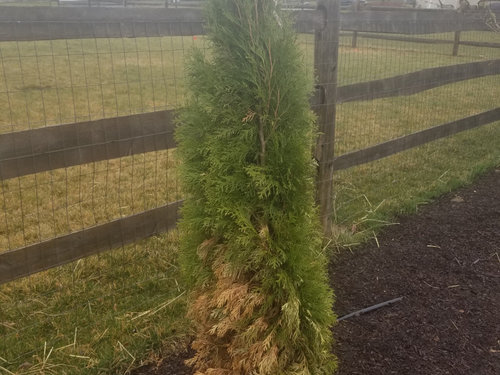
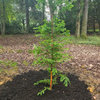
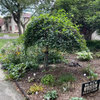
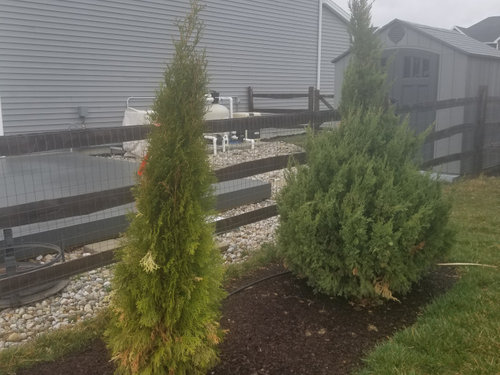
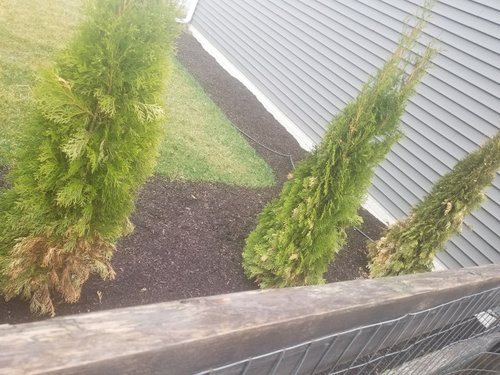
Hello! I had 30 trees planted around the perimeter of my backyard last fall (october). We live in new construction and our soil was pretty poor quality-compacted clay that appeared to have just been turned over when they dug the home's foundation. The company that planted the trees just brought in a large auger to dig the holes and then back filled with the existing soil without amending and then mulched on top. They are planted slightly above grade. I noticed a little discoloration on some of the emerald green arborvitae shortly after planting but was told this was probably transplant shock. The weather has warmed up considerably here in the last week or 2 and I've noticed almost all of the arbs have areas of a yellowish/tan/gray discoloration and a handful of the junipers have much smaller areas of brown. I installed drip irrigation at the time of planting and watered deeply a few times but then the weather turned cold and I didnt water over winter. I've stuck my finger into the soil to assess moisture levels and it seems moist- not overly wet or dry. Any ideas on what's going on and what I need to do? Seperately, I had been planning on planting some tall annuals (3-4' zinnia and cosmos) in between my trees to fill in the gaps until they get larger. Im wondering if the annuals will shade out the lower branches of the evergreens and negatively impact them? Thank you very much! Any help is much appreciated!


Comments (8)

  • 5 years ago

    planting in unamended soil is prime.. no reason for complaint there ...

    they are stressed .l. from perhaps digging at grower .. being shipped to seller .... then shipped to you. and then from de potting or ball and burlap .. and then winter..

    where are you .. big city name ...

    winter damage is also a possibility ... especially if they got dry before or during winter ..

    trees grow in tree time.. usually counted in decades ... injury in tree time.. can take one or 2 seasons to show.. so it hard to figure out where the injury or stress was... in those two season.. last fall. and winter ..

    but they usually 'show' the damage after winter .... winter wind and sun are hard on plants with disturbed roots ..

    as they are stressed.. they are not hungry.. fert is not a response ...

    talk to your seller and see if they will stand by them.. i wouldnt be surprised if they ask you to wait a few months to see how they further respond ..

    and even with 200 humored years of experience...... if i planted 30 of anything.. i would expect at least a few to have problems ...

    but.. next time.. dont plant all of one kind of anything .. besides being boring.. if something come along to attack one.. it could attack all ...

    soooo .... if a few fail ... replace them with something outside the arb world ... and break up the monotony .. and to add some diversity ...

    the only thing i would worry about an auger in clay... is digging glazed hole .. embo can talk about that.. since hes mentioned it before.. i have to go cook dinner ... butter noodles with shrimp and mushrooms.. if you care to know.. lol ...

    ken


    is that a juniper on the end???

  • 5 years ago

    Dig inside original soil balls and check moisture situation.

  • 5 years ago

    Hello! Thanks for your response! We are in the Toledo, Ohio area. There was a juniper in one of the pics...we actually have a mix of blue point, moonglow and skyrocket junipers, emerald green arbs, a baby blue eyes spruce and some deciduous trees. The junipers all seem to be faring better....a few very small spots of browning, but nothing like what we're seeing with the arborvitae. I had been planning to just stick to watering deeply once a week and fertilizing sometime soon and then again in the fall. Would you advise not fertilizing? Also, what do you think about the annuals? Can that yellow/gray foliage return to green or is my hope that those will fall off and grow back green? Thanks again!

  • 5 years ago

    You need to find out what the problem is before you can know what to do.

  • 5 years ago

    Thanks for your responses...I dug down about 6 inches around the root ball of one of the trees and it seemed to be moist, but not overly wet.

  • 5 years ago
    last modified: 5 years ago
    Look inside the balls at the soil the plants came in, see what the moisture status is of those.

    And of course if they were dry earlier, have remoistened since there won't be any hint now at what happened previously. Except for the appearance of the foliage.

  • 5 years ago
    last modified: 5 years ago
    Buy some bags of compost and put a 3" to 4" layer around each bush and spread out to a foot beyond the drip line, (but not touching the trunks). Cover back up with your wood mulch.

    In the fall get some fallen leaves and add a 3" layer the same as compost and cover with mulch. In time they should recover nicely.

    I have done this many times and just did it last year when planting 4 Emerald Green and 3 larger Nigra Arborvitae trees. All are very healthy after their first season of getting established. ORGANIC MATTER addition should help immensely.

  • 5 years ago
    last modified: 5 years ago

    Before installing wood chips, create a
    thin underlying layer of a more nutrient rich mulch (like compost) if there are
    concerns about nutrient deficiencies.


    This “mulch sandwich” approach is
    a logical one that mimics what you
    would see in the mulch layer of a forest
    ecosystem. It’s not required, though, and
    over time a wood chip mulch will develop
    this same structure as the lower layers
    break down.

    wood-chips.pdf (wsu.edu)