Software
Houzz Logo Print
webuser_204521890

can I mix 4x4 and 2x8 tiles

5 years ago
Hi,

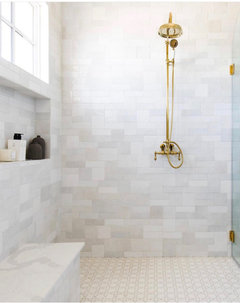
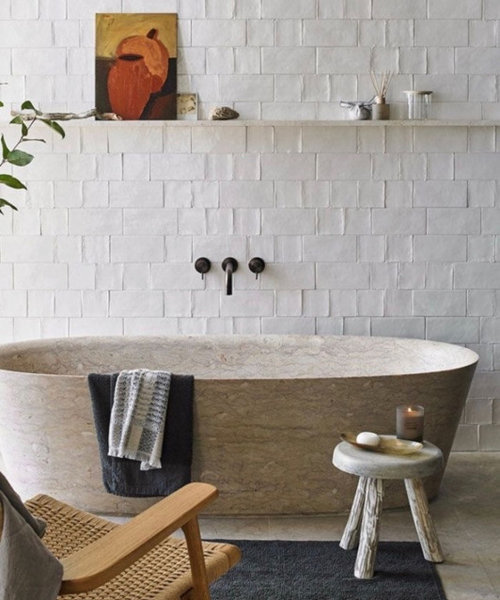
I saw a beautiful photo of mixing subway tiles and square tiles in a bathroom. The tile I picked comes in 4x4 and 2x8. I wanted to make a random layout that looked organic. As it turns out, this is more complicated than I expected bc when stacking 2 2x8s you need grout between, and therefore slightly increasing the total height to more than 4”. Contractor said IF I do this I need to a) probably cut down all the 2x8 tiles a little and b) hire a designer to make a layout. Thoughts? Has anyone done this with success? Attaching a pic of my inspiration photo.

Comments (17)

  • 5 years ago

    Edit to the post. It’s actually 3x8 and 4x4....

  • 5 years ago

    Why don't you use them in alternating rows? Do NOT cut down the 2x8's. You will eliminate the factory edge if you do that, and it will not look right unless you cut off all four sides of every tile, including the 4x4's. And then you still will probably end up with some chipping.

  • 5 years ago

    Yes I had that same thought about the edges. Here’s another example that was done w 5x5 and 2.5x8. I just love how random it is and I don’t think I’ll get that feeling by alternating rows.

  • 5 years ago
    last modified: 5 years ago

    I love your first example with the uneven edges. I’m nit a fan of the second example.

    I love the Flemish pattern. I know it’s not random, but I especially like it with the handmade tiles.

  • 5 years ago

    To do that look, you need to find tiles that are modular. That means that they are made to fit together with their grout joints. If you don't care if all the grout joints are the same size, you could probably fudge it by putting a stack of three 4" tiles with a stack of four 3" tiles to make up a "row" that is approximately 12" high. The grout joints between the 3" tiles would be narrower than the joints between the 4" tiles. Are you sure the dimensions are exactly 4" and 3"? Or is that the nominal size?

  • 5 years ago
    last modified: 5 years ago

    Sarah - your second example photo appears to be using Bedrosian Cloe tiles (or Equipe Artisan tiles). While the nominal dimensions for the tiles are 2 1/2” x 8” and 5” x 5”, the actual dimensions are 2.55” x 7.87” and 5.19” x 5.19” respectively.


    The suggested grout line for this tile is 3/16” = 0.1875“. However, if you reduced that grout line between the tiles to about 0.17” - the length of using (3 - rectangular tiles) = (3 - square tiles + 1 rectangular). The heights of - (2 - rectangular tiles/5.1”) = (1 square tiles/5.19”) if you use a 0.8” grout line between the rectangular tiles. The heights of (1 rectangular tile + 1 square tile)/7.74”) = (3 - rectangular tiles/7.65”) with a 0.09 grout line between tiles. That’s how they are able to use a “random” tile layout using the two different sized tiles.


    I‘ve been thinking about using Cloe tiles in a random pattern in one of my shower remodels - so I already did these calculations a couple weeks ago. If you look closely, you can see that the grout lines are not exactly the same size between all of the tiles. I haven’t yet priced this layout with my installer - he will be at my house to discuss the tile installation for my master bathroom later this week. He will probably think I’m CRAZY!!


    Hope this helps.

  • 5 years ago

    Yes dmac1108 you are correct on the tile bedrosian cloe. Does the .09 difference then account for the grout between?

  • 5 years ago

    Also @dmac1108 please let me know what the installer says I’m dying to know before I ask mine lol. The contractor told me making the pattern alone could cost a pretty penny w the installer.

  • 5 years ago
    last modified: 5 years ago

    Sarah - yes - 0.09“ would be the grout line between each tile. I will let you know what he says after we talk. If it’s not too cost prohibitive, I feel like I would want to “babysit” the entire installation!


    There will definitely be a premium charge added to the installation invoice - it would look pretty cool though!

  • 5 years ago

    I love your original inspiration post. more like a randomized version of the Flemish pattern. It seems easier to install as all the heights are the same. Any idea on the tile manufacturer for that one? I would assume the installers hesitancy would be their "random" pattern not matching your mental idea and having problems with the job. Rather than paying a pattern designer, can you lay out the tiles in your garage or something in a manner that you like and just jot down a running list or photograph in sections?

  • 5 years ago
    last modified: 5 years ago

    @kj s - You are EXACTLY correct! If I was installing the tile - I would probably take a hard PASS on this job! Hopefully, both Sarah and I have tile professionals who don‘t “scare” easily!! LOL!


    It would be MUCH EASIER to use the tile in the first photo vs. the Cloe tile in the second pic.

  • 5 years ago

    Yes agreed. I wish I knew where those original tiles came from. I have searched everywhere for sizes that line up but can’t find any.

  • 5 years ago

    WOW Crafted has a 3x6 and 3x12 that will give you the same effect as the first photo. Lots of subway lines come in 4x4, 4x8, 4x12, 4x16, which would give the layout of the first photo, or some variation of it. It wouldn't be the rustic look, but rather look more like the 2nd photo with the layout of the first photo.

  • 5 years ago

    The biggest issue in creating something like the above, is finding two tiles that will line up AFTER adding a grout line. You have to find out what the actual measurements are for each tile - not all sites list this information in the spec sheet shown for the product - many only list the nominal sizes. It was “lucky” that I wanted to use the Cloe tile due to its actual size vs. nominal size.


    2 1/2” x 8” tile - the actual height of the tile is 0.07” LARGER, and the width is 0.13” SMALLER than listed nominal dimensions.


    5” x 5” tile - the actual size of the tile is 0.19” LARGER than listed nominal dimensions.


    In order to make these two tiles work, the grout lines will need to be pretty thin. Cloe has irregular edges which allows the grout to be worked into those spaces - many people on Houzz have installed it without using the recommended 3/16” grout line. The grout lines in the second pic must have been very small like the ones I calculated in order to work.


    If you have a 4”x4” tile and 2”x8” tile that you want to use - and if their listed nominal sizes = actual sizes of the tiles, it wouldn’t work after adding grout lines. For example, using a tile line with 4”x4” and 2”x8” tile sizes. Two 4”x4” tiles with a grout line will always have a longer length than one piece of 2”x8” tile. The same is true when stacking two pieces of the 2”x8” tile next to a 4”x4” tile - the grout line will interfere with lining up the top and bottom edges.


    You need to find tiles specifically sized to be mixed with the other sizes within the collection. I don’t think that it was a coincidence that the Cloe tiles worked - most likely, the manufacturer specifically calculated the dimensions of both sizes in order to allow for mixing the tiles together. Maybe I’m wrong - but I don’t feel like I’m that lucky!

  • 5 years ago

    Cat builder I wish that company was in the US!

  • PRO
    5 years ago

    here is a great pattern for 2x8 and 4x4 tiles: https://www.pinterest.com/pin/810648001681935315/