Software
Houzz Logo Print
heruga

What amendments to use in tree mounds?

5 years ago

Have a rather saturated yard and I will be planting some trees soon but will build a mound/berm first for improved drainage. Do you just make one with straight out topsoil? Or some other amendment like bark, sand?

Comments (34)

  • 5 years ago

    Topsoil.

  • 5 years ago

    i would visit multiple yards that sell bulk soil... and walk around and touch.. feel and smell the soil offered.. and buy a good topsoil ... dont just look at a bin of dry soil in the store ...


    you try to make a snowball with some ... and see how long the ball holds together ... it should more or less only hold for a short time .. meaning its not clay ...


    and you dont want any that smells bad .... nor feels mucky .....


    and then you order a truckload... for all your projects all summer ...


    ken

  • 5 years ago
    last modified: 5 years ago

    Dealer should be able to say what the ingredients are. Manufactured soils are used to dispose of waste products such as sludge and construction debris so if concerned about that a body should investigate each offering being considered.


  • 5 years ago
    last modified: 5 years ago

    I found a supplier that delivers good quality topsoil with good reviews. But I can’t go there to feel.

    One of their topsoil is Jersey brown topsoil which has the following description: Premium topsoil, screened and blended mixture. A combination of organic matter, sand, silt, and clay.

    Their other topsoil is black gold topsoil which has the following description: A high quality screened, organic, compost topsoil. This mixture has the most nutrients and is the richest topsoil.

    I’m planting mostly conifers and a Japanese maple this year, which topsoil is better for it?

  • 5 years ago
    last modified: 5 years ago

    Unless certified as clean since the black gold product mentions compost specifically it is probably more likely to have contaminants than the other. With the only nebulous area with the Jersey brown material being whatever "organic matter" consists of in this particular instance. Something that might even vary with the batch, hence the use of "organic matter" as a descriptor.

    Use Compost (compostingcouncil.org)

  • 5 years ago

    I think you might want to have a expert investigate why you have a 'rather saturated yard'.

  • 5 years ago

    "Manufactured soils are used to dispose of waste products such as sludge and construction debris so if concerned about that a body should investigate each offering being considered."

    Rarely will one find this to be of concern with commercial soils OR composts. Sludge - biosolids - are required to be disclosed if included in any public product. And building or construction debris is usually confined to dyed mulch products.

    Concerns for any contamination would be primarily from persistent pesticides in compost, typically originating from the incorporation of livestock manures. But these are pretty highly regulated as well although now and again, some still slips through.

  • 5 years ago
    last modified: 5 years ago

    Okay then I'll tell the wood fragments with blue paint on them that are scattered all through the 20 yards of "regular" (as opposed to "certified" - something the same retailer also offers - for a 15 dollars per yard higher price) play chips I had delivered recently that they don't exist.

    I'll also tell the treated wood odor the "regular" product emanates that it's not there either.

    certified play chips - Bing


  • 5 years ago

    Play chips are wood anyway!! And unprocessed wood at that, except perhaps for some tumbling to remove splinters. So the fact that they may have included some other unprocessed wood - like any painted particles - is not overly surprising. And is certainly not the same thing as a compost or engineered soil product. That should be fairly obvious!

  • 5 years ago

    A realy good designer will enhance the existing features of a site rather than make it into something it is not. On the large scale that might mean a settlement pond but on the smaller residential scale maybe something like a rain garden. These are really becoming popular. Here find pond cypress in a wet site.

    Heruga, forget the mounds and work with what you have. FWIW you want more palmatums? Has anyone else noticed the increased disease incidence with palmatums in the mid-Atlantic, in NJ that would be my last choice.

  • 5 years ago

    Well the saturated part is mostly towards the back of my yard. The other half is fine. There was a 50+ year old white pine growing happily there so I’m assuming it’s fine in terms of drainage.

    Also for something like my pinus thunbergii where it naturally inhabits coastal areas, would mixing topsoil and sand for the mound be a good option?

  • 5 years ago
    last modified: 5 years ago

    The product I ended up with is visibly primarily material other than cedar chips straight from the tree - some of the cut board sections are well over 6 in. long. And positively reeks of what smells like wood treatment to me. Goings on like this are why certification programs were instituted in the first place and continue to be offered.

    A major generator of manufactured mulch and soil products for the local region used to have a giant mound of mixed construction debris at one of their production locations. Which I was told was being ground up and mixed into their soil blends. However I see their web site now says they do not accept such material.

    Perhaps on a related note when I was on the retailer's physical site to order the "regular" play chips a statement was made from one staff member to another that seemed to indicate they weren't going to be able to restock. So maybe production and dispersal of this stuff has now been discontinued also. Elsewhere there is a suggestion on a web site that the certified version be placed over the top of the "regular" when a play area is being made - I certainly wouldn't want my kids being in contact with what I was supplied with.

    In the urban area I moved from outlets offered a single product as play chips and it now seems apparent this is the certified version. With this being the first time I encountered a splitting up into regular and certified offerings with a significant price difference. And product makeup.

  • 5 years ago

    'would mixing topsoil and sand for the mound be a good option?'

    For a raised area like a mound, that should be fine as long as the mound containing the amended soil is built on a rise or at least level with the surrounding grade. So any water that builds up inside the mound can drain away from the mound.

    Don't build a mound with amended soil where the water will sit, like a lower area surrounded by higher ground, where it will create a 'bathtub' effect.

  • 5 years ago

    Thank you. Once the topsoil is dumped on the planting site, do I have to dig into the indigenous soil and mix it in with the topsoil? Or can I just plant it straight into the new topsoil?

  • 5 years ago

    Digging into the 'indigenous soil' underneath would create a bathtub effect, so no, plant straight into the new topsoil.

  • 5 years ago

    Ok great that would be a lot less labor for me. But when the tree reaches its root into the indigenous soil eventually, will it go into ‘shock’ because it’s so used to the topsoil and now all of a sudden it’s exposed to a different soil?

  • 5 years ago

    sounds like you already decided.. but i cant stress enough.. next time ... go look and feel it.... marketing mumbo jumbo.. written descriptions are really rather useless.. because.. get this.. marketers sometimes lie ... go figure ..


    and i dont think between the two offered descriptions.. there might not be any real difference you could define wihtout looking at it .. .... they are both screened topsoil with some other stuff ... the only difference.. MAYBE.. might be the one with more nutrients might be better if you were putting down an inch or 2 to seed in a lawn ... the differences being not very important to planting trees and shrubs and what not ... what you dont mention.. was there a price difference between the two ...


    if i were doing this on clay .. i might dig a spade down into the clay .. break it all up ... put it back ... stomp omn it a bit ... and then put the good soil on top ... we want to avoid your plants sinking ... but it wouldnt hurt to break it up ...


    all you are doing with the mound.. is to nurture a transplant with proper watering for a year or 3.. so it can get its roots down into the native soil .. clay in an of itself.. per se ... is not really a problem .. and if you think about it.. ALL ball and burlap plants are grown in clay.. to form the ball for the burlap...


    i trust you will be muclhing properly afterwards .... and you may as well get a large dump of those for future use ... but keep that tarped.. mulch is lightwieght and easy to move around.. until it get full of water and weight 3 or 4 times what it was dry ... then it becomes a heavy work job ...


    if you need bulk.. plan ahead.. and skip all the plastic bags.. and the cost ... associated with prepackaged materials ...


    think of money saved as .. and this important.. MORE PLANTS ...


    ken


  • 5 years ago

    'Ok great that would be a lot less labor for me. But when the tree reaches its root into the indigenous soil eventually, will it go into ‘shock’ because it’s so used to the topsoil and now all of a sudden it’s exposed to a different soil?'

    No.

  • 5 years ago

    I have done this, long term you get some wins and some significant loss as well

    -consider correcting the drainage issue first if it is at all feasible. You won’t regret this down the road.

    -if the mounds drain water too quick you will end up with drought stressed trees... even if they are floating on a swamp. Trust me :)

    -many trees will develop root rot as they mature, as the roots inevitably go down in to the native soil the problem there still exists. And unlike others I would scarify the soil so that the tree roots go in to the native soil. Otherwise once they develop any canopy that can catch wind they will topple over like a plant in a pot

    -plums have done the best for me in mounds, apples long term all died except a few crabs. Hazelnuts also did good but don’t produce perhaps their flowers get frosted in my low area/late frosts are common. I have planted more for pollination in case I was sold mislabelled initially

    -good luck. You have to make do with the ground you have!


  • 5 years ago

    For amendments maybe best to do a soil test to see what you need first. I needed trace elements. Or ask the supplier for a soil test they should know what they are cooking up.

  • 5 years ago

    Tree roots won't have any trouble at all transitioning from the topsoil into native clay. This condition occurs naturally all around in my area and we never have trees toppling over.

    Some areas here are a foot of topsoil and blue clay underneath and the trees there look the same as they do in areas where it's topsoil and sand underneath and have no trouble rooting down, it's a fact of nature.

    Besides, the soil we're talking about is a topsoil in it's own right.

  • 5 years ago

    Guess I will mix some silty soil with topsoil and plant in that. I hope the 100 ft white pine that once grew there can be an indication that other trees will be ok.

  • 5 years ago

    At this time, we have no idea what kind of soil the OA is getting but that's a good point. Too much OM and it will eventually break down to only a portion of it's original mass. Of coarse, that would make for interesting root flares.

  • 5 years ago

    Hugelkultur has entered the chat

  • 5 years ago
    last modified: 5 years ago

    Heruga,

    How high do you plan on making these mounds? And will the area still be too wet for the type of trees you're planting?

    You gotta think hard on this one so you don't end up with a would've, should've, could've type of thing. It's a lot harder doing things over than it is doing them right the first time.

    If I was starting with a clean slate with unfamiliar soil, I'd sure get some outside advice. whether it be the city or your local soil & water office. You've heard the saying 'measure twice and cut once' haven't you? This will be something you'll live with for many year if not the rest of your life so you want to get it right the first time.

  • 5 years ago

    Probably a foot at the highest. And I think it should be ok, the only area thats really bad is the area I screwed up with my skid loader and we’re having landscaping professionals come and fix that soon. So with those big puddles gone I think the runoff shouldn’t extend far into the yard anymore and therefore less wetness. I’m just hoping it will work that way. Also I did notice that water in those puddles tend to percolate faster now that soil is thawed. The tree that I have planned to plant closest to that puddle is my larix kaempferi, which should be able to take some wetness looking at various sources about their environmental tolerances. And if I mound it like 8x8 ft x 1ft high it should be ok. The mound won’t be in a particularly low spot. Honestly I’ve got nothing to lose. I have all these plants(conifers) in pots that I’ve had for 3+ years ready to be planted and there are no other areas in my property I can plant them as of now. I have 2 of each species so I’ll plant one and see how they do and if it doesn’t work I always have a spare that I can work with.

  • 5 years ago

    If you have a low wet spot where a 50+ year old white pine grew. It sounds like the tree over the years create a high spot in the yard trapping water creating the wet spot.


    You may get better results with what ever you do, to reestablishing the original drainage pattern that was there before the tree to drain the area.


    In our last house I had a wet area. What caused the wet area was the large tree that was growing bout 15; from the flow channel. One of its roots grew across the channel creating a dam.

  • 5 years ago
    last modified: 5 years ago

    I would be careful about assuming Larix can "take some wetness looking at various sources about their environmental tolerances". Although it's true their native habitats can be boggy, boreal haunts, that isn't to say they will tolerate wet conditions in a climate at the warm end of their preferences. I lost a whole bunch of both L. kaempferi and L. X marschlinsii to root rot...and even worse the Larix mastersiana I had died when grading on the adjacent property raised the water table where it was. A section of the garden that had never been 'squishy' when walking, became so. It was on a mound - just not enough of one.

    Any healthy L. kaempferi or L. decidua I've seen in mid-Atlantic was on well drained soil or sandy soil like Long Island. Never in a lowish spot.

  • 5 years ago

    The white pine was on a high spot above a ditch/swale. The catch basin was below it so I’m sure the tree avoided all the excess water that was below the surface which leads me to believe that as long as it’s not in a low spot it can safely find its way in the soil.


    Well David, I have 12 larix kaempferi seedlings so I will try one out and see how it does for a few years to maybe a decade and if it dies, I always got more to plant elsewhere. Not sure how big it’ll be by then in pots though...


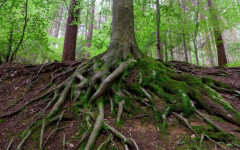
    So I noticed that most trees in arboretums aren’t really planted in those artificial looking mounds but rather just planted slightly higher than the rootball. Very old trees look like this with its surface roots exposed( this one not from an arboretum). I wonder why arboretums do more of that then mounds? Does it necessarily make a difference if you plant on a foot high mound or just couple inches above the rootball?


  • 5 years ago

    The tree in your picture looks like that because it was planted properly with the root Flare at or slightly above grade level. You want to do that whether or not you plant on a mound or in the native grade level. If you don't like mounds, don't use them.

    What's important, is that the site you choose is compatible with the type of tree you're planting. Some won't survive long periods of wetness.

    I think this is why it was suggested that you get some professional help. Your yard is your garden and should be designed in such a way for it to be a beautiful, lush growing place, not just plopping trees here and there hoping for good results.

    You may need some landscaping work.

  • 5 years ago

    Bringing in soil to create a different condition from that provided by the existing soil and then mixing the two together defeats the purpose of bringing in the different soil. And - yes - mounding above a damp or wet area in order to get a tree started that will grow much larger than the mound in time carries an implication that the tree is a kind that will be able to grow in the existing soil around the mound later. That the purpose of the years spent on the mound was to save the nursery grown specimen from suddenly being stuck in a much moister situation than it had been growing in at the production facility. There is also likely to be a percentage of situations where the tree having its root crown elevated above the water table protects it from occurrences like crown rot that the rest of its root system is not subject to.

  • 5 years ago
    last modified: 5 years ago

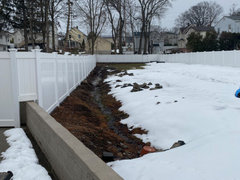
    I am having a very trusted plumber come and look at my yard tomorrow for a french drain installation quote. I'm thinking of having the french drain installation directed to my current ditch that I have and then just let the water flow from the ditch to the catch basin I have, instead of having a drain at the end of the french drain. Where the tan pot is is the catch basin so French drain can be directed straight into the middle of the ditch, not parallel to it. May or may not hire depending on the quote. Lets say that my yard wasn't as wet as I've been overly stating and then the french drain is installed. Will that dry out my yard now to the point where trees will be stressed from too much dry?