Software
Houzz Logo Print
webuser_272343471

Help: Is my pachyveria glauca dying?

5 years ago
last modified: 5 years ago
I've come to this site for advice about succulents and found it extremely helpful, so I decided to make an account to get some advice about my pachyveria glauca (or little jewel) to hopefully save it.

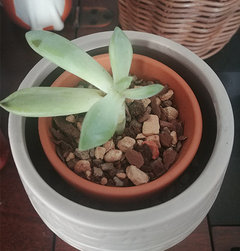
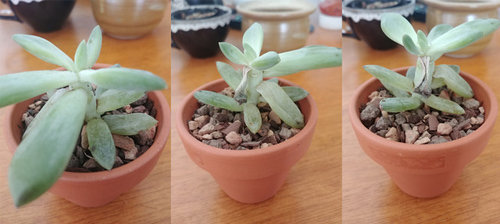
The main problem is that its health appears to be declining rapidly, as you can see below:


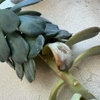
It arrived (via package with a heating pad) about 3 weeks ago with one of its leaves damaged (as you can see below):


After a week and a half, I repotted it in a terracotta pot with Bonsai Jack's Gritty Mix and a bit of all purpose soil (along with some of the soil it came with, to avoid shocking it too much). The roots looked fine at the time, though a small offshoot that was growing beside it separated (I decided to repot that alone since it had a lot of roots but it has since died, seemingly from the same thing harming the parent plant).

As for watering, I've watered it around 2 times since I've had it and always allowed the water to drain through the bottom of the pot. It is located in my kitchen, with ample indirect sun and a ceiling fan on during the day to keep a healthy airflow.

Since the leaves don't appear to be mushy, I don't think it's been over-watered (please feel free to tell me otherwise though). If anything, it kind of looked like the leaf had been burned when it arrived and since then, several leaves have fallen off and two (including the injured leaf) have turned dark and started shriveling. Meanwhile, the bottom leaves look a bit translucent and some of the leaves have dark spots. I'm worried that this might be a sign that it's under-watered, but I wanted to get more advice before I do this, since I know it's better for succulents to be under-watered than over-watered and I'm very new to succulents.

Thank you!

Comments (19)

  • 5 years ago

    I would suggest that there is a chance it may have been damaged by cold - unless packed properly and warm enough. Small damage on 1 leaf is usually no problem, they could get worse in transit. What I would question is: repotting - it is a good idea, unless plants didn't have chance to recover...it may not have been needed to divide, new pot is large enough...adding soil to a mix that already has some...watering may be too much; you said leaves are falling off and few are translucent = waterlogged IMO...light: indirect is ok for a little while, but in 3weeks I may have moved it into more...

  • 5 years ago
    last modified: 5 years ago
    Thank you for your comment, Rina! Since I got it in the mail, there is a chance that it could have been damaged by cold, but I'm not sure what else to look for there (are there any other symptoms to watch out for?) I really hope that repotting was a good idea (the pot it came in was very small and the soil was really dry). As for it being waterlogged, is there any way to tell? The roots seemed a bit damp when I repotted it (I waited a few days after watering to repot it), but I tried to be extra careful with them. I'd be interested in investigating the roots again, but I'm scared that taking it out would shock it more and it already seems very delicate. Otherwise I'm curious if maybe it's just taking some time to adjust to soil change (from soil to gritty mix) and hope that that hasn't caused it any harm.

  • 5 years ago

    It arrived (via package with a heating pad)


    ==>>> never heard of this.. tell us more about it .. could it have cooked the plant???


    i never transplant or repot a new plant for at least a month.. if not longer ...


    you plant was stressed from shipping.. arrival.. new environment.. etc ... so why stress it more by disturbing its roots ...


    did you wet the new media first ... a lot of media is so bone dry in the package... that it is near impossible to wet it once its in the pot ... so i usually take a grocery bag.. or gal baggies.. and take a few days to moisten it .. not make it sodden.. just moisten it ...


    then i would pot whatever up .. and then water it in to firm the media ... and then probably not water again for weeks .. since i know its all moist ...


    since its already stressed.. i might actually tip it out of the pot.. and see what if any moisture is in your media... and react from there ....


    where are you .. big city name.. and how cold was the trip.. and for how long ...


    and thank you for actually figuring out how to use a name.. rather than those anonymous HU names ... im ken.. in case you cant tell.. nice to meet you jen ...


    ken


    ps: i dont think the ceiling fan is needed.. nor really accomplishes anything anyway ... if i needed it for other reasons ..... good enough.. but i probably wouldn't run it just for these plants ... air movement is way down low on the cultural variable list .. and usually only an issue in stagnant greenhouses ...


  • 5 years ago
    last modified: 5 years ago

    Thanks for the info and nice to meet you too, Ken! I ordered it from a plant store in another city (about 5hrs away via car), which added a small heating pack to the package to ensure that the plants didn't freeze (since it can be cooler here in early March - we're in Canada). The shipping itself didn't take long and the two other plants I ordered (also succulents) are healthy. I didn't realize it wasn't a good idea to repot plants so soon - a lot of sites I'd looked at said it was good to repot new succulents after bringing them home (at least after waiting a week or more for them to adjust and as long as it wasn't during winter) to ensure that the roots were healthy. I didn't wet the gritty mix first -- how wet should it be before potting it? But the soil that I added was moist, so I waited over a week to water it after repotting. As for the moisture, the mix is dry and the roots have some of soil on them (and unfortunately some loose leaves fell off in the process...)

  • 5 years ago

    Plants are shipped with the heating pads that keep them warm, not cooked.

    Yes, it is usually very good idea to repot plants unless they were grown in well draining mix and didn't have any diseases or bugs. Sometimes they do, often not; it really depends on the grower. It is also good idea to get old soil off the roots unless it is a good mix (seldom, but it happens). Contrary to what others say, I would repot into a dry mix, but there could be exceptions (rarely in my case). As I mentioned before, BJ mix has soil in it, perhaps it was not needed to add more, and wet. I received almost dead tiny plants from UK that were in the box for almost a month, and in the Summer (hot). They were bareroot. They did recover, but it took a while.

    Yellowish, translucent leaves are full of water = waterlogged. That is what you said. That means to me that plant was shipped too wet (bad idea in winter!), or you overwatered it. In general, succulents recover easier from underwatering rather than overwatering. You don't want to desiccate them, but 'when in doubt (about watering) - dont'...

  • 5 years ago
    last modified: 5 years ago

    Thanks for the clarification, Rina! It's so hard to know what to do as a beginner because there is so much contradictory information out there. I suppose I could have left it in the original soil, but I wanted to transfer all three succulents into gritty mix as I'd heard that it's really good at eliminating the chances of over-watering/root rot (and the other 2 succulents I got have been stable since their transfer). I didn't add very much soil in the BJ mix (only a few pinches) so there isn't enough in there to keep the mix wet for long periods of time. I'm glad that the plants you received from the UK made it - that gives me hope!

    As for the translucent leaves, those ones were at the bottom and have mostly all fallen off (the remaining leaves on top look healthy), so I'm hoping that if they were waterlogged, the plant will recover without them if I don't give it any water for a while. The only thing that felt iffy to me is that some of the leaves (around the middle of the plant) were shriveling, which made me think that the stem was drawing water from them (and could be under-watered? I've only watered it twice since I got it, last time being around 6 days ago), but I really don't know enough about little jewels to be able to decipher if that's correct. In the meantime, I think I'm going to let it rest without water (at least this week) and keep my fingers crossed that it recovers. I've also kept the leaves that fell off to propagate.

  • 5 years ago

    Leaves that fell off will not propagate if they were not healthy (example: waterlogged...)

    Sorry for repeating, but: In general, succulents recover easier from underwatering rather than overwatering. You don't want to desiccate them, but 'when in doubt (about watering) - dont'...This works for all succulents, not only one you have. Water only if/when potting mix has dried up.

  • 5 years ago
    last modified: 5 years ago

    Ah, that's fair, Rina - I hadn't realized that, but the leaves I did take have turned dark and begun shriveling so that makes sense.

    I haven't watered it since and it seems to be relatively stable:


    It still has some dark spots (on two of its biggest leaves, as you can see above) but it hasn't lost any additional leaves (at least in the past few days). One of the leaves also has a dark spot where it meets the stem, though, which is what happened to the leaves that shriveled and fell off.

  • 5 years ago

    I would remove that leaf with the black spot next to the stem. That rot will spread and if it's close to the stem that's no good. And sounds like overwatered for sure. With succulents check their leaves not the soil when you're going to water. If the soil is dry, but the plant is still plump and juicy DO NOT WATER! If the leaves are starting to wrinkle or seem a little squishy as opposed to firm then we water. I make them wait. Lol. Since they store water in their leaves/stems etc even if the soil is dry they're so plenty hydrated if they're plump and giving them more water cuz the soil is dry just causes them to take in too much water because they're still drinking the stuff they stored up. If that makes sense. Best of luck!!


    Oh and the reason I wrote remove the leaf rotting next to the stem is because it's so close to the stem. You don't want the stem to rot out. If it was at the tip of the leaf or anywhere but so close to the stem I'd say just leaf the plant alone. I personally would probably also spray it with an alcohol or insecticide soap, but that's cuz I'm paranoid cuz I got scale lost year from a cutting someone gave me and it was a nightmare. Lol.

  • 5 years ago
    last modified: 5 years ago

    Shawna

    Rubbing alcohol or insecticidal soap will not cure rotting. If you are recommending it for scale, that is ok but I would first check the plant to see if any. Otherwise, spray is not needed. It is much better to periodically check the plants to see if any bugs, rather than spraying for no reason.

  • 5 years ago
    last modified: 5 years ago

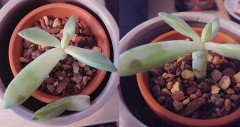
    Thanks for the reply, Shawna! I just removed the leaf with black spot next to the stem, which was already beginning to shrivel (as you can see below). Most of the leaves that have fallen off so far also had black spots on them and close to the stem -- as you can see in the image below on the right, there are still a lot of darker spots along the stem where the leaves used to be. And most of the remaining leaves have black spots on them, but it's hard to see if they also have spots next to the steam since they're so close together. As for water, I haven't watered it since my initial post. Overall, I have watered it twice since I got it. However, as someone who is new to succulents, I'm still figuring out how to tell when each plant is thirsty. I also use gritty mix so the medium always looks/feels dry.


    From what I've seen of scale (from Google searches at least) it looks like white-ish bumps. I haven't noticed anything like that on my pachyveria. However, I have since talked to someone who had the same issues with their pachyveria (the black spots on the leaves and close to the stem) and they told me that their plant continued to decline due to what they think was a bacterial infection. Do you think spraying it with alcohol or insecticide soap would still help?


    Thanks for the reply too, Rina! I'm still not sure if I should be spraying it since (as I mention above) I think it might be infected with a bacteria (at least according to someone who had the exact same issue -- and who said that nothing they did managed to save their plant). Overall, the top leaves seem stable, but almost all of them have dark spots at this point. I feel so helpless watching it decline like this :(

  • 5 years ago

    Many spots are because of mechanical damage. Do not assume there is bacterial disease with every little spot. Get educated first by reading reliable advice, not just hear say. There are different products to use for different problems. And, often, problems are caused by growing conditions. The very common is overwatering that could lead to rot-fungus...

    Pls. do not spray with ru or insect. soap for bacterial infection! They work on bugs, not a rot or fungus or bacterial disease. Some bacterial pathogens can't be treated and plants should be destroyed - but that doesn't happen every day. Some bacterial pathogens are spread by bugs, and bugs needs to be eliminated to prevent them from doing that. Do you see any bugs?

    While scale could be of few different colors, most commonly seen scale is brownish. It appears as a regular, oval bumps that do not move. If there is any, it could be physically removed unless there is a big infestation. White bugs are often mealy bugs (probably more common on many succulents) and should be taken care of before there is a huge infestation.


  • 5 years ago

    As always, thanks for the info, Rina! I definitely agree -- I'm trying to educate myself on what the problem could be and am in no way resigned to the problem being caused by a bacterial disease. As for overwatering and rot-fungus, the root system looked healthy (no dark or mushy bits) over a week ago when I checked, but I haven't had a look at it since. From what I've read, it seems like overwatering can cause dark spots and the leaves to look transparent, which I've witnessed, but most of the leaves also turn dark and shrivel up, which seems like a cause of underwatering. As for bugs, I don't see any but I'm keeping an eye out just in case.

  • 5 years ago

    Hello,

    I had similar problem with echeveria. I don't know if this would help but as far as I researched, the plant might be in stress after reppoting. I bought mine, reppoted and this happened.

    I moved mine to more shady area and watered in smaller doses. The plant seems as it adjusted right now.

    Maybe a few more leaves will come off but if otherwise the plant seems fine it should stop that in 2 weeks.

  • 5 years ago

    Hi, Alexa, thanks for the info -- I'm glad your echeveria recovered!


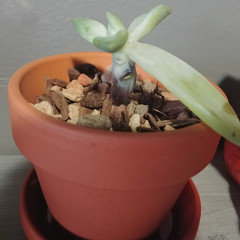
    I left my pachyveria alone for a few days to give it time to settle, but I just took a look at it today and it seems like things have taken a turn for the worst, as it's stem has started turning black :(


  • 5 years ago

    Jen,

    Water = #1 killer of plants. More so with succulents.

    Research your species of plants and find out what the native growing conditions are.

    Many live in hot, dry climates with plenty of direct sunshine and don't see water (rain) for weeks on end, possibly even months. And in coarse, dry gravely sand that let water drain through like a sieve.

    When it does rain, the plant sucks up as much water as it can and stores it inside the lobes. Within a day or so, the soil is dry again and the plant lives on the stored water for the next month or so until the next rain. Roots do not need to stay moist, just the contrary, they need to be dry in between times.

    That should give you an idea of how drought tolerant many succulents are. But if too much moisture gets retained or if you water too often, thinking your plant will die overnight if not watered, bacterial and fungal infections can start in around the roots.

    So don't worry about it, give it plenty of light, warmth and if possible, low humidity and after a couple or three or four weeks, the lobes shrink considerably and/or wrinkle, then it's time to give it a drink by watering the fast draining potting media until water comes out the bottom drain holes. Then not again until the plant shows signs of drying again.

    With the gritty mix or other coarse media, you may need to add your fertilizer nutrients with the watering but not real strong and not very often.

  • 5 years ago

    It seems it's rotting, is the black part soft? If yes it's rot. Remove all the black and let the top dry for 2 days, than place it on to soil and mist with water every or every second day, it should make new roots.

  • 5 years ago

    If there is any rotting, misting it will make it worse. JMO...I successfully rooted many cuttings and never mist. Stick them in dry mix, and start watering when there is sign of new growth. That could be a week, 10days or longer.