Software
Houzz Logo Print
clint_carlisle

Wires connected to window

5 years ago

Curious to know if anyone has thoughts on what these wires are? They connect 3 of our window frames together in the back of the house, and the center wire runs into the ground, but aren't found anywhere else. My best guess is they're the remnants of an old security system that is no longer functional.
Thanks!

Comments (17)

  • PRO
    5 years ago

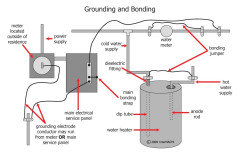
    What you see in pic 1 is a grounding wire, 2 is a bonding jumper. Here is an image to give you an idea of how it works.


  • 5 years ago

    Is it normal for grounding to be done through the window frames? I've never seen that before. Thanks for the inputs

  • 5 years ago

    Is/was there a pool or hottub there?

  • PRO
    5 years ago

    I have never seen that before also... but why it's there they need to find out, calling an electrical contractor would be a good start

  • 5 years ago
    last modified: 5 years ago

    My guess is that it is equipotential bonding, but I don't understand the wire going into the ground unless there was power to a pool or hottub in the ground. You don't ground equipotential bonding as that would make it worse.

    Also, for three windows it would need to be one heck of a hottub...

  • 5 years ago

    Re Stax, who will soon delete his post. The wiring maybe for a hot tub. Common where I used to live.

  • 5 years ago
    last modified: 5 years ago

    Note: this post is in response to a deleted post by Stax, asking why someone would need equipotential bonding on side windows.

    ---

    Well the OP said they were in the back of the house, so not sure about "side windows" would need equipotential bonding... My guess would be same reason back windows need it.

    Furthermore, I made no assertion as to the need for equipotential bonding, only noted what I guessed it to be.

    However, if it helps, I believe any conductive surface within 5' of the inside edge of a pool and certain hottubs is supposed to be bonded. That notably includes fences but also includes aluminum windows and doors.

  • 5 years ago

    "Furthermore, I made no assertion as to the need for equipotential bonding, only noted what I guessed it to be."

    Oh, now I see why I was confused. lol

  • 5 years ago
    last modified: 5 years ago

    "Oh, now I see why I was confused. lol"


    Let me clear it up a bit further. To know whether it was required we need information about what was there when it was installed. Looking at a close up picture today isn't sufficient to comment on the necessity of the installation. Not mention that I am not qualified to comment on the necessity.


    However, comments on necessity do not change what it is. If a bald guy has a hairbrush, it's a hairbrush. It doesn't suddenly stop being a hairbrush because a bald guy shouldn't need one.


  • PRO
    5 years ago

    It becomes a head scratcher.

  • PRO
    5 years ago

    When you see 2 metal objects being bonded it's usualy done to mechanically connect a few or more conductive materials together to have a conductive path between them. In certain situations, both materials can be bonded together without being grounded. That could be the situation in picture 2.

    Picture 1 with just one wire that could be going to a rod, a panel, or to the land of nowhere, who knows what's connected to or why it's there to begin with.

    Since there no "sure" answer and only assumptions best bet to call a local electrician and pick his brain... By the way, are you in the region with seasonal tornadoes, thunderstorms, etc that this could be a local requirement?

    I never saw this around here on the east coast, yes we bond and ground swimming pools, re-bar placed in the footings, etc... but windows that new to me.

    Let us know please what you find out, if found out, I think most of us here curious as well to see why.

    Thanks!

  • 5 years ago
    last modified: 5 years ago

    Again, not really qualified to comment on this. Just something we were informed about for a pool fence, but I did find this.

    Here is the code section and NEC Handbook commentary on this:

    II. Permanently Installed Pools

    680.26 Equipotential Bonding.

    (A) Performance.
    The equipotential bonding required by this section shall be installed to reduce voltage gradients in the pool area.

    (B) Bonded Parts. The parts specified in 680.26(B)(1) through (B)(7) shall be bonded together using solid copper conductors, insulated covered, or bare, not smaller than 8 AWG or with rigid metal conduit of brass or other identified corrosion-resistant metal. Connections to bonded parts shall be made in accordance with 250.8. An 8 AWG or larger solid copper bonding conductor provided to reduce voltage gradients in the pool area shall not be required to be extended or attached to remote panelboards, service equipment, or electrodes.

    (7) Metal Wiring Methods and Equipment.
    Metal-sheathed cables and raceways, metal piping, and all fixed metal parts shall be bonded.


    Handbook Commentary:

    The metal parts required to be bonded per 680.26(B) include all metal parts of electrical equipment associated with the water-circulating system of the pool, all metal parts of the pool structure, and all fixed metal parts, which include conduit and piping, metal door frames, and metal window frames, within 5 ft of the inside walls of the pool and not separated by a permanent barrier. Other examples of fixed metal parts covered by this requirement include metal fences and metal awnings. The bonding of these parts can be accomplished by one or more of the following methods using a solid 8 AWG or larger, insulated, covered, or bare copper conductor. See Exhibit 680.13. Brass or other corrosion-resistant metal conduit can also be used as a bonding conductor for connecting metal parts together.
    • Connecting the parts directly to each other in series or parallel configurations
    • Connecting the parts to the unencapsulated structural metal forming the shell of a conductive pool or connecting the parts to a copper conductor grid system used around the contour of a conductive pool shell
    • Connecting the parts together using the pool shell constructed of bolted or welded steel as a common connection point. See Exhibit 680.13
    • Connecting the parts to the perimeter bonding grid consisting of either structural reinforcing steel (re-bar or welded wire mesh) or a solid 8 AWG bare copper conductor encircling the perimeter of the pool

  • PRO
    5 years ago
    last modified: 5 years ago

    Are these windows metal? They look like vinyl windows. I guess the OP made a left.

  • 5 years ago

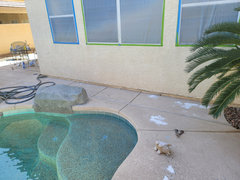
    Thank you for all of the input and apologies for incomplete information/pictures. There is indeed a pool very close. I added a new picture, but we've temporarily detracted the wire to paint. The reason we asked is just because they're kind of ugly haha, and we want to make sure we don't remove anything important. I had never heard of equipotential bonding before, but sounds like that's what it is. The windows are metal and definitely within 5 feet.

  • 5 years ago

    Since you are painting... I would get some paintable raceways and paint them to match the exterior of the house. When you reinstall the wires run them through the raceways and that will clean it up a lot.


    Please note that the wire going into the concrete most likely attaches to your pool's grid and is not a ground, so if you can't reattach it to that same wire have an electrician look at it. I don't see that wire in the picture, but it may be there.

  • PRO
    5 years ago

    That explains everything!