Software
Houzz Logo Print
webuser_928827909

serviceberry input

I have been interested in getting one of these for my yard for quite some time. I am part of a Pennsylvania gardening and Pennsylvania native page and people always preach about these. I posted there asking for pictures and don’t get many responses. Sometimes I think people like to suggest things without actually having the plant or tree. So I come here where I always get good answers. Who has a serviceberry and what kind ?My only options are full sun as of now until my tree get bigger. Please share any advice of experiences with them as well ! Please post pictures of yours !!

Comments (26)

  • 5 years ago

    I planted one for my parent's in Pennsylvania (Philadelphia suburbs, full sun) and one in my NJ yard several years ago. I liked it but cut mine down later to give more room to an adjacent dogwood that was too close. I probably would have left it except the fruit on mine was infected with a fungus every year (and I really wanted it for the fruit for me and for wildlife). My parent's tree does not seem to have the fungal problem on the fruit, and it produces bumper crops of it that the birds (and I) love! They flower in the Spring and look as nice in my opinion as Callery Pears when in full bloom. The fruit is very good too when it is not blemished.......kind of like blueberries. The birds LOVE the fruit. I think you will get better fruiting in sun and maybe less fungus, even if the tree itself is shade tolerant. These are one of the native species.....I think arborea (?)......from a native plant nursery originally.

  • 5 years ago

    @woodnative ! Thanks for the great information! I am in Philadelphia suburbs as well (glenside) I know the rust can be an issue but I will take my chances. Like you said full sun may help with that. Do you know what kind of serviceberry you and your parents have ? I know there are quite a few varieties

  • 5 years ago

    The rust has nothing to do with the tree being in sun or shade. The development of any rust issues is dependent entirely in the tree's proximity to the other host species, junipers. If eastern red cedars, Juniperus vriginiana, are present in your area, chances are high that your tree will develop rust. While it is unsightly, the rust really has minimal impact on the health of the tree.

    Serviceberries are an excellent choice for a native spring flowering tree that stays of a reasonable size. And gets great fall color!

  • 5 years ago

    Here is cedar hawthorne rust on amelanchier. This rust also effects the foliage. I'm in Maryland and never see fall color on amelanchier, instead by late August or Early September they are defoliated. Delicate and beautiful when they bloom, I'd suggest OP drive around and observe them which are blooming even as we speak. Sadly I decided to pass this one by several years ago because of disease issues.


  • 5 years ago
    last modified: 5 years ago

    Collection of various serviceberries I planted for a friend on country acreage (30 in her case) with no Juniperus virginiana visible anywhere around this western WA location suddenly got full of rust one year. After the planting had been in place for years. But by the following year or so the rust was mostly if not entirely gone. Without any attempt at control or elimination of the infestation having been made.

    [Note spelling is hawthorn, as in cedar hawthorn rust. And not as in Nathaniel Hawthorne]

  • 5 years ago


    This is Amelanchier ‘Autumn Brilliance’ . I’ve only had it a short while so can’t comment on issues yet.

  • 5 years ago

    No serious issues with Autumn Brilliance and I even had a couple of big old red cedars in the yard up until a few years ago. Still a couple of big ones a few doors down. I don't think it quite lives up to the 'brilliance' part, at least here in MN, in the fall. It's ok.

  • 5 years ago

    We have a juniper/cedar and a serviceberry, and they did fine for a long time, we were going to get a second serviceberry in another spot, but we got a bad tree (it died and was replaced with a dogwood at no cost to us); we subsequently had rust on the cedar (under which the bad tree sat for a bit), and following the cedars orange-horned balls, the serviceberry had rust too. We cut off the rust off both trees as best we could for the last couple years (we drew the line at what would need an extension ladder for the cedar), and this year I see no orange tentacled balls on the cedar, so we're hoping we may have broken the cycle. Anyways, both trees are healthy otherwise (the bad tree died from a root issue, but we think it introduced the rust to the cedar).

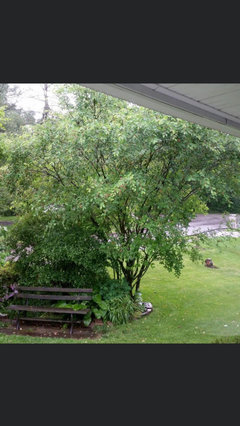
    Here's the serviceberry last year:

    It's one of our favorite trees; the birds love its berries.

  • 5 years ago
    last modified: 5 years ago

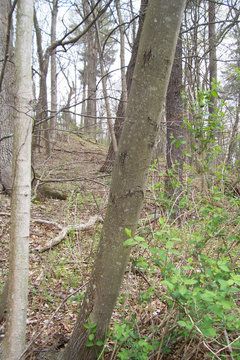
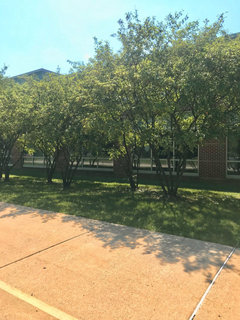
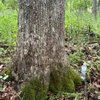
    Tried one once and it struggled & failed after a couple yrs -- might have been the location. School near my brother's house in PA has a dozen of them planted in the parking lot mediums and those actually have done very well. Art museum in Hagerstown City Park has two large ones in front (my guess is they're Allegheny serviceberries) and they look very nice. Couple pics of a very slim 45 footer near my house.


    Trunk.


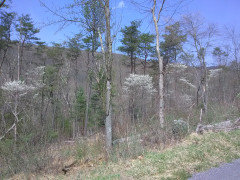
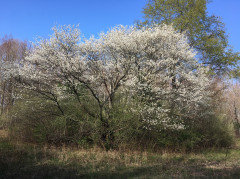
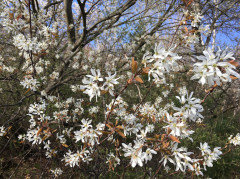
    Pic just recently of Allegheny serviceberries in the understory. Ethereal is a good description of their appearance when blooming.


  • 5 years ago

    Found a Google view of the serviceberries right in front of the Hagerstown City Park Art Musuem.


  • 5 years ago
    last modified: 5 years ago

    There tends to be a lack of dramatically distinctive characters and in the wild there is a lot of crossing between species so that different treatments have had different interpretations of where one species starts and another ends, how many species there are:


    Amelanchier in Flora of North America @ efloras.org


    Details of Allegheny serviceberry are discussed here:


    Amelanchier laevis in Flora of North America @ efloras.org


    Otherwise commercially circulated decorative cultivars such as the now possibly most prevalent 'Autumn Brilliance' tend to be attributed to A. x grandiflora. With there being a history of treelike forms being circulated under wrong species names such as A. canadensis in particular.

  • 5 years ago

    Yeah such mixed reviews on these, like any plant I guess. In searching through Facebook I saw some great examples. Both are in full sun for the most part. I will continue my research to see what makes some thrive and others not so much.

  • 5 years ago
    last modified: 5 years ago

    It being a rose family tree regions where certain bugs or blights are prevalent these can show up and have a spoiling effect. Same as with Malus and Crataegus. And where there is not so much pressure from any particular nuisance entity then Amelanchier plantings can have quite different outcomes.

  • 5 years ago

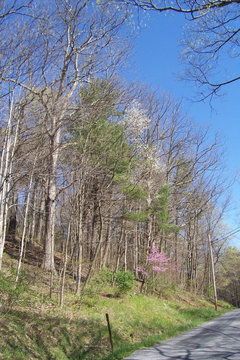
    Local site conditions (and regional differences as Embo pointed out) can have a major impact on performance in the landscape. Note where sam_md's example is growing - in a narrow planting strip between a sidewalk and the side of a building. Serviceberries are happiest in decent soil with good drainage, and in warmer climates adequate moisture through the heat of summer. We use the tree form varieties Cumulus and Lustre in our street tree plantings, and Autumn Brilliance as multi stem plants in parks. Serviceberries grow wild in my area without too many pest/disease issues. Photos below from yesterday (4/17/21) of a wild serviceberry along the road. This one had a wider growth habit, but more often the wild trees are relatively upright in form.


  • 5 years ago

    I never had any issues with mine when we lived in Minnesota, aside from some minor bird predation. They always bore a lot of fruit for much of early summer. Flowers are attractive, but small and flowering doesn't last long. Very nice fall color - a very bright orange-red mix like sugar maple. I had a number of Saskatoon-berry shrub types, and a single tree-type grandiflora (I believe it was called). Slow-growing, good for tight spots. No single awesome characteristic, but all around nice plant to have - I wish I could grow them in zone 9.

  • 5 years ago

    The fruit on Autumn Brilliance is consistently tastier than some others I've tried, assuming you don't get rust on it. My trees have gotten so tall I can only collect off the bottom branches and if the birds leave me some. If the timing is right boil it down with some rhubarb, maybe a little sugar if desired, and put over vanilla ice cream.

  • 5 years ago
    last modified: 5 years ago

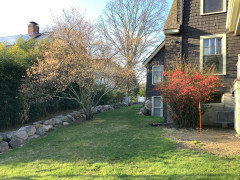
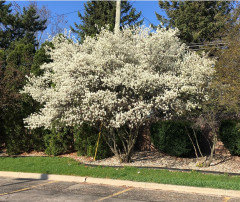
    In my area, multi-stem Autumn Brilliance are a common sight in both residential and commercial landscapes. Photo taken this morning (4/19/21).


  • 5 years ago

    @arbordave best pic I’ve seen of one yet ! That’s something I’d love to see in my yard!

  • 5 years ago

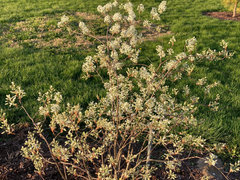
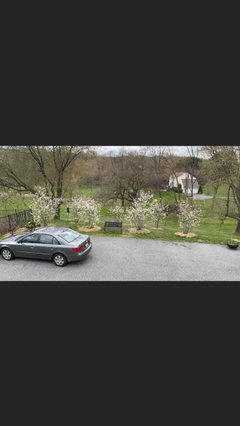
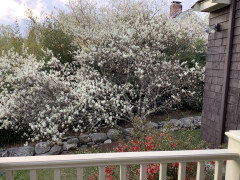
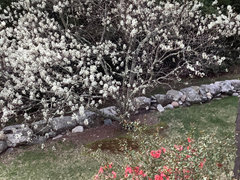
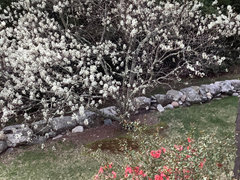
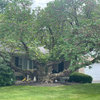
    Just thought I'd reshare our serviceberry now that it's blooming.


    It's missing a branch on the right side in this picture because it got snapped when the neighbor's bamboo whacked and tangled it during a storm. The right side is also more shaded (by the bamboo), so it started blooming a bit behind the left (south side).

  • 5 years ago

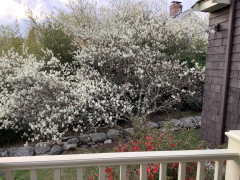
    I wanted to reshare our serviceberry now that it's blooming:


    It is missing a branch on the right due to it being snapped by the neighbor's bamboo.

  • 5 years ago

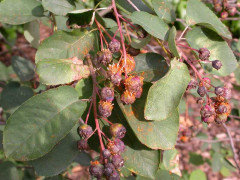
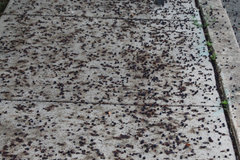
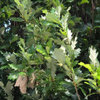
    Today's pic of infected fruit

    Never plant Amelanchier over hardscape

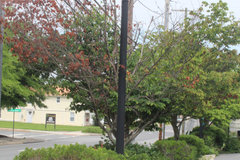
    streetside planting with dieback, tree will likely be removed soon.

    My state's flora recognizes 7 species of servicebery not including naturally occuring hybrids.

    I wouldn't give you two cents for any of them. I sampled some fruit today with many almond tasting seed. Fruit not really to my liking, sort of fermented.

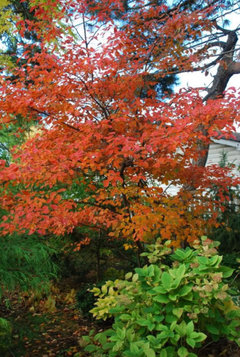
    My observation is around here by late August/September trees are essentially leafless, not even a hint of fall color. AAMOF I've never seen fall color on this genus. How about someone here go back to your pix from last year and show us examples of Amelanchier fall color. Remember OP is in Phily.

  • 5 years ago
    last modified: 5 years ago

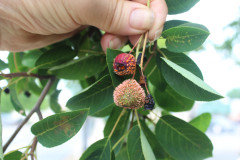
    Fruit is showing Cedar-Apple Rust. As for flavor ... couldn't tell you, as the birds are too fast and eat it before its even ripe; to be fair, we don't grow our serviceberry for the berries, so we don't really try very hard to beat the birds. Die back is something else ... possibly due to pavement, road salt, etc. (Hard to tell much from the picture angle, but the shrubs aren't doing great either.)

    I'm not sure if I have any fall pictures of it ... I'm more of a flower girl than a leaf peeper.

  • 5 years ago
    last modified: 5 years ago

    Over the last couple of days I’ve eaten about two cups worth. To me they taste like a cross between apple and blueberry but I don’ t let them ferment.

    I’m not in PA and this pic is a few years old but the color is reliable.


    tj

    ETA it is an x grandiflora.

  • 5 years ago
    last modified: 5 years ago

    sam_md -- ugh.

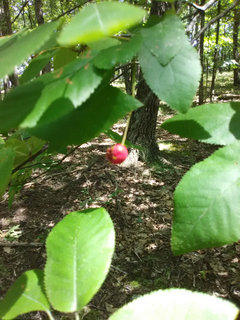
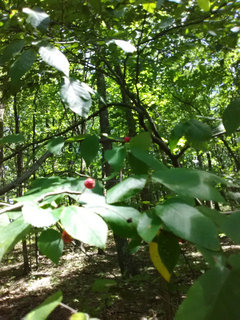
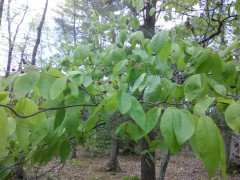
    Alot of small serviceberries in the understory of Rocky Gap State (Md) Park, but hardly a one had any fruit even tho the timing was right (and I didn't see any empty fruit stems either). Out of dozens, I found maybe two w/a couple berries ranging from not-quite-ripe to over-ripe, The "ripe" ones were sweet, tho. Here's a couple pics.


    These below are not-quite-ripe.


  • 5 years ago

    Happy to see people still giving me good information. It’s funny since I posted this I’ve noticed a lot of them. The building I work in actually has one of the property and two grade schools near me have groves of them! Also noticed a huge one, easily 20 feet tall in front of a house near my job. It’s beautiful. I will keep an eye of them to see how they look in August/ September as mentioned above.