Software
Houzz Logo Print
katec14

Columnar European Hornbeam or Columnar Oak or something else?

5 years ago
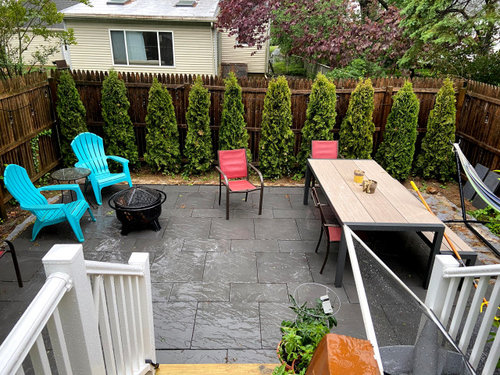
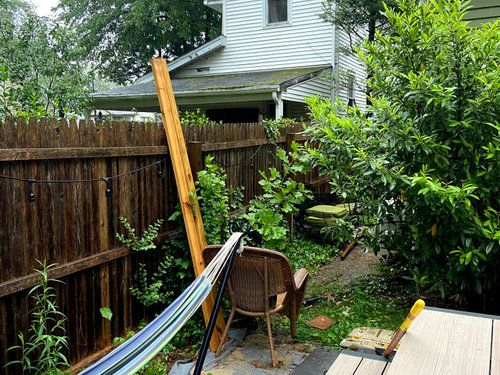
I'd appreciate some opinions about a tree for my backyard. It is a tiny yard that we recently almost completely covered with a patio but I left about 4-5 feet of yard on one side of the patio with the hope that I can plant a tree for privacy from a neighbor's second floor window. Photos attached...a pic of our (in progress) DIY patio with green emeralds we planted for privacy from neighbor behind us (someday) and then the side of the yard that our next door neighbor looks down on. Please look past the mess...I'm hoping to put a narrow tall tree a litlte to the right of where that tan wicker chair is sitting.

I love the look of the manicured European Hornbeam but I fear that it might be too big for the space. I've seen a lot online about Columnar Oaks. My local nursery has a Bonnie and Mike Swamp Beacon Oak in stock but I fear it will look like a solitary shurb just akwardly placed rather than an accent tree. I'm not set on keeping the overgrown Skip Laurel near where I want the tree. I could trim it way back. Hoping to keep the hammock and put a walkable ground cover underneath. Links to pics of European Hornbeam https://www.monrovia.com/pyramidal-european-hornbeam.html and a Columnar English Oak https://www.monrovia.com/columnar-english-oak.html. Privacy from that second floor window is the priority. Any thoughts?


Comments (10)

  • 5 years ago

    You might also consider a 'Slender Silhouette' Sweetgum (Liquidambar styraciflua). This tree will ascend to the height you want more quickly, and it is pencil thin.


  • 5 years ago
    last modified: 5 years ago

    Even one of those sweetgums (post immediately preceding this one) would not fit in the space discussed and still allow room to walk by. Otherwise there's a pyramidal European hornbeam in the county east of mine that could be 40' across, nearby the USDA station had a 'Frans Fontaine' hornbeam that was about 20' wide and so on. ("Had" because they cut it down recently, maybe because it was thought to have overwhelmed the planting site because it didn't stay skinny). Instead of columnar with branches coming low look for dwarf on a long single stem - from the perspective of your second picture all you need is a comparatively small bushy top at the level of the window. Dwarf hornbeam, dwarf crabapple, naturally small growing maple species - whatever you kind find. In either case (tall and narrow or lollipop/mushroom shaped) it's going to grow sideways over the neighbor's lot - so you need to be prepared for that. As in discussing it with them beforehand, so that you don't have an unpleasant surprise later - just as you are finally getting the coverage out of it you want (tree plantings take years to size up). A surprise as in one day you look at it and all of their side has been cut back to the fence - or even a couple feet back into your lot. (At my previous house a neighbor reached over a fence, cut a screening planting I had put in - that I thought they would appreciate being between them on their patio and my back windows - off at fence height apparently as far as they could reach into my lot. When I had occasion to discuss this unauthorized action with them later the complaint was the living screen was dropping dead leaves on their bark mulch).

  • 5 years ago
    last modified: 5 years ago

    I happen to love European hornbeams and I have used the fastigiate cultivar 'Frans Fontaine' in my designs for over 20 years. Although it may be possible for these not to remain as narrow as described, most do. In fact, some of the earliest I had planted - nearly 25 years ago now - have never exceeded an 8' spread. And can always be pruned to keep more strictly narrow. European hornbeams are frequently used in hedging and pleaching so a very malleable tree :-)

    One of the reasons I do use them so frequently is because of the ability to stay within scale and because they have a very tight upward sweep of the branches, they provide excellent screening even in winter when out of leaf.

    btw, there is also a dwarf version - Carpinus betulus 'Columnaris Nana' - that grows to 10-12' tall and with only a 4' spread. I have one myself growing in a container.

    As a further plus, European hornbeams are rarely ever bothered by any disease or insect issues.....a pretty much problem free tree!

  • 5 years ago

    Thank you for the replies. I’m going to look into these other options!! There really is an amazing variety out there.

  • 5 years ago

    If you were to plant a hornbeam there with the idea you would shear it to keep it within the space you would be taking on a yearly commitment going out indefinitely into the future. And being able to get at every part of the tree from top to bottom, cleaning up afterwards. Including whatever involvement with the neighboring property this might entail. Such as picking up pieces falling on their side.

    To see how often 'Frans Fontaine' does not remain strictly narrow simply requires an online web search. The ~20 ft. wide one up my way was the broadest one in a short row that had all made a percentage of determinedly out spreading branches.

    I've seen street tree plantings of 'Fastigiata' hornbeam with significant buildups of sooty mold fungus on them in Seattle.

  • 5 years ago

    Ahh, Mr Negativity strikes again!!

  • 5 years ago

    If you have decent soil, not too dry, and you're open to something a little less formal looking, a Sun Spire Magnolia might work for that spot. This Magnolia Society article says "if you have overplanted your garden and have only a microscopic amount of space left, this may be the magnolia for you." I saw it at the Dawes Arboretum a couple years ago, and although still relatively new it was distinctly upright in form with dark green textured foliage.


  • 5 years ago

    Any plant grown as a tree form can have lower branches removed in order to access space around and beyond its framework. Any plant will produce leaves and other plant parts like buds, flowers, fruit, stems, branches, POLLEN, etc. that can travel with the breezes or local fauna - no matter how tall or short it may be. And pruning does not have to be an annual endeavor, unless one is an inveterate shearer and must maintain a perfectly planar surface.


    Maybe others know already, but Kate C hasn't stated where this proposed columnar plant will be spending its future life (city, part of the country, or growing zone). That may have everything to do - or nothing - with what species is selected and maintenance regimen required. As a grower of plants, I believe that is a first consideration, so things like Cupressus sempervirens or the growth rate of species already mentioned could be evaluated - or discarded. As has often been stated, YMMV...


    An obelisk could work as well to obstruct a view (Egyptians and Romans did it), as could a big tarp (a la Frank Gehry) - but neither would provide seasonal interest, support local flora and fauna, and provide the pleasure of just watching a plant grow and change with age.


  • 5 years ago

    In the vein of arbordave's suggestion, another member of Magnoliaceae - Liriodendron tulipifera ''Fastigiata' (aka 'Arnold') - might also be a choice to consider. Planted here at Viburnum Valley 30 years ago, a specimen resides next to my front walk and driveway, does not exceed eight feet in width at any point, and has never been a problem to navigate - with an average of one pruning cut per decade.


    https://www.monrovia.com/arnold-tulip-tree.html


  • 5 years ago

    Wow! Love the magnolias! Zone 7 here.