Software
Houzz Logo Print
lone_elm_z6

How long before giving up on a Beech?

5 years ago
last modified: 5 years ago

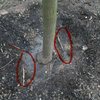
I am just about ready to order a Fall replacement. This is the 4th season with no real growth. The spot is windy and the tree gets leaf burn. During a wind storm this past week the bottom of the trunk showed inadequate root anchorage still, as soil had pushed away leaving a good space from trunk movement. Two Oaks planted in the same conditions around the same time have grown handsomely and are competing on which will rule the yard. If a tree is not happy into the 4th season maybe I should get the message and try again.

Comments (15)

  • 5 years ago

    Could it have been pot bound in the nursery long enough to cause knotted roots? I had a European beech cultivar that didn't seem to grow for almost 10 years, when it finally died and I dug it up, the root mass was hopelessly knotted into a bowling ball shape.


  • 5 years ago
    last modified: 5 years ago

    As davidrt says, prb'ly girdled roots. As an aside, planted a European beech 15 yrs ago as a curiosity in a remote spot (wet soil). Still alive, but has never prospered, my guess is it really needs a well-drained location (a problem for some trees on my bottomland lot, rock chestnut oak and firs suffer too, tho other species grow like rockets).

  • 5 years ago

    Yes to the above two posts. Everything you describe indicates a compromised root ball. Do you recall what the roots looked like at planting?

    tj

  • 5 years ago

    Oh I should have said -- it was a bare root planting. Those tend to be better for getting locked in and going fairly fast, and this makes me wonder what is happening. I think I may have got the wrong tree in the wrong spot.

  • 5 years ago

    Any chance of a pic or two?

    tj

  • 5 years ago

    really.. 4 years ... you are much more patient than i would be ...


    be done with it .. sounds like it will be easy to pull out.. lol .. and once you do ...... you will have the answer ...


    dont you hate when the facts get in the way of answers .. lol ... i was wondering why you of all people wouldnt have bare rooted it .. and do what need be done to do it properly ...


    ken

  • 5 years ago
    last modified: 5 years ago

    European beech is drainage sensitive. And when a specimen of much size dies it should be dealt with fairly promptly because this species is unusually quick to topple afterward.

  • 5 years ago
    last modified: 5 years ago

    Ken, yeah I am trying to get out of the habit of waiting on trees obviously not working out. Sunk cost fallacy.

  • 5 years ago
    last modified: 5 years ago

    Interesting thing about native American beeches...where I grew up in the DC area, they always seemed to be found in well drained woods. On slopes or the tops of hills. They were one of my favorites trees so I was good at spotting them. I was astonished when I started visiting parkland in the lower Susquehanna valley, where I moved ca. 15 years ago, to see them growing almost in swamps. One can see them in places like Susquehanna state park, for example, where they are on little 10-20" rises, islands almost, that are directly above constantly damp ground or even standing water! I'm not saying seedlings, I'm saying full sized trees.

    The USDA write up seems to capture this odd dichotomy: https://www.srs.fs.usda.gov/pubs/misc/ag_654/volume_2/fagus/grandifolia.htm

    Beech populations frequently are higher on coarse-textured, dry-mesic soils in the northern part of its range (38). In Indiana, beech is more sensitive to reduced soil moisture than is white oak (Quercus alba), sugar maple (Acer saccharum), American elm (Ulmus americana), and slippery elm (U. rubra). It will grow on poorly drained sites not subjected to prolonged flooding and may grow where the water table is within 15 cm to 25 cm (6 to 10 in) of the surface. It is markedly less tolerant of such conditions than are red maple (Acer rubrum) and sweetgum (Liquidambar styraciflua). Beech trees on poorly drained sites have shallower root systems than those on better drained sites (39).

    So what I find fascinating is whether there's a local ecotype that is better at growing on poorly drained sites. Because they have clearly outcompeted things like red maple in these locations I'm talking about. Even on the wooded property adjacent to mine are beeches growing in lowish spots.

  • 5 years ago
    last modified: 5 years ago

    This thread is actually astonishingly timely because I was about to create a new topic about my attempt to save a beech with this problem.

    About 5 years ago I saved a 'Dawyck Gold' by aggressively hacking away at its knotted root crown. It seems to be back on track now and is close to hitting 20' I'd say. It was a 3' mail order plant from Song Sparrow, probably bought 2009. A 'Purple Fountain' I bought 3 years ago also seemed to be struggling, and as luck would have it, it partly blew over in the big windstorm we had earlier this spring, exposing obvious problems with the root system. There's a company on Long Island that has created a machine using many compressed air nozzles to completely blow the soil off huge trees during transplantation. (at sensible times of year, obviously) So I tried a smaller scale approach to expose as much of the root system as I could:


    Brought my air compressor to this part of the garden in my FEL! That sucker (no pun intended ;-)) is surprisingly heavy.

    Anyhow, after blowing the reservoir out, I exposed exactly the disaster I expected to find. Alas, I was too rushed to take a before picture, I just have this picture after making several cuts. It still looks bad, but I hope it will be able to start growing correctly now. I feel confident because I've already been through this with another beech.


    I pulled a couple of the root out tangentially, holding them with rocks, before repacking with the native soil. Then mulched and watered, obviously. Fingers crossed! These sort of 'prestige plants' are getting harder and harder to find. The once legendary Styer's of SE PA had at least 10 beech cultivars for sale at any given time in the 1990s. Last time I was there at "Terrain" - now basically a housewares store/restaurant/events venue that happens to sell some plants - they had a couple.

    One does have to be careful though. I tragically lost a Rhododendron delavayi because its roots had gotten very knotted - it was obviously in a hurry to form a tree - and I aggressively tried to straight them. Well, when rhodies do form big roots, they are brittle. They kept snapping. I replanted it but a hot dry spell finished it off, it just couldn't cope with that amount of root loss. It would have been barely hardy here, but I was lucky to hybridize with it before its demise, so the genes will live on LOL. It was so root rot resistant, it had survived over 2 days of being inundated - quite literally under water - after hurricane Irene! Its pot was in a non-draining outer pot, and we had many inches of rain and I was distracted for a couple days with basic surviving. Running my fridge off my car and an inverter, for example LOL. Luckily a huge cold front came through after that hurricane so air conditioning wasn't needed!

  • 5 years ago
    last modified: 5 years ago

    Btw both the late lamented Song Sparrow and Tripleoaks, my source of the 'Purple Fountain' - are nurseries as good as nurseries come. So this is a problem with stock you buy ANYWHERE.

  • 5 years ago

    Embo says:

    because this species is unusually quick to topple afterward.


    Yeah, that's true even for a healthy tree, I had to hold one up nearby in the mountains.


  • 5 years ago
    last modified: 5 years ago

    Other than trees like Hickories that take a while to adapt, how long should one wait on

    bareroot before calling it a day and trying something else? If the tree has shown no real branch extension by 2nd or 3rd season? I have a 3rd season Red Oak which looks the same as when first planted other than larger leaves, and seems uninterested again. A Chesnut Crab planted this spring already has 14 inches of growth. A hello there and I am happy to be here kind of tree.

  • 5 years ago

    Plant something else right beside it. Then after a couple yrs decide which is better and remove the loser.

  • 5 years ago

    I plan to replace it with a White Oak.