

The Rose Doctor: Diagnosing Rose Problems (Thx Straw)
Here is a thread where we can post our rose problems and Straw (our rose and soil expert) and others can help us figuring what is wrong with our roses. I will go first in the following thread.
Thank you Straw and others for generously sharing your knowledge.
Helen
Comments (328)
 5 years agolast modified: 5 years ago
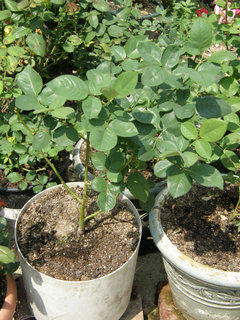
James Austin's bloom is gorgeous !! Fast drainage by elevating pots on bricks works for my July's two-weeks of heavy rain (3 to 6 inch. per day). Here's Stephen Big Purple (1 1/2 month gallon-own-root) elevated on bricks, pic. taken Sat. July 24 at 89 F and 70% humidity. Soil is completely dry on top, which prevents any pests from hatching on top.
 5 years ago
Helen, Your potted plant looks so happy now! Pot feet area great idea! I love cutting my roses. I always have roses in the house.
Straw, I just bought Langbeinite at Armstrong Nursery and the directions say sprinkle 1-2T around each established plant once a month. Any reason I couldn’t do more volume less frequently, since as I understand, it is a more slow release type product?Related Professionals
Newark Landscape Architects & Landscape Designers · Fort Smith Landscape Contractors · Charleston Landscape Contractors · Savannah Home Builders · Toms River Home Builders · Merced Home Builders · Tupelo Landscape Architects & Landscape Designers · Frederick Landscape Contractors · Tulsa Landscape Contractors · Wichita Falls Landscape Contractors · Fort Wayne Landscape Contractors · Lafayette Landscape Contractors · Superior Landscape Contractors · Los Angeles Landscape Contractors · Waterloo Home Builders- 5 years agolast modified: 5 years ago
Stephanie: I don't trust any granular products in hot & dry weather, and you have sandy soil which has less buffering capacity than my dense clay. This month I induced instant nitrogen deficiency on Munstead Wood by topping it with 2 TBS. of sulfate of potash. Too much at once is NOT good. It's SAFER to dissolve 1 TBS. of Langbeinite per 3 gallons of water in twice a week watering. Potassium is best in a solution since it binds up with soil.
Helen: Per your questions: "Would you please share the links of the products that have sulfate of potash and gypsum either from Amazon and/or Home Depot? How much of each to give to a rose?"
For fast release of sulfate of potash, it's Alpha Chemicals in a white powder, this stuff is very strong and can burn if NOT diluted (1 TBS. per 3 gallons of water), NPK is 0-0-50. Hard to dissolve in my alkaline tap water at pH 9, so I pre-mixed in vinegar.
I prefer the natural & mined sulfate of potash (brown granules) Southern Ag Sulfate of Potash 0-0-50, 5 LB for $27 on Amazon. This dissolved instantly in water and made my water greasy, plus made leaves very glossy & shiny. This works better than Alpha Chemicals for inducing blooms.
I would test the pH of your tap water before deciding if gypsum or Garden Lime is needed. I use fish-tank litmus paper to test the pH of my tap water, which agrees with my village's stated pH of 9 on their website.
If your tap water is slightly alkaline at pH 7.2, then use Garden Lime (pH 10) when any nitrogen fertilizer (including alfalfa meal) is used. Nitrogen fertilizer makes soil more acidic.
If your tap water pH is 8 to 9, then use gypsum (has 20% sulfur). Gypsum is acidic and I induced rust and blackspots on roses when I threw gypsum on top with acidic rain pH 4.5. But gypsum is fantastic for pH over 8 tap-water. Too alkaline results in tall roses with no blooms, or Iron deficiency (pale leaves with dark-veins) on newest leaves.
If your rose is stunt with zero growth, plus mildew, rust, blackspot, or sulfur deficiency (pale leaves that start at bottom of plant), then use Garden Lime (22% calcium and 12% magnesium). Sulfur deficiency also occurs at acidic pH, UP the pH to neutral via garden lime will release sulfur & nitrogen for dark-green leaves.
I get gypsum pellets from local Menards, and it's quite acidic (burns my finger and I had to wash it off). The SOLUBLE gypsum powder that I ordered from Kelp4Less is acidic and dissolved well in my alkaline tap water at pH 9, plus supply sulfur for dark-green leaves. Best gypsum to order on Amazon is the SOLUBLE gypsum.
For zillion-petals roses, I use twice more calcium than potassium. For 3-gallons of water at pH 9, I use 2 TBS of gypsum per 1 TBS. sulfate of potash. For 3-gallons of rain-water at pH 4.5, I use 2 TBS of lime per 1 TBS of sulfate of potash.
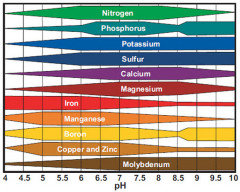
Click on below pic. to see that sulfur, potassium, calcium, magnesium are plenty at alkaline pH, but are less available at acidic pH:
- 5 years agolast modified: 5 years ago
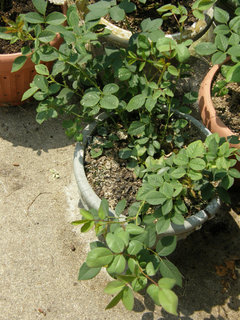
Since lime takes months to neutralize the acidity of organic matter, I find it faster to dissolve Garden Lime in water to fix acidity. Below Sonia Rykiel's leaves were previously pale (sulfur deficiency) from 2 weeks of acidic rain, it STOPPED growing since calcium were leached out with constant rain. Too acidic: dull leaves then become pale (sulfur deficiency at pH < 6), then zero growth. Calcium is needed for growth of stem, roots, leaves & flowers.
I put 2 TBS of Garden Lime mixed with water, and watered it. Within 2 days leaves became dark-green and pumped out new growth with buds. Note the new growth has normal & shiny leaves, versus DULL old leaves of sulfur deficiency. Got it as a tiny 3" rooting late April, pinched off at least 10 buds so it can survive my zone 5 winter when I put in the ground late fall. Sonia Rykiel today July 24.

bayarea_girl_z10a_ca
Original Author5 years agolast modified: 5 years agoI reposted this in case you missed it the first time Straw. Thanks.
Straw, you said ”For the zillion petals rose like Summer Romance, there's a higher need for sulfate of potash & gypsum. Crown Princess Margareta is a zillion-petals rose that was stingy on me, until I gave it sulfate of potash & gypsum (calcium sulfate). Potassium initiates the blooming, and calcium is to form those many petals. For hot weather with alkaline tap water, I always use sulfate of potash & gypsum with many-petals roses in my alkaline clay.”
Would you please share the links of the products that have sulfate of potash and gypsum either from Amazon and/or Home Depot? How much of each to give to a rose? Thanks. Helen
 5 years agolast modified: 5 years ago
Helen - I'm so glad that your potted roses are doing better...so are the vast majority of mine...they've got glossy leaves (thanks, Straw)...now just need to grow. That is a STUNNING JLA!!!! WOWZA! Oh my goodness...and then I see your truly elegant display of your rose blooms!!! How do you do anything besides sit and stare at your bouquets??? GORGEOUS!!
Straw - those leaves!!! It's hard to believe that leaves can be this exciting...but after my hideous summer of leaf disaster...I'm really excited by leaves...and those are gorgeous!! Oh, and a heads up for next year when my roses are doing better...then I'm going to focus on gypsum, etc...and I'll need more help. I can hear you running, screaming into the night. LOL
- 5 years agolast modified: 5 years ago
Carol: I'm very happy that your roses are doing better. I enjoy Helen's bouquets too, they brighten up my day. Leaves are hard to tell .. the best way is to dig around the rose and check the soil. pH test the top level is not accurate, since lime moves down very slowly. Only when I dig down to 7 inch. and get the soil at root-level, then I can see how acidic it is. I bury my roses so deep for winter survival that I have to dig down to 1 foot to get to the root-level. Or people would do a pH test of the top soil where the mulch is, and it's always neutral or slightly alkaline pH !!
Helen: I wrote a long answer to your questions, but Houzz delayed in posting it. Scroll way up, and you'll see my answer.
bayarea_girl_z10a_ca
Original Author5 years agolast modified: 5 years agoStraw, I think I know what is the issue with your long post if it has a direct link to Amazon. It happened to one of my posts before. If I had a link to Amazon in my post, I could see my post but the post was hidden from others. Once I removed the Amazon link from the post, it is shown to everyone. If you had an Amazon link on the post, would you please edit your post and remove it so your post is visible to me? Thanks Straw.
- 5 years ago
Same thing happened to me years ago. Houzz deleted my posts just because I posted links to Amazon, so I quit Houzz for a few years, but came back to help Carol with her pots. I deleted the link to Amazon, and please let me know if you can see my answer. Thanks.
bayarea_girl_z10a_ca
Original Author5 years agoI can see your long post now. Thank you so much for doing it Straw 😊. Helen
- 5 years agolast modified: 5 years ago
Straw - my rose pot soil seems very compacted...do you think that all of the lime I put in did that? Maybe I should put some worms in the pots. But what would the worms eat? I put sooooo much lime in my pots.
And I'm sooooo grateful that you're here, Straw!!
- 5 years agolast modified: 5 years ago
Carol: You are right about Garden Lime (22% calcium, and 12% magnesium) makes soil compact. It's the magnesium which glue soil together and make cement, along with the high pH of lime. Worms like to eat green & organic matter like alfalfa meal.
I always put 1/3 cup alfalfa meal ON TOP of 1 to 2 TBS of lime during heavy rain (1 TBS for 1 day rain, and 2 TBS for 2+ days of rain). The acid in the alfalfa meal loosen up the compactness of Garden lime.
I find that alfalfa meal works better than alfalfa pellets for pots since alfalfa meal breaks down faster. Alfalfa meal is great for pots, IF ONE USES A SMALL AMOUNT FREQUENTLY. I did put worms in all my pots to aerate roots (roots need oxygen as much as water to grow).
Now we are in hot & dry August I'll make alfalfa tea, and put the wet residue on top of pots to feed the worms.
Below is my pot ghetto July 14, I constantly have to pinch off buds so they grow big root for zone 5 winter-survival. Note the yellow leaves on Golden Celebration, that one needs more oxygen to root, and I need to elevate that on bricks. Sonia Rykiel is the one in front, note lowest leaves are pale .. that's from sulfur deficiency with too much acidic rain.
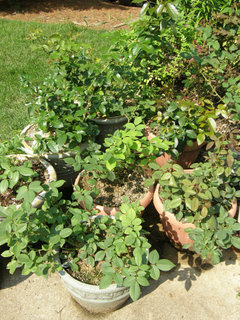
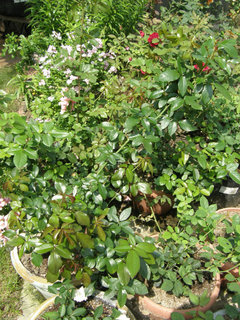
Below is pot ghetto (own-root-bands received on May 12 and June 11). Pic. taken July 24 AFTER I put earthworms in the pots. Note the growth from roots getting more oxygen, from the worms' aerating the soil.
- 5 years agolast modified: 5 years ago
Could you tell me how early in the spring season to apply alfalfa and potash? My roses have just started sprouting leaves after pruning 2 weeks ago. I was going to start giving them rose food (I use Sudden Impact by Neutrog, the analysis is here -https://neutrog.com.au/2019/08/19/sudden-impact-for-roses/) in August, but I thought I might apply potash and alfalfa (I have pellets) with lime now. Do you think this is a good idea?
My soil is acidic but I have been amending it and it is getting more neutral. I recently dug pumice and some organic material around the plants.
- 5 years agolast modified: 5 years ago
Apply lime first, then alfalfa on top immediately after pruning to stimulate new growth. Lime & alfalfa is best during tons of rain. Lime helps with nitrogen uptake. Farmers here routinely apply lime with nitrogen to their crops in spring to maximize nitrogen uptake.
It takes 1/2 cup of lime to neutralize the acidity of 2 cups of alfalfa meal if you have FAST DRAINAGE. If you have slow-drainage clay with flooding, alfalfa meal gets more sour and it takes 1 cup of lime per 2 cups of alfalfa meal.
Sulfate of potash works very fast in inducing bloom, less than 1 week. When the new growth gets to the height you want, then apply sulfate of potash. From below link:
https://geologyscience.com/rocks/igneous-rocks/extrusive-igneous-rocks/pumice/
Pumice pH is 7.2, Chemical Analysis
Silicon Dioxide:76.2%Aluminum Oxide:13.5%Ferric Oxide:1.1%Ferrous Oxide:0.1%Sodium Oxide:1.6%Potassium Oxide:1.8%Calcium Oxide:0.8%Titanium Oxide:0.2%Magnesium Oxide:0.05%.
My only concern is aluminum oxide at 13.5%. Aluminum is toxic to plant and is released when the soil is acidic. If Pumice breaks down very slowly like red-lava-rock, then you are safe. However, pumice pH is 7.2 versus pH near 9 of red-lava-rock, so my bet is pumice will break down faster than red-lava.
The NPK of Sudden Impact rose fertilizer is 9:4:12, with 9% nitrogen, 4% phosphorus and 12% potassium, plus 9% sulfur, 2.5% calcium, 0.8% magnesium, 0.4% iron, 0.2 zinc, Mn, copper, and 1% humic acid. Good stuff, I lilke its high potassium at 12% and high sulfur at 9% (sulfur is essential for growth plus dark-green leaves). Calcium is low, but you are applying lime to neutralize spring rain.
If your roses are grafted on Dr.Huey, Mr. Frank Gatto, rose-nursery owner in high-rain PNW recommends 1 cup of lime per rose bush in spring to neutralize lots of rain.
- 5 years ago
Thanks, Straw! :)
So when you put a worm in a rose pot...do you dig in a little bit of food for the worm? Maybe it would eat the alfalfa pellets I put on the pots in the spring? Hmmm...I read that I can soak the pellets to make meal. I'll do that. :) But I'm still too afraid to use alfalfa this year. What are your thoughts on this knowing how badly my roses have been. Just let well enough alone and do alfalfa meal next year?
Since this is me...the Queen of overdoing things...could you be more specific about small amounts of alfalfa/frequently? LOL
We've been in hot/no rain for most of July and probably all of August. But, at least we're getting nice weather. :)
Wow!! Your roses' leaves loot fabulous!! :) :)
- 5 years ago
Terrific, I'll do that, thanks. The pumice I got is sold as orchid raising mix, this is the one I got. https://www.petandgarden.com.au/pumice/2014-pumice-25l.html
Hopefully it will be ok.
Tomorrow I'll be getting out the alfalfa & lime! And I'll leave the potash for a while.
- 5 years agolast modified: 5 years ago
lenarufus: Thank you for the link on pumice, an excerpt from your link:
"Pumice will not rot or break down, it is less likely to wash out of the pot. For propagation use the smaller grade 1-2 and 1-7. Hardwood cuttings can be stuck in 100% pumice. The variation in particle sizes allows excellent basal contact for supply of water yet the porosity maintains aerobic conditions around the newly formed roots. Slow rooting species such as Conifers, Maples and Camelias are particularly well suited to propagation in pumice. Cacti and Succulents need to open and well-drained potting mix, pumice is ideal for this purpose."
So pumice is safe since it won't break down plus its porosity helps with fast-drainage plus aeration to roots. What impresses me about pumice is its 76.2% silicon dioxide. Silicon helps with strong tissue for the thick petals in orchids. Potassium silicate is known to prevent blackspots on roses, see below link:
Applications of Potassium Silicate Decrease Black Spot Infection in Rosa hybrida`Meipelta' (Fuschia Meidiland™)
https://journals.ashs.org/hortsci/view/journals/hortsci/38/6/article-p1144.xml
So the slow-released silicon, plus slow-released sulfate of potash granules before blooming will prevent blackspots once roses are done with blooming.
- 5 years agolast modified: 5 years ago
I started a new thread for discussion/questions about pots & growing in the ground, plus posting results of what you tested. Will answer Carol's questions in below thread:
- 5 years agolast modified: 5 years ago
Carol asked: "could you be more specific about small amounts of alfalfa/frequently?
We've been in hot/no rain for most of July and probably all of August."
If your tap water DO NOT cause paleness in leaves like my tap water at pH 9, then most likely it's at pH 7.2 (slightly alkaline).
Alfalfa meal pH is 5.8, but alfalfa pellets is MUCH MORE ACIDIC at pH 5. During hot & dry, I tested soaking 4 cups of alfalfa pellets in 32-gallon of tap-water at pH 9. And it became sour within 2 days, at pH similar to acidic rain (5.6 at west coast and 4.5 at midwest and east coast).
A rough guideline is if it smells slightly fermented (1 to 2 days), then the pH is slightly acidic. If it smells sour and stinky, then it's too acidic and needs some Garden Lime to balance the pH. 1 TBS of Garden lime is enough to raise the pH of rain water (4.5) to neutral pH per 1 gallon of water. In the same way, 1 TBS of vinegar is enough to lower the pH of 1 gallon of my tap-water from 9 to neutral. 1 TBS of pickled veggies (3.6) or fermented alfalfa pellets has the same pH as 1 TBS of vinegar (3.4).
https://www.clemson.edu/extension/food/food2market/documents/ph_of_common_foods.pdf
I tested 2 TBS of Garden lime per 1 gallon of acidic rain water and that was too much, and I got whitish lime showing up on the leaves. 1 TBS of Garden lime per 1 gallon of fermented alfalfa tea or acidic rain water would bring it to neutral pH.
- 5 years agolast modified: 5 years ago
That's really well thought out!! I'm going to do this next year. I'll write it down in my book. Right now, I don't want to mess with pH as all but 4 roses have gotten or are getting wonderful leaves...thank heavens and Straw!!
I just googled and I found this:
Calgary tap water is quite alkaline – above a pH of 8. Plants get by just fine on this water but they would prefer a slightly more acidic water.
I didn't know our pH is so high. Interesting.
- 5 years agolast modified: 5 years ago
Carol: Soaking alfalfa pellets (4 cups per 32 gallon of water), or 0.6 cup of pellets per 5-gallon of water in LESS than 24 hours was safe for my pH 9 tap-water.
Since your tap-water is less alkaline at pH 8, soaking 0.5 cup of pellets per 5-gallon of tap-water for 24 hours, plus stirring it well, should be neutral to slightly acidic pH & safe to use in hot & dry summer.
La Reine was 1-cane wonder, less than 1 foot since I moved it last year. It finally sprouted a 3rd-cane, thanks to watering with alfafa-tea. Alfalfa helps with growth if the pH of its water is neutral.
 5 years agolast modified: 5 years ago
Me again, back with another question about what could be wrong with my roses! This time it's my voodoo rose... I posted a month or so ago in a different thread about how there wasn't any new growth showing more than two months after planting it in the ground. Some here advised me to water more frequently and I did... and I got a nice new shoot coming up as of a couple weeks ago. However, at the same time, I discovered a chilli thrips infestation in my roses thanks to Straw's good eyes. I've been rotating spinosad spray with neem oil/soapy water spray every 5 or 6 days on all my roses, and I removed damaged new growth from quite a few rose plants in my yard.
My Julia Child broke out in bad blackspot after the spinosad spray (not necessarily thinking it's related, but it did happen right after I sprayed). And a few of my roses started going yellow and brown in a weird arrowhead pattern after the neem oil spray. It's the older leaves... I wonder if it's even related to the neem oil spray and might instead by a nutritional deficiency? heat stress? This is the hottest part of the year here in Southern California, and I've been withholding my usual fish emulsion fertilizer because I didn't want to encourage any new growth that would just get attacked by the chilli thrips that established themselves in my yard. Could it be related to that? Or is it something else... sun burn? chemical burn? old insect damage?
Here's a photo of my voodoo rose from this morning:
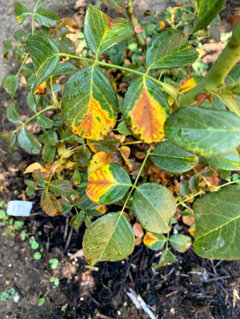
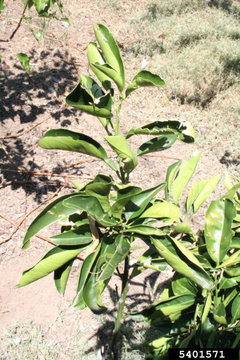
and here's the new growth at the very top -- which is exciting! -- but notice that some of the new leaves are coming in really pale: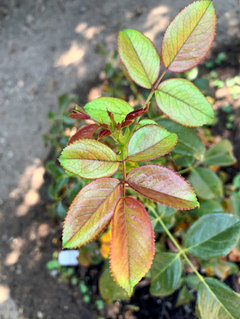
What do you think? This is my first year with this rose, I got it from Huntington Gardens at their annual plant sale, so I assume it was very well taken care of. It went into the ground in my backyard later than I would normally plant, at the beginning of May. It had some granular fertilzer from Huntington in its 5 gallon pot when I bought it, but I have added no new granular fertilizers since. Just weak fish emulsion until about a few weeks ago when I stopped fertilizing entirely to avoid the chili thrips.I'm in zone 10a in southern california and I water this one by hand every few days.
- 5 years agolast modified: 5 years ago
Heather: some info. about spinosad from below link: "Spinosad is broken down rapidly by sunlight, with a half-life on leaves in sunlight being 2 to 16 days and less than one day in water with sunlight. In the environment, its solubility is low above a pH of 5, and if it is binding to soil particles and breaking down from sunlight and soil microbes under typical aerobic conditions; it would be unlikely to leach into groundwater."
https://www.phillyorchards.org/2019/06/13/pop-tips-spinosad-orchard-sprays/
Most likely the burn results from the neem oil and hot sun. Years ago someone reported horticultural oil burnt roses' leaves under hot sun.
New leaves that turn pale with yellowish/bronzy is sulfur deficiency. Sulfur is an essential plant nutrient. Rain water, decayed organics (alfalfa), gypsum (calcium sulfate), potassium sulfate (natural mineral), or ammonium sulfate (high salt chemical nitrogen) all supply sulfur.
Sulfur deficiency is common in hot & dry and no rain. I used SOLUBLE gypsum and SOLUBLE potassium sulfate to fix my alkaline tap water at pH 9 .. otherwise young leaves turn very pale. Difference between sulfur and iron deficiency: Iron deficiency has DARK-GREEN veins on pale youngest leaves, versus sulfur deficiency has pale veins & pale leaves that start at youngest leaves, then progress throughout the plant.
Since high nitrogen and high phosphorus attract thrips, the best fertilizer for hot summer is SOLUBLE gypsum and SOLUBLE potassium sulfate. It's hard to dissolve both minerals in alkaline tap water, but 1/3 cup alfalfa meal soaked in 3-gallon bucket for 1 to 2 days will give off sulfur plus acidity to dissolve minerals.
NPK of alfalfa meal is 2-1-2 plus growth hormone and trace elements.
I use 2 TBS of gypsum and 1 TBS potassium sulfate (sulfate of potash) per 3 gallon of tap-water at pH 9 plus 1/3 cup alfalfa meal (pH 5 but gets sour within 1 to 2 days soak).
My worst thrips infestation was back in 2014 when I used stinky organics (Dr. Earth Flowergirl high-phosphorus fertilizer with fish bone meal and kelp) on 2 roses only. Thrips are like flies, they are attracted to stinky smell. That's why I no longer use molasses for trace elements. One study showed that flies went for donuts over rotting meat.
"Sulphur deficiency symptoms in many ways resemble those of nitrogen - that is, the leaves become pale-yellow or light-green. Unlike nitrogen, sulphur -deficiency symptoms appear first on the younger leaves, and persist even after nitrogen application.
Plants deficient in sulphur are small and spindly with short and slender stalks."
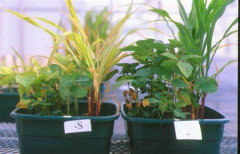
Below is a pic. of sulfur def., note the entire plant is pale (yellowish/orangish leaves)
- 5 years ago
Straw - would the alfalfa pellets in the water work for my glossy leaved roses too? Thank you for the advice. I have bags and bags of alfalfa pellets. :) :)
To be careful...should I just put the alfalfa mixture on my roses that have awful leaves? Or should I try it on all of my roses?
- 5 years agolast modified: 5 years ago
Carol: Thank you for your fantastic questions, your daughter (Kendra) the doctor gets her smart-genes from you, and your daughter Holly gets her creative and responsible genes from you as well.
Alfalfa tea is safe for all roses if you use only 1/3 cup alfalfa pellets per 3 gallon of tap-water plus 2 TBS gypsum and 1 TBS sulfate of potash. Soak that for 24 hrs, if there's a faint-sour smell, it's ready to use. If there's no smell, then wait for 1/2 day and sniff again for SLIGHT fermentation. I can smell the fermentation (light sour scent) within 2 days.
If it's very stinky (too sour), then it needs to be diluted with your alkaline tap at pH 8.
There's fermenting bacteria in alfalfa tea that helps to break down hard alkaline minerals in soil for plants to use.
I soaked pea-gravel (many colorful minerals) plus red-lava-rock in my acidic rain water (pH 4.5). Even after 1 week I get very little "mineral-dust" leaching out. In contrast, I dunked pea-gravel plus red-lava-rock in my 2-days-soured alfalfa tea, and I got 10 times more minerals leached out from those rocks.
There are FERMENTING BACTERIA that corrode those rocks/pebbles better than any acidity. Even vinegar at pH 3.4 cannot dissolve sulfate of potash (from Alpha chemicals). I have to add rain water (pH 4.5) to force sulfate of potash into SOLUBLE for plant uptake.
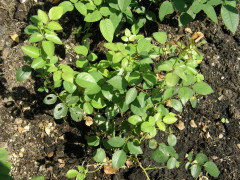
In hot & dry with no rain, I find that alfalfa tea with its fermenting bacteria help to make minerals more bio-available for plants' uptake. Below pic. is Queen Nefertiti, 2 weeks after I moved it. Normally roots are wimpy after moving, and leaves got wilted. But Queen Nefertiti leaves BECOME GLOSSIER plus pumping out buds, pic. taken July 29 at 89 F. heat. Very impressive for a rose recently uprooted & moved. I fertilized it with alfalfa-tea. Note the old leaves of rose-slug and blackspots, that's why I had to move to a new location with faster drainage:
- 5 years ago
LOL - I certainly don't feel very smart when I look at my roses. LOL But thank you anyway!! Your are an Einstein compared to me. :) :)
Darn...I don't have gypsum. Should I wait until I get some or just soak the alfalfa pellets in the water?
That rose bush looks fabulous!!! Thank you, my friend!! - 5 years agolast modified: 5 years ago
Carol: What's missing in hot & dry weather is sulfur. Sulfur is needed for plant's growth. Rain or decayed organics provide sulfur. Fertilizers like ammonium sulfate (salty nitrogen), gypsum (calcium sulfate) and sulfate of potash also provide sulfur.
I use zero gypsum this year but I give my plants lime plus alfalfa before a heavy rain, and the growth is excellent.
Fermenting alfalfa pellets in water will release sulfur plus calcium for growth. From below link, alfalfa meal has 2.5% nitrogen, 0.5% phosphorus, 2.2% potassium, 1% calcium, and 0.25% sulfur, but with 17% protein which makes it a substantial fertilizer. Once fermented (more than 24 hrs. soak in water), it will release more sulfur.
https://norganics.com/index-12/index-11/fertilizers/alfalfa-meal/
- 5 years ago
Oh, pellets will release calcium. I'm not sure that's good for my roses because of all the lime I put on this year. A lot!! I think my roses need something acidic that doesn't have calcium. What do I know though? LOL I have been giving them Langbenite ... has sulfur...would that be enough? Next year I could try alfalfa pellets again...since hopefully the calcium levels will have gone down by then. I wonder how long it takes calcium to get out of a pot. But, if you think that the calcium levels would be really low by now...then maybe I should try the alfalfa pellets. Oy vey...so challenging once I've made a mess of this. :)
 5 years ago
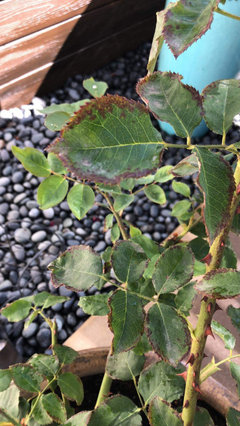
My friend just sent a picture of one of her roses.
Any ideas what is going on with her rose?
- 5 years ago
She in Southern California and waters 2 or 3 times a week
2 times a month she uses fish emulsion.
- 5 years ago
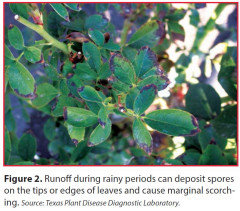
That's anthracnose, cause by a fungus. It looks similar to blackspots, but it forms at the edge of leaves. An excerpt from below link:
https://agrilifeextension.tamu.edu/library/landscaping/rose-anthracnose/
"Small reddish-purple discolorations appear on leaf veins
- Spots eventually turn dark with a thin, brown margin around the border.
- Leaf spots have smooth, distinct edges, unlike the feathery borders of black spot. Cool temperatures and high humidity favor infection and disease development. "
- 5 years ago
Straw, thank you so much for your detailed diagnosis! I got langbeinite and gypsum and alfalfa last week but haven’t used them yet, I was gonna wait until I had finished my current spray cycle for the chili thrips. I did an initial spinosad solution spray, then neem/soap six days later, then spinosad six days later. I’ll do another neem/soap spray Thursday ( though if it’s burning leaves I’m kinda hesitant to do that again! Maybe I’ll try halving the amount of neem in my spray this time). And then hopefully I’ll have disrupted the breeding cycle enough to introduce some beneficials like pirate bugs and lace wings, and hopefully they can keep big outbreaks under control for a while.
I haven’t fertilized at all for a good month now because I didn’t want to encourage new growth ( I allowed the new growth on the voodoo rose to stay because it didn’t look mangled by thrips and I’d been waiting all spring and summer for it to start up… I hope I don’t regret that). Do you recommend putting the gypsum/alfalfa/potash soak down now? And can I use langbeinite instead of sulfate of potash? For some reason i thought it was just potassium but now that I’m looking it has all sorts of minerals in it.
I will definitely put my fish/seaweed fertilizer away for the rest of the season. Didn’t even occur to me that it could be attracting the thrips with the smell but it makes perfect sense.
Thank you thank you… I am learning so much from you!
- 5 years agolast modified: 5 years ago
You are right about postponing growth. New growth means softer tissue and more susceptible to thrips. Skip alfalfa if you don't want growth. Skip gypsum (has 20% sulfur plus calcium) if you don't want growth, and use Langbeinite only.
Langbenite has 22% potassium, 10% magnesium, 22% sulfur, and only 3% chloride. The 10% magnesium helps to retain potassium in the soil, rather than being flushed out. The 22% sulfur helps it to dissolve in water. Langbenite is lowest in salt among potassium fertilizers.
FOR PALE LEAVES OWN-ROOT ROSES WITH WIMPY CLUSTER ROOT: gypsum is best mixed into soil (esp. potting soil) at least 1 month in advance. These are the reasons for mixing gypsum into soil 1 month in advance before planting:
1) gypsum provides SOLUBLE calcium for root growth, plus thicker leaves against pests.
2) gypsum is acidic thus softens soil in advance & make soil fluffy for root growth. Fluffy soil means faster drainage. This helps with potassium uptake since potassium is most available when soil is damp, rather than soaking wet or bone-dry.
3) gypsum is best used in dry & no-rain climate to provide sulfur for growth. Sulfur also helps with dark-green leaves.
4) gypsum also helps with alkaline tap water at pH > 8
5) a wait of 1 month before planting ensures the acid (sulfur portion) is diluted throughout soil rather than hurting roots if planted immediately.
FOR GRAFTED-ON-DR.HUEY (prefers alkaline) and less alkaline tap water at pH 7.2, or high-rain climate:
1) Twice more potassium than calcium, per U. of CA at Davis's rose tissue analysis.
2) Potassium helps with disease-prevention
3) UP the pH with lime to make tissue thicker against pests. When I grew bok-choy next to my patio with a dolomitic limestone base, stems were so thick & fibrous, inedible. This is the first time in decades that I put 6 cups of pelletized lime in the planting hole of tomatoes rather than gypsum, and I got the crunchiest cherry tomato, no more cracking like previous years. The leaves are larger and the stems are twice thicker than previous years. I also water my tomatoes with pH 9 tap-water fixed with sulfate of potash. Dolomitic lime (yellowish Garden Lime dust) has 22% calcium and 12% magnesium, this raises the pH fast. Pelletized lime (calcium only) is best for high-magnesium clay like mine to raise the pH slowly.
- 5 years agolast modified: 5 years ago
Late getting back to this thread (had a nutso week), but I just wanted to say thank you, straw! I'm putting down a bit of langbeinite next weekend to address the deficiencies and doing a (late) followup spray with a much more diluted neem oil/soap solution tonight to head off any more chili thrips. Hopefully by spreading these treatments out I can see what's having the desired effects.
My voodoo rose is planted in an amended hole here in alkaline southern california, but it's a grafted rose. I'm guessing it's grafted on Dr. Huey (most seems to be here). I'm betting my tap water is alkaline too, though I haven't tested.
In the last week I had basically no time to garden beyond sneaking out to hand water, and I still haven't fertilized now in about a month, and yet most of my roses are suddenly pushing new growth! It's been in the 90s here every day for the last month (some days even triple digits). The troubled Voodoo rose now has a tiny bud appearing! They truly have a mind of their own...
- 5 years ago
Strawchicago...I have a number of roses that have cupped leaves making like a bowl...is that from overwatering? Most of these are grafted, but 2 aren't...Pinkerbelle and Daybreaker. (I can try to attach pictures, but often that takes several hours of trying.)
- 5 years agolast modified: 5 years ago
If they are grafted-on-Dr.Huey (likes alkaline pH and fast drainage), then cupped leaves is from poor drainage which causes pH to drop, also calcium leaches out with too much watering. See excerpt from below link:
https://drecampbell.com/plant-nutrient-deficiencies-how-fix-naturally/
"With calcium deficiency in plants, young leaves will be affected first. They will show signs of distortion (cupped or curled up). The leaves will be small and have yellowish/brown spots. Terminal buds and root tips will also die."
Right now with my 18 own-roots (12 bands and 6 gallons) in pots, the only one with cupped leaves after tons of rain is Golden Fairy tale, it's in a poor-drainage pot which I DID NOT DRILL 10 extra holes at the sides like the other pots, so excess acidic rain-water pooled up and "sour" the pot. I put extra lime on top, and the curling up of leaves stopped. Calcium deficiency is leaves curled up & thinner and wither easily, as in tomato in below pic.
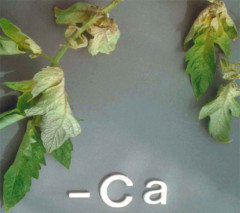
Calcium Deficiency Caused by:
- Low soil pH & Low soil cation-exchange capability (CEC).Clay has the most CEC, but sand/loamy soil leaches out more calcium due to less CEC.
Daybreaker is VERY THORNY so it would prefer fast drainage, in contrast, low-thorn roses like Sweet Mademoiselle or Firefighter can take poor drainage & soaking wet better.
The other possibility for cupped AND PUCKERED leaves is boron deficiency, which occurs at high pH or sandy soil: See pic. of Boron deficiency below:
"Symptoms appear on the new growth as small, upwardly cupped or puckered, dark green, brittle leaves with short internodes (Figures 20 and 21). It may result in a rosette effect or even shoot die-back (Figure 22). Boron deficiency is caused by leaching on sandy soils, but by drying or high pH on other soil types." Below link also has a pic. of boron def.
https://edis.ifas.ufl.edu/publication/EP362
- 5 years ago
I think that a lot of my roses have/have had boron deficiency based on your description and pics. High pH from all the lime I gave. Thanks for the info!
- 5 years agolast modified: 5 years ago
After growing 140+ own-root roses (with Felicia died this year as a band) ... I finally realize that wimpy roses need gypsum (calcium sulfate) for growth, and vigorous & constant-blooming & fungal-disease-prone roses need lime to neutralize the acid produced by aggressive roots (like Dr.Huey-rootstock).
- 5 years agolast modified: 5 years ago
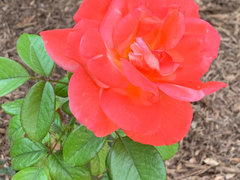
Update for those who have helped me tend to this troubled voodoo rose this summer… the foliage is still not well but it did push out this incredible bloom. No filter, the color is just surreal!
- 5 years ago
Heather - wowza!!! That's an intense color! :) :) I love bright colored blooms :)
- 5 years ago
Heather that is amazing, is it grafted or own root?
I keep trying to get it, but it seems to sell out quickly or there just aren't that many produced and I am trying to figure that out. - 5 years agolast modified: 5 years ago
It’s grafted. I got it from Huntington Gardens in Pasadena, CA during their annual public sale last spring. I was actually hoping to get this one on its own roots from heirloom but they haven’t had it available for a while. So when I saw it pop up at the Huntington sale I jumped on it.
If it recovers and gets going next year I can attempt a cutting for you, if you still haven’t found it. - 5 years agolast modified: 5 years ago
The leaves are coming back thanks to you, straw! I put down some langbeinite a week or so ago because the new growth was so light colored. All the old burnt leaves fell off and the light colored leaves in the new growth are starting to green up again. There’s only one new cane coming up from the graft and it’s a cross cane but I’ll take it.
This is despite a very slow start (more like no start) after I planted in spring, me withholding fertilizer the last month and a half due to the chilli thrips breakout in my yard, and the weekly sprays with spinosad and neem/soap. It wants to grow. Hoping next year is better and it gets a strong start a lot earlier in the year, but for the time being I’m just grateful I got this bloom!
- 5 years ago
I echo that!....love it when a rose pulls thru! Yes, if it lives and is healthy, I would love cutting, I hope it ends up doing well for you.






strawchicago z5