Software
Houzz Logo Print
johnc777

More Receptacles

5 years ago

The kid bought herself a little condo but it's in an older building and there aren't enough receptacles in the kitchen. Basically it's a U shaped kitchen with the sink at the "bottom" of the U with one duplex receptacle on either side. One of the four spots to plug anything in is already taken by a undercabinet light over the sink (and necessary). That leaves three. Microwave, coffee maker and she's down to one.


While I'm capable of safely adding receptacles, because it's a condo... She could bring an electrician but getting settled has already cost her (and me) plenty. <lol> Obviously there are short extension cords or a power strip that I guess could be mounted to the wall or under a cabinet.


I was just curious if anyone had seen something that might be a bit more attractive.


Thanks!


Comments (18)

  • 5 years ago

    Just be aware that you doing anything electrical in the condo for your daughter -- unless you're a licensed electrician -- may violate the condo bylaws, as well bring in legal and insurance issues

  • 5 years ago

    Yes, I know I can’t do electrical work. :-(

  • 5 years ago

    @kudzu9:

    1. Please document why making changes to the electrical wiring by adding outlets within a condominium that do not affect common elements or the exterior of the building would "violate the condo bylaws".
    2. Please document why adding electrical outlets would violate the law.
    3. Please document how adding electrical outlets would result in HO-6 (condo insurance) "insurance issues".
  • 5 years ago

    The simplest answer may be that in many condo developments, you only own to the surface of the wall - inside the walls may be common property.

  • 5 years ago

    wdcruise-

    In addition to what mtvhike points out, condos vary widely in what is allowed and what is not allowed. I was just informing the OP that these complications are a real possibility. And it's one thing to wire something improperly in your own home and its another thing to do something in a common wall shared with another owner, or that could potentially even affect the whole building. No need to "document"...just real world experience and common sense.

  • 5 years ago

    @mtvhike: "in many condo developments, you only own to the surface of the wall"

    I see. So anything within the walls, even if it services only one unit (as is the case here) is a common element and is therefore the responsibility of the homeowners' association? If this is the case, then how would the OP or any condo owner make changes to his unit other than, say painting the walls? Certainly an HOA doesn't want to pay for every change to unit electrical, plumbing, HVAC, etc. that an individual unit owner might want to make over the life of the condo building. And the Board of Directors certainly doesn't want to have to review and approve every inside change an owner might want to make.

    Please explain. Thanks.

  • 5 years ago

    @kudzu9: "it's one thing to wire something improperly in your own home and its another thing to do something in a common wall shared with another owner, or that could potentially even affect the whole building."

    Please explain how adding a receptacle to a circuit protected by a circuit breaker dedicated to a circuit entirely within his unit could "potentially even affect the whole building"?

    Thanks.

  • 5 years ago

    Must we continue this? When a non-electrician miss-wires something there can be consequences, like interruption of GFI protection, shock hazards, or fires. And I guess you've never lived in a condo where you need approval to do plumbing or electrical changes....

  • 5 years ago

    @kudzu9: "When a non-electrician miss-wires (sic) something there can be consequences, like interruption of GFI protection, shock hazards, or fires."

    All the OP wants to do is add some outlets to a kitchen. Why do you assume he's so stupid that he can't figure out how to do this and needs a "professional" electrician to charge him $$$ to do something so simple?

    I replaced a fuse in my package heat pump after diagnosing the problem with -- hold the phone -- a scary volt meter! I guess I should have paid some HVAC "professional" to go up on the roof and charge me $200 to replace the $5 part. (Oh, and I didn't get approval from the condo board. My bad.)

  • 5 years ago

    dennisgli-

    Thanks. Sometimes I'm baffled by people wanting to provoke a fight....

  • 5 years ago

    @dennisgli: "as far as I can tell kudzu just said that condo bylaws may require that work be done by a licensed electrician."

    No, what kudzu is claiming without evidence and without even an example that owners can't work on their own condos and that disaster will result including "legal issues", "insurance issues", fire, shock hazards, interruption of GFI, destruction of the "whole building", hurricanes, nuclear war, and sea level rise if they don't hire some overpriced "licensed" electrician do a simple task that the average person can figure out how to do by simply reading instructions or watching a youtube video.

  • 5 years ago
    last modified: 5 years ago

    Wow! I'm done. I see no point in trying to engage with someone on another astral plane. :-)

  • 5 years ago

    Actually I'm not stupid and am quite qualified to do the work but code requires a licensed professional as it's a multi-family dwelling. Personally I can understand that, I can burn down my own home but not my neighbors'... I'd have to double check but I think local ordinances also require a permit.


    I was just wondering if someone had seen anything that might be a little more attractive than an extension or a power strip. If not, then we'll run a couple of power strips, probably mount them under the cabinets and that will be that. Down the road she'll look at getting something more permanent installed.

  • 5 years ago

    @johnc777: "code requires a licensed professional"

    Can you provide a link to the code where the type of person who does the electrical work is specified?

    It's expensive, but the Legrand Adorne Under Cabinet system offers power, lighting, and other features.

  • 5 years ago

    Not sure that I like the idea of using power strips in a kitchen environment where you have a lot of high current devices - eg. microwave oven, etc. But they're better than extension cords - just get good quality ones with over current protection. For me this just encourages overloading the kitchen circuit(s).


    Since you are "quite qualified" and "not stupid" :-) I would check to see if the outlets are on one or two circuits and 15 or 20 amp circuits - obviously two 20 amp circuits is better than a single 15. If it's the latter it might be a good thing if you are forced to unplug one high current device in order to plug in another one - not convenient - but safer?


    I would not hard wire anything in without bringing things up to code - multiple 20 amp circuits, GFCI, etc.


    Just some thoughts.

  • 5 years ago

    The service panel isn't well marked but from what I could tell, the kitchen is served by two 20 amp circuits. I haven't mapped anything out yet and that might wait until she thinks more about a kitchen upgrade. But, yes I'd definitely want to bring things up to current code and I'd suspect the local building code folks would want that as well... The kitchen circuits are GFCI.


    The bathroom is also served by a single 20 amp circuit. She's got one of those gazillion watt hair dryers that could be used to remove paint. Plus assorted other appliances that I don't fully understand (nor want to). The only good news is that the bathroom only has a single (not duplex) receptacle built into the medicine cabinet (did I mention this place is older). But it does have a heater in the exhaust fan...yes, I've warned her about using the two in combination (hopefully she remembers when the weather gets cooler).


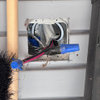
    Unfortunately the bathroom is not GFCI protected and I'm not really sure how that could be accomplished. No space to add one in the only wall j-box. Service panel is an old ITE (maybe original) so I'm going to have to do some investigating there to see if there's a GFCI breaker available.


  • 5 years ago

    I believe the NEC uses the words "qualified person" but for all practical purposes that translates to "licensed" or working under the supervision of a "licensed" person. I suppose one could demonstrate their qualifications but I would imagine that would involve pretty much the same steps as licensure.


    As an aside, our local municipality requires homeowners (single family dwellings only) looking to do their own work to pass a test demonstrating some level of knowledge before a permit is issued. I have no idea the scope of the test but from what I understand it's administered through one of the national testing companies (Pearson??).