Software
Houzz Logo Print
whip1_gw

Whacking roots when repotting

I spent part of today repotting various succulents. Ive learned over the years from reading here to be aggressive with trimming the roots when repotting. This isnt something that would naturaly occur to the plant. Of course neither is keeping them in small pots. My question is whats happening with the plant that whacking the roots off encourages growth? It seems like it would have the opposite effect.

Comments (29)

  • 5 years ago

    I would give a guess at this.

    It would seem that distorted roots (being bent up in a pot) can't seem to correct themselves to continue to grow out. Scaring off side roots eliminate this and the shock simulates the roots to seek outward instead of circling back around itself. Some Aloes will not respond well to this but most do. I don't do this for my Agave due to I want to keep the size of the plant small.

  • 5 years ago

    Think about the response most plants have to top pruning......a flush of growth! That's what occurs to roots when they are cut with a clean,sharp instrument. This flush of new, vigorous root development will give containerized plants a new lease on life.


    Our goal is encourage the plant to expend its energy on creating a youthful, multibranched root system, which will be far better at accessing water and dissolved nutrients from the potting medium.


    I am not at all certain that it works well with some succulents, however. A bit of research on your part should result in some good information.

  • 5 years ago

    From what I've seen repotting over the years, non-woody entities benefit less from root trimming, and some plants don't react to it well at all. But woody entities almost always show, like Rhizo said, (Hi! So good to "see" you!) a flush of new growth afterward.

  • 5 years ago

    Tiff! Where the heck have you been, girl?

  • 5 years ago

    Let me start by explaining how we prune parts of the plant which are above ground to stimulate the juvenile vigor that was the norm when the plant was still in its juvenile state. While we go about the pruning systematically to ensure our pruning efforts increase the plant's eye appeal, all we are really doing is cutting the plant back closer to the root-to-shoot transition zone at the soil line ...... at least that's where it should be. The tissue in this transition zone is the most vigorous of all tissue on the plant. In fact, this type of pruning is called rejuvenation pruning because it returns the plant to a more juvenile state of growth.

    We tend to think of the age of plants from the same perspective we think of aging in humans or animals, chronologically. We, like plants, go through several life stages - embryonic, juvenile, adolescent (intermediate in plants), and sexually mature, are human stages mirrored in plants. Where we vary greatly is in the way our cells age. In animals, body cells all mature at approximately the same speed. Plants grow by consecutive divisions of cells at the growing points (meristems), so their various parts are different ages (the top of the plant, or the ends of branches and stems are younger than the basal (lowest part, just above roots) portions, chronologically, but there is another way of aging plants.

    The ontogenetic age of plants is related to how many times a cell has to divide to make that particular portion of tissue. Basically, the closer the tissue is to the root-to-shoot the younger it is ontogenetically, even though chronologically, it is the oldest.

    Why is this important & how does it apply to rejuvenation? Dormant buds retain the ontogenetic age at which they were formed & retain the same level of genetic vigor as well. (Most people use the term ''vigor' when they mean 'vitality. Vigor is a genetic trait where vitality is a measure of the cultural hand the plant is dealt - by the grower, in the case of container culture.

    Those of you who are familiar with rejuvenation pruning of multi-stemmed shrubs in the landscape are familiar with the procedure, but might not have known the actual mechanism which drives the results.

    Another example of ontogenetic aging is seen when you propagate a basal sprout, which would produce a plant that is very young, ontogenetically. Before that sprout will produce blooms, it has to pass through all but embryonic growth phases until it reaches sexual maturity. Let's say that takes 5 years. A tip cutting from a part of the plant that is sexually mature (very old, ontogenetically) will be capable of producing blooms as soon as it has grown a root system capable of supporting fruit. Sometimes that occurs in the current annual growth cycle, but more often than not in the immediately subsequent growth cycle, this, because when cuttings strike they retain their ontogenetic age.

    Roots are no different than the top of the plant in this regard. The further removed from the root-to-shoot transition zone, or, the more cell divisions it took to produce the tissue that makes up the root, the less natural vigor it will have. Chopping roots back hard reinvigorates roots by the same mechanism as that which reinvigorates shoots after rejuvenation pruning.

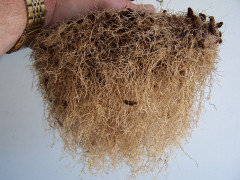
    The other reason to root prune is to remove inessential older roots that take up space that could otherwise be colonized by much finer roots, which do nearly all of the plant's heavy lifting. The root system seen below has many times the potential to produce superior plant than a root system with 3/4 of the root mass serving no purpose other than plumbing, and the only roots particularly important for that purpose are those directly attached to the base of the trunk. We really don't need, or want a pot full of large roots to keep the plant anchored to the pot. Fine roots are able to perform that job just fine in container culture, so the larger the % of fine roots in the total root mass, the greater the plant's opportunity to realize a larger fraction of its genetic potential.

    Finally, like branches, the tendency of roots is to grow ever longer. Pruning those roots reliably forces lateral rooting proximal to the pruning cut by the same mechanism which forces lateral branching after pruning or pinching.

    Al

  • 5 years ago

    I was busy with other things. Hope life has been good to you. : )

  • 5 years ago

    @Mary Gold - It doesn't hurt my feelings if you think what I offered is too long and you didn't feel like investing or wasting time in reading it. I wrote it for anyone who might take the time to read it now or when they find it in a future search, with hope it might serve as another piece of their growing puzzle cemented in place. If that's not you, I can live with it. The folks I concentrate on reaching, are reluctant to rely on being spoon fed the 10 second blurbs that today serve as a primary source of information. But hey, whatever gets your marshmallows toasty.

    Al

  • 5 years ago

    Al, Thank you. That is a very thorough explanation.

  • 5 years ago
    last modified: 5 years ago

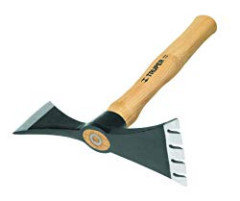
    Thanks ..... appreciate the kind words. As others have noted, not all plants are best served by the same 'bare-root, root prune, change the grow medium' procedure, but no plant appreciates being grown tight (under rootbound conditions). Many plants are best divided to resolve root congestion; and, some can be chopped into segments with a hatchet or hand mattock (a very useful tool in the garden)


    without fanfare and the divisions potted up or planted out as the case might be. If ever you need to divide a very congested planting, new starts harvested from around the perimeter of the root mass will be more vigorous than those in the center as they will have had less competition for resources. Best luck to you!

    Al

  • 5 years ago

    Tapla, your efforts are certainly appreciated

  • 5 years ago
    last modified: 5 years ago

    Tapla, I always enjoy reading your thorough responses. It reflects the depth of your knowledge on the matter. I really learn a lot from you. That is very much appreciated.

    On a side note, I am happy to hear the term ’ontogenetic’ used outside of the realm of neurologic rehabilitation. :-)

  • 5 years ago

    My internal monologue whilst repotting: Oh, wtf are you doing with all that? Your roots look like someone's 20-strand clump of hair 2 meters long, trying to cover up a balding head. Well, off with you. Gross. Hmm..lots of dead roots and no biota to break it down. Off with you! ......Aaaand, tight pot. Do I have a bigger pot? I don't remember. How will I have to move you guys around in the basement this winter if I move you up to a larger pot? Well, $crew that, you're going back in. Snipsnipsnip. There. In you go. Get over it.

  • 5 years ago

    Aloe Polyphylla Spiral Aloe seedlings. I grew them and sent some out to people and told them 'What ever you do, do not disturb the roots when re-planting'. Well seems they never listen. Their potting soil was better than my humus mix and all died weeks later. I find the same with my Red Leaf Peach Tree seedlings. Must keep the root ball intact. No plant likes their root ball cut but most respond well afterwards. After cutting roots, must give the plant a resting place in cool shade to recover and the roots to repair themselves to take up water again.

    One other plant that I have never seen recover from roots being disturbed is Butterfly weed. Asclepias tuberosa.

    Many times it drives Sansevieria into it's juvenile stage when pups are removed too soon or if roots are cut apart too deeply. Following new growth will resume normal growth.

  • 5 years ago

    I appreciate Al's wordy responses and articles

  • 5 years ago

    I've been doing what I can to help others get more from their growing experience here and in the mid-Michican gardening community for a very long time. I don't have a "boiled-down ruleset" because I don't have a boiled down mind-set, and because of that, I'm quite used to having shots fired over my bow for my wordy responses. Fortunately the responses and especially the outreach I get from fora participants and the people I am trying to help, allow me to disregard that type of criticism w/o a second thought. So while it's true I might find pleasure in someone's approval, it is certain their disapproval will not deter me from the course that has served me and others well for so long.

    I hope everyone has a safe and enjoyable weekend.

    Al

  • 5 years ago

    Mary, apparently you're conflating tapla's generous educational contributions with pretentiousness and sesquipedalian loquaciousness.

  • 5 years ago

    Worth mentioning that the topic at hand is specifically "whats happening with the plant that whacking the roots off encourages growth?" I'm not sure why you would expect a boiled-down ruleset considering nobody had asked for one. Al's post addressed the question perfectly, and I learned a lot from it.

    I had some strawberry plants to repot yesterday that had stayed in their pots a bit too long (probably why they were so cheap). I pruned off a good amount of roots and they seem pretty happy today. My guava tree on the other hand is sulking a bit, hopefully he'll perk up soon.

  • 5 years ago

    😅

    👏🏽👏🏽👏🏽👏🏽👏🏽👏🏽

  • 5 years ago

    Several times now, I have considered -- and then reconsidered -- posting on this thread because it has become contentious and unpleasant when it should not have been. Al wants to educate, but is long-winded about it. Some people want the long version. Mary Gold wants the abridged version. I can understand that. I do too. And then, people seem eager to pick sides and find fault....and out come the snipey, snotty disagreements I'm not interested in. I find the whole thing silly. So, here's my contribution, for what it's worth.


    I usually root prune when I repot, mostly to get the rootball into the size pot I have deemed appropriate for that plant's next yearor two or three of life. There's no science or education to my method. I'm old, I've been growing plants for 45 years. I do it by the seat of my pants. It's a HOBBY, not the center of OCD. I know what I've got, I know what I want, and I root prune to make it so.


    That said, the post I love here the MOST is Pagan's from 3 or 4 days ago. LOVE IT. I think it's the best one here! His ending is priceless: "Snipsnipsnip. There. In you go. Get over it." Thank you Pagan!

  • 5 years ago

    I don't have a problem with wanting some practical rules, of course the goal in the end is to be able to apply this knowledge. Mary just came off a bit dismissive imo, then proceeded to insult Al in half of the posts that followed which brought out some understandable defensiveness. I agree though that there are much more interesting things we could be talking about.

    So far the advice seems to be root pruning is generally helpful and doing it when repotting is a good rule so let's flip it around: when wouldn't you root prune and why? Are there some plants that are extra sensitive?

  • 5 years ago

    Well, At least it liven up this forum some what. Take it for what it is. Don't add nothing to any comment from anyone. No big words from me. I'm lucky to have made it thru high school. But, like Robin said, seems like high school all over again.

    The sign of an smart person is one who tells something as simply as possible. I'm not impressed with all the big (25 cent) words being used here to show off.

    I am old and been playing with plants most of my life. When I quit enjoying it, then I'll move on to some thing else.

    Boy did we get way off subject. Sorry Rob. Hope you learned some thing about root pruning.

  • 5 years ago

    That is great news Manuel. Just think what you could have attained with a proper education? Shame but very good for you. Same with my aunt. She self taught herself and became a professional seamstress with only first grade education. Back in the old days, they didn't think it necessary to learn much when you could get a job early at age 8.

    English was always my worse subject. Math and science was my strong points. Did me well in electronics.

  • 5 years ago
    last modified: 5 years ago

    Just musing - not a call to war: I have often complimented those whose enthusiasm and perceived need for knowledge underlie their determination to become more proficient at the science of growing things. Manuel and those who share the attitude he expressed are actually the stars of the show here at Houzz/GW. Manuel WANTs to learn and is willing to ask questions to get at the heart of any matter that needs resolution or represents another piece of the puzzle. People like him are practically assured of continued successes and greater proficiency, in part because it's much more fun to help someone with a good attitude and boundless enthusiasm. .... not so much fun to try pushing someone up a rope when they aren't willing to climb. It's not difficult to figure out where people stand in terms of what I just described.

    I have also noted those who feel entitled to answers in their favorite format and show an unwillingness to even dip their toe into anything that sounds like science tend to remain on the crowded path to mediocrity, albeit with company. Many who fit that category care little about the whys and wherefores, and are more interested in hearing one of two things 1) confirmation of their biases or 2) the easiest path. Very often, the full solution is put before their eyes, and very often by a number of fora contributors, yet what's very often chosen is the easiest path.

    Any who believe growing is not a science, or perhaps more rightly a collection of sciences, puts themselves at a disadvantage; and, there is no judgment in that statement. How people order their priorities is their business, but that does not change the fact that the more we know about how plants work and the science of caring for them, the less time we'll be required to spend on the journey to a green thumb.

    Big words .......... since I was a child, every time I've encountered one I don't know the meaning of, I looked at it as a learning opportunity and looked it up, which does expand one's vocabulary. "I don't want to waste time learning something new" or "I don't care enough about the topic to make the effort to find out what (s)he's talking about" both ring hollow to me when it comes to reasons for not looking something up, but still, no judgment because I have no interest in changing anyone's priorities. I don't use big words to impress anyone; rather, I use appropriate nomenclature because it eliminates confusion, it provides a learning opportunity for others, and using appropriate nomenclature in searches gets right at the heart of things. As I mentally compare the quality of the search results someone might get when searching leaf axil instead of leaf crotch, rhizosphere instead of root zone, root primordia instead of root nubs, palmate leaf instead of leaf like a maple tree, photosynthate instead of plant food ..... I can't help but conclude using appropriate nomenclature provides a better opportunity when the word is first read, even if it must be looked up, and, when it is looked up in order to expand on it's meaning. I have mentioned several times how much I learn when I look something up to confirm what I'm about to post is accurate. It should follow that others would also be afforded the same opportunity if they also look up words unclear to them.

    The earlier reference to big words in my original post, this thread, had me wondering about what big words I might have used. When I reviewed my offering, I found it interesting there were no words that might be considered part of botanical nomenclature or not to be part of any teen to adult's vocabulary, the meaning of which were not made perfectly clear by way of both explanation and/or context.

    Al

  • 5 years ago

    Al, danged if you don’t sound like a teacher! Reminds me of when I was a kid and would ask my parents or teacher what something meant. Their reply? ”Look it up”, as they sent me off to the dictionary. I’m still in the habit of doing that today & I tell my grandchildren the same thing.

  • 5 years ago
    last modified: 5 years ago

    SC - I'm often asked if I am/was a teacher.

    I know how difficult it was to come by what knowledge I gleaned from texts before the internet was a thing. Today, the internet makes learning valuable lessons about growing things much easier, and I enjoy helping others get more from their growing experience as natural extension of my own learning experience, passing on the bits of knowledge proven most useful to me in practical application ..... and I've had a good amount of that.

    I think some might find it offensive when I assume the role of teacher, but I feel like I have much to share, and I'm always willing to explain anything I say, in detail, whenever I'm questioned. Providing details and context also helps to limit someone's ability to challenge the actual information provided, which one would think would be the focus. I don't care if someone challenges the manner in which the information was presented as that's just white noise. We all have equal opportunity to share our opinions and what we know, to put ourselves 'out there' by providing very specific information w/o built-in loopholes that allow an easy escape when information provided is questioned. Fortunately all opinions are not created equal, and it's how well we defend or support our opinions that allows others to decide how meritorious they might be.

    There's a right way and a wrong way to do everything, and the wrong way is to keep trying to make everybody else do it the right way.

    Al

  • 5 years ago

    So, are there any plants that DON'T benefit from having their roots pruned?

  • 5 years ago
    last modified: 5 years ago

    First, it's important to be sure we're looking at things from the plant's perspective, so we're judging the best course based on the plant's ability to maximize the gift of genetic potential endowed by Mother Nature. Al might posit that terra cotta pots are best for plants because of the superior gas exchange they afford, while Alice disagrees because clay pots are too heavy and ugly. From the perspective of what's best for the plant, the claims Alice made is moot, even though they form the basis for her decision. Heavy and ugly have nothing to do with how the pots perform.

    Getting back to the question - if we're trapped in the prison of only 2 ideas, so our only choices are to root prune or not root prune terrestrial plants and just let nature take it's course, the answer would be no, with the qualifier that there might be some plants in certain categories (carnivorous, cacti, truly exotic one-of-a-kind plants, ....) I know nothing of that are claimed unable to be repotted. That claim, however does not make it true. I've been told that palms can't be repotted, but I've repotted several with no problem. Other plants have been said to have very sensitive root systems and will suffer severe damage or death if repotted, and I've had no problem with those either, so I don't put much stock in what I hear floating about.

    If we broaden your question to we're comparing a full repot with root pruning vs potting up vs making divisions of some plants when they become rootbound, we have a whole new conversation.

    Dividing plants that lend themselves to being divided would be on a more or less equal footing with repotting if the divisions were taken such that all limitations associated with root congestion are eliminated, because that's what a full repot does. IOW, if you start with a 5 gallon bucket so jammed full of roots of Aspidistra elatior, Spathiphyllum, Protasparagus densiflorus, Sansevieria, Boston fern (I forget its binomial name), and simply chop the root mass into 2 or 4 pieces and pot those up, it would be more like potting up and a good measure of of the limitation imposed by root congestion would remain. If you were to make several single divisions, the result would be essentially the same as repotting. So there are many plants that are easier to divide than repot, and if you break the divisions down into single plants, the results should be equal.

    Potting up regularly can be a method of dealing with root congestion as long as the subject plant is potted up before the root/soil mass can be lifted from the pot intact. Once the planting has been allowed to get to that stage, nothing will eliminate all limitations imposed by root congestion other than a human being getting his/her hands into the root mass to correct congestion and make room for a larger mass of the fine roots which do all the plant's heavy lifting. Potting up doesn't stimulate a growth spurt, as one might think, it simply allows the plant to perform a little closer to it's potential in terms of growth rate. Since that's an improvement, it's almost universally looked upon as a growth spurt when in reality the plant could have been growing even better all along had it been repotted at appropriate intervals.

    The funny thing about a plant's potential is, once lost there is no reclaiming it, it's lost forever.

    Al