Software
Houzz Logo Print
webuser_379761195

water propagating white stuff?

5 years ago
last modified: 5 years ago

Hi,
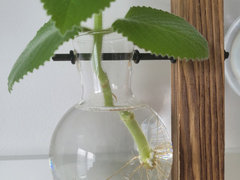
I'm water propagating my oregano and the roots are looking healthy but I don't know what this white stuff at the base is? I'm a newbie :)

Comments (10)

  • 5 years ago

    hope you intended a pic and forgot.. because i dont understand what you mean ...


    if it has any root at all.. then why not pot it up .. no need to grow long water roots which will end up hard to plant in a pot later ...


    ken

  • 5 years ago


    Oops I thought the photo was just taking long to load. Here it is. I was waiting for the roots to grow to pot it.

  • 5 years ago

    Could be mold. Could be root primordia. Either way ignore it and pot your cutting up into a proper mix and get it out of the water. Btw your plant is Lippia graveolens, Mexican Oregano, rather Origanum vulgare, true Oregano. They're in different plant families.

    HU-379761195 thanked floral_uk z.8/9 SW UK
  • 5 years ago

    imo... it should have been potted in damp media.. when those roots were about a quarter inch long .... now you are going to have to figure out how to wind all those roots into media ... and good luck with that ...


    so.. plant it ... and take a new cutting from the top ... and propagate it in media this time ... and if this stuff that worries you kills the first.. well.. the next will be on the way ...


    cutting the top.. will cause dormant buds below to trigger growth.. and give you a stouter plant ..you dont need height.. you want volume ...with herbs anyway ...


    did you use sterilized water??? ... doing so.. would insure the water didnt introduce something into the rooting vase ... and bleach out the vase after each use ... just put a teaspoon or so in it.. add some water. .and swish it around .. you dont have to go all autoclave on it.. but a little prevention never hurts [and is worth a pound of cure] .. and well im at it.. always sterilize you potting media also ... see link below ...


    the rooting vase and system looks fun.. bet you are learning a lot ...


    ken


    https://tipnut.com/sterilize-soil/

  • 5 years ago

    Thank you Floral_UK I had no idea it was a Mexican oregano...I thought it was a Cuban😊. Glad to know it's a true oregano.

    Thank you Ken! I will sterilize next time. I wasn't sure how long to let the roots grow lol. I potted it up and it was tricky...I will cut it shorter next time for sure. I can see the height being a problem with the leaves being so heavy.

    I hope it's a calluses and not mold Tapla or something natural. Everyone in here is so informative😊 thank you! I have lots of learning to do.

  • 5 years ago

    ..... best not to confuse yourself by comparing the calluses we get on our hands and feet to the callus tissue plants naturally form in response to wounding. This tissue is indeed natural and normal, and occurs after wounding whether or not it forms on above-ground plant parts or on parts submerged in water. It's more conspicuous when it forms in water because it's white, and people are always scoping out their cuttings with the hope of seeing roots. When instead they see the callus tissue forming, something they might be unfamiliar with and which looks like it might be something other than benign, it causes curiosity or mild concern. The reason it's white when it forms in water is because the water dilutes the tannin which gives the tissue its brown color when it grows on plants' above-ground parts.

    You said you have a lot to learn .....

    About Learning

    Some people are perfectly content, growing in/with whatever is easiest, and simply can't understand all the fuss when they feel what they do 'works for them'. I look at growing in containers like a journey up a mountain, with millions of people on the same path. The way-points represent our abilities, knowledge, and our level of understanding. We all travel at different speeds, but some, in their hurry to get to the crest, pass way-point after way-point, leaving behind those content to check in for an extended stay in the foothills.

    Some people have scoffed and asked what good all the reading and studying will do. They think experience is the most important component, but I can tell you it isn't. When you're learning - you're on the right path. What good is 20 years of experience if you do the same thing over and over? What if you're doing something wrong - or there is a better way? Isn't that 20 years of experience wasted?

    More times than I can possibly count, I have seen advice to do this or that, yet it makes no sense from a scientific perspective. In the same vein, observations made that attribute an effect to an impossible cause are extremely common. The more pieces of the puzzle we have to work with, the easier it is to see the big picture clearly, which is why learning is so beneficial to increasing our effort:reward ratio.

    I think though, that the most important aspect of accumulating knowledge lies in our ability to accurately validate our observations. Growers who have taken the time to understand the 'whys' behind what makes plants grow well can make observations within the limits of what science allows, instead of making up science to fit their observations. This gives folks who really want to learn and understand, a great advantage over those taking a more laissez faire (literally: leave things alone) approach. You'll be able to resolve issues by accurate assessment, instead of guesswork; and you'll be able to eliminate most of the trial and error associated with those that rely on experience only. Your experience(s) will become validation(s) of your storehouse of knowledge, instead of becoming your source of knowledge. Why is this a better arrangement? Because the more you know, the more difficult it is to assume in error, and the easier it is to winnow possibilities to get to the probabilities.

    I applaud you and everyone else making an individual effort to learn about growing in containers and expand their understanding.

    Al

  • 5 years ago

    You're right. I’ve looked again and I do think it’s Cuban, not Mexican, Oregano. Plectranthus amboinicus. But still not a ‘true’ Oregano which wouod be an Origanum species.

  • 5 years ago

    I saw some photos of a Mexican that looks like mine too but with so many varieties I can see how easy it would be to mix these up.


    As for experience...when I first started buying plants years ago, it was more for decor and I had that mindset of just having them in the background and watering/giving some sun. I didn't understand why my plants were dying off quickly.


    My approach has changed soo much since. Now I buy each plant with intention. Wanting to learn about it and observe them every morning and through out the day for changes. Understanding the lighting/humidity/temperature/soil they each individually like and trying to acclimate them to my environment to some extent. Seeing new growth always makes my day. Hoyas have become my favorite plant of the moment to study. I do agree experience will get you somewhere but studying and researching will get you further.

  • 5 years ago

    I'm not sure it's amboinicus, which has very thick leaves that snap instead of bending, but agree that it's a Plectranthus. Possibly argentatus, which has soft fuzzy bendable leaves.


Sponsored
Peabody Landscape Group
Average rating: 3.5 out of 5 stars8 Reviews
Columbus' Reliable Landscape Design & Contracting