Software
Houzz Logo Print
aspen75

Range hood sizing

5 years ago
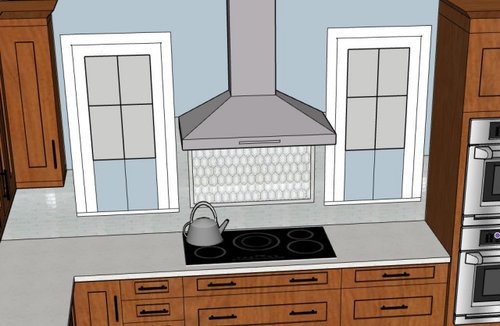
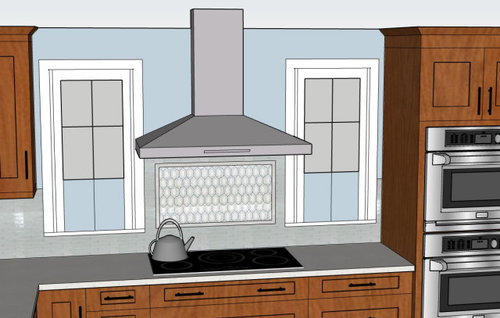
Made a mistake (don't need beratement over that) and seeking opinions about best way to proceed. Mistake was sticking with a 36" hood over a 36" induction cooktop in new kitchen...I knew it should be bigger but that messed with too many things in my kitchen design :P So I chose form over function, which is probably a wrong move with a kitchen/great room and a family who cooks a lot and now I'm rethinking...cabinets already a done deal. Anyway, can't upsize it without having to notch out window trim on flanking decorative windows (bummer). Choice is either doing that notching to fit a 42" range hood, or getting a more expensive, uber powerful 36" hood. I started out thinking NO WAY would I notch that window trim and disrupt the looks, but we cook a lot and I don't want the great room smelling like fried chicken or stir fry all the time :P Maybe I should do it. Or, would a really powerful 36" be adequate over Wolf 36" induction? Would value advice! TY!


1st picture 36", 2nd picture 42" running into window trim.


Comments (7)

  • PRO
    5 years ago

    IMo sometimes it is just not practical to do an oversized hood but I just up the CFM and have found that works well even with gas so IMO up the CFMs and leave all the rest alone. Make sure to turn the hood on before you start cooking and let it run for few minutes after wards that also helps .

    aspen75 thanked Patricia Colwell Consulting
  • 5 years ago

    Increasing CFM's will generally have little effect. Hot rising effluent goes where it wants and it takes an enormous amount of airflow (think 4,000 rather than 800) to change that even just a little bit. That's why the capture area (open area at the bottom of the hood) and containment volume (empty space inside the hood to contain effluent until it can be exhausted) are so critical.

    With many consumer hoods increased CFM also usually means significantlly increased noise and that often results in people not using their exhuast hoods when they should.

    Depending on your styles of cooking, how often, and how important your families health is...

    If wider is not possible then focus on; 1) Deeper, 2) Containment volume, 3) An inline blower w/ silencer so that you get what CFM's you can as quietly as possible.

    A commercial liner (30"x30" opening) with plenty of containment area would be best. Short of that maybe consider a Wolf hood liner w/ a silencer + inline blower.


    aspen75 thanked opaone
  • 5 years ago

    That was my idea too. Do drywall returns with the backsplash wrapping into it and it will look like that was the plan all along.

  • 5 years ago
    last modified: 5 years ago

    I don't think it's so terrible to have a 36" hood over a 36" induction cooktop. I would not agonize over it the way you seem to be. And I would not jump through hoops like notching out or eliminating window trim. To me, the depth of the hood front-to-back is more key than the hood width being wider than the cooktop. With the 36" hood you get entire coverage of the 36" cooktop from side to side, but if the depth is too shallow, the front burners may not be covered by the hood. Typically induction cooktops in the counter are 24" or so deep. If the hood is, say, 19" deep, you are not getting coverage of your front burners. If you install a 42" hood that is still too shallow, you aren't really bettering your current situation.

  • 5 years ago
    last modified: 5 years ago

    Another possibility is to use a 42 inch island hood spaced a tad out from the window trim. Given the shape of, e.g., the Wolf Pro Island hood, plume portions rising along the back wall will meet hood edge flow and I think mostly be drawn into the hood entry aperture and thence the baffles. This is easier achieved with your induction cooktop with its lack of gas combustion plume enhancement.

    Island hoods also provide improved depth (front-to-back). Even with drywall returns an island hood could be used to good visual effect. See page 154 of https://www.subzero-wolf.com/-/media/files/united-states/product-downloads/sub-zero-wolf/design-guides/wolf-design-guide.pdf. See a bottom view of my 66-inch long Wolf Pro Island hood in this thread: https://www.houzz.com/discussions/5934150/ceiling-mounted-vent-hood-4-feet-above-cooktop#n=40. Note rails are optional. I would then run the tile higher per opinions of the Kitchen forum, and window frame to window frame. Some window cleaning will be needed in any case.

    A commercial hood (providing depth improvement) could also work and fit to the 36-inch gap, or whatever was possible from a drywall return configuration.

    For the 42-inch island hood, you should be able to operate with 2/3 what I use, which would be 2/3 of 1500 CFM or a 1000 CFM rated roof blower, or equivalent in-line blower. I also have a Fantech silencer in my duct.

  • 5 years ago

    I'd use 10-inch duct in this case unless there was an architectural impediment. How far from the wall is the back edge of your induction cooktop?