Software
Houzz Logo Print
heatheramartin

Fiddle Leaf Fig Care

5 years ago
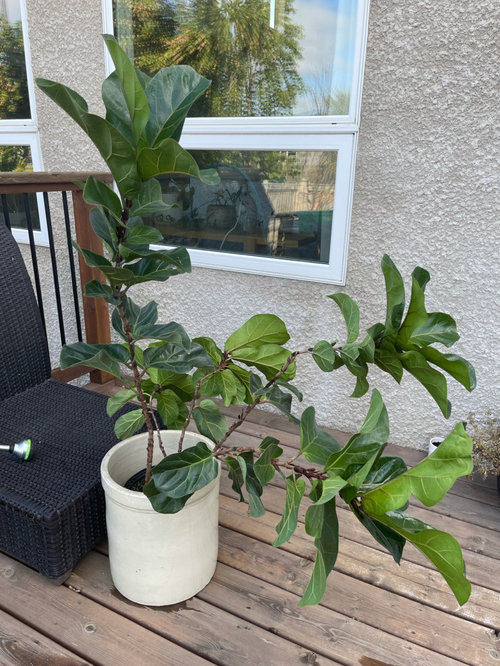
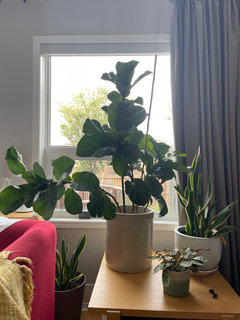
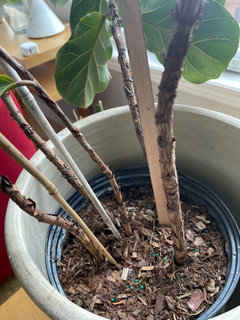
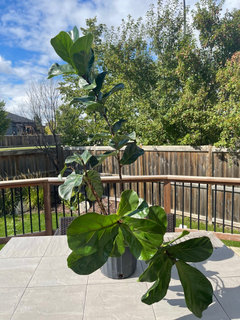
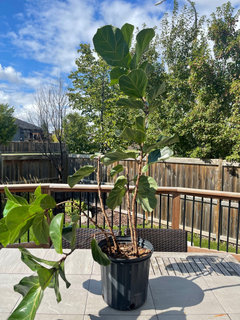
Hello. I have mostly smaller house plants but I got this FLF a couple years ago. It’s been growing steadily all along, but this summer it dropped a bunch of older leaves and then have a growth spurt. I’ve never pruned or replanted it. There are 5 stems. One is quite strong. Two aren’t far be behind it and the other two are quite thin. I’ve been staking it to keep it upright. Should I braid the stems? Should I prune it. Repot separately? I’m really out of my element with a plant at this stage. Help? Any advice it welcome.

I live in central Canada.

Comments (25)

  • 5 years ago

    much to late to braid ...


    why is it in the white bucket?


    i presume in tropical canada.. it spends winter in the house???


    id probably propagate small bits of the growth ends ... and get rid of the rest... basically start over ...


    but as an experiment... while those are rooting.. i would cut back the big plant to straight stout trunks.. and see if it releafs down lower... a sort of rejuvenation pruning ...


    regardless.. by next spring... i would have some new plants ... and probably a few to gift away ....


    ken


    https://duckduckgo.com/?q=Fiddle+Leaf+Fig+propagation&t=ffcm&iax=videos&ia=videos

  • 5 years ago

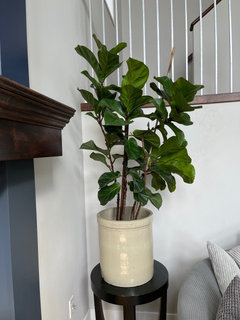
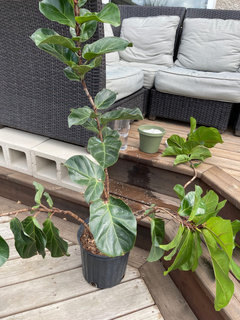
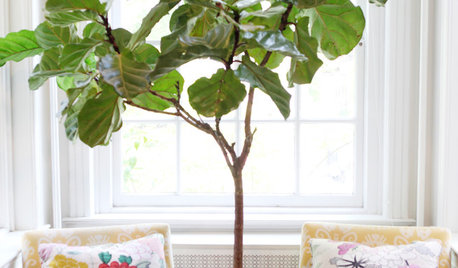
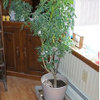
    It lives inside. I attached a picture of it where it usually lives. I restated it.

    I take it outside to water it in the summer. I leave it out there for the day once and a while because I read that time outside with the breeze might help. The ‘white bucket’ is a big ceramic crock I use as an putter pot.

    Starting over sounds scary. Not sure where to begin.

  • 5 years ago

    That a FLF cannot support itself is a clear indication it wants/needs more light. An increase in light energy striking the leaves leads to a more abundant food supply; this, because the plant uses hydrogen from water, carbon dioxide from the air, and light energy to create glucose, a sugar/carbohydrate which is the plant's actual food. In most cases, more light energy = more food (up to a certain point where too much light becomes counterproductive).

    Many if not most hobby growers feel a sense of obligation to leave all growth produced by the plant, on the plant. Possibly, this feeling originates in the fact that many growers are unsure of what happens if/ when a plant is pruned, or the grower might have settled on the fact that growth is a measure of success. It would be better if the grower focused on the plant's vitality (health) and eye appeal. If the plant is kept healthy, it will be producing more food/energy than it is using, which results in additive and multiplicative growth (thickening and extension of branches + more leaves and branches. Making health and eye appeal your goal frees you to remove any growth that spoils the appearance of the plant or is not in the best interest of the plant to retain.

    A slender branch 3 ft long is far easier to bend than a branch of the same thickness only 1 ft long. The trunks of your trees are the same. By shortening the trunks, you make them stiffer and more resistant to bending. If you can't give your plant enough light to ensure it's self supporting, the best remedy is regular shortening. Done correctly, you can even change the direction of the trunk(s) to better fit whatever you have envisioned as the end composition. Pruning regularly also ensures a much greater leaf/branch density (ramification).

    Should I braid the stems? Probably not a good idea to try. Being a bonsai practitioner (nearly 40 years) I do a lot of serious manipulation of trees, and I can't really see a good outcome should you try to braid or plait the trunks. Should I prune it. If I get a vote, I vote yes, and I can walk you through the process if you're willing to have a little faith. I currently care for no fewer than 30 Ficus trees in pots, some of which are older than 30 years. Repot separately? That is an option, but the best time to do heavy work like seriously hard pruning and repotting, is in June for those living in the Northern Hemisphere, December in the SH. I’m really out of my element with a plant at this stage. That's an oft heard admission from many of the members who arrived here looking for help. I'm going to link you to another thread in which I'm talking to Lisa about her FLF, its care, and the prospect of pruning. I've provided some images in that thread that should give you a better feel for whether or not you want to put any trust in me. I'll watch for your reply.

    Click me to go to the thread Al referred to.

    Al

  • 5 years ago

    Thank you for your response. My interest lies in keeping the plant healthy…even if that means drastic pruning. I just have no idea how. My goal for the plant is that it’s strong…I would love for it to look like a tree but it’s clear it needs to get much stronger for that to happen.

    I read through the linked conversation with Lisa. You are obviously very knowledgeable and your guidance is appreciated. She and I have different issues but I understand from your explanation how cutting the plant down would be a benefit in both scenarios.

    Should I move the plant closer to the window and wait for Spring to prune and/or repot?

    My window has west exposure and though it gets very very cold here, the city I live in has more sunny days on average that California. Right now the plant lives about 13 feet from the window.

    It’s never been repotted and it has 5 stems. I have had it for nearly 3 years.

    Your guidance is appreciated.

  • 5 years ago

    I'm just musing here, not being critical of you, Heather. Tree time and people time are different. If someone is impatient and wants an immediate reward for their efforts, unless they are pruning an already refined tree, it's not likely to happen. Actually, the tendency to look for immediate results very often ends up being counterproductive to the goal of an eye-appealing (tree) composition because the tendency is to sacrifice the long term appearance of the tree on the altar of the immediate. Example: The best way to approach the weakness of your tree's stems/trunks is to shorten them regularly. When you see a trunk leaning, shorten it.

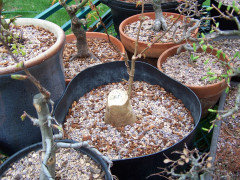
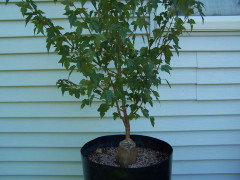
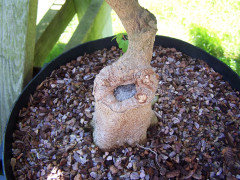
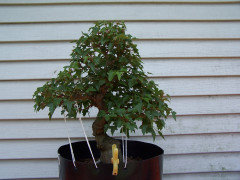
    I shorten my trees all the time, even though they are always self supporting. The reason I shorten them repeatedly is to induce a rapidly tapering trunk, which adds to the feeling of great age, which is a major plus for a bonsai. Below/middle is a tree (big white scar) that was 7-8 feet tall when I chopped it back to about 3 inches tall.

    By the time I chopped the tree back ^^^, the existing branch with the wire attached had long been planned as the plant's new trunkline.


    Tree growing nicely after the chop ^^^ and no ill effects.

    Here you see the same tree ^^^, wound is healing, new trunk above the wound is thickening, and another chop has been performed at the elbow where the new trunk takes a turn to the left.


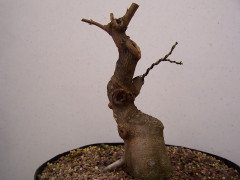
    This is the dormant tree a couple of years later after a hard spring pruning. At least 4 hard chops have been performed to produce the taper in the trunk.

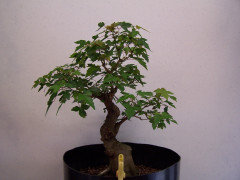
    After a bit more time/work ^^^


    Most recent image. ^^^

    Darn! I just realized I posted a number of these images on Lisa's thread.

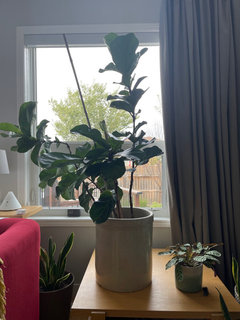
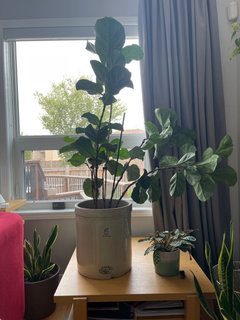
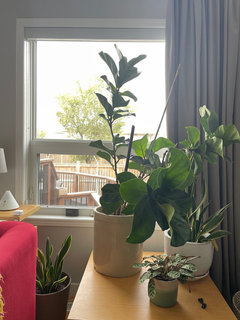
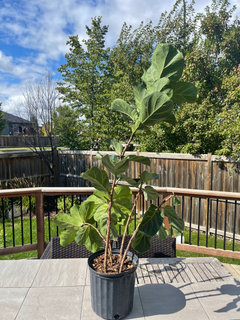
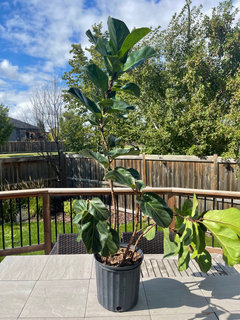
    If you want to go ahead and prune, please take 4 images showing the tree after rotating it 90*, so there will be a view from each compass point (N, S, E, W). The reason for the images is, I can't get a sense of depth from a 2D image, and depth is important to how the tree should be treated insofar as pruning goes.

    Should I move the plant closer to the window and wait for Spring to prune and/or repot? Your call. I would move it quite close to the window, but do it gradually. Once acclimated to the increased light load, the tree is more apt to react to a heat build-up in the leaves than light load, so you might want to put a fan on a timer during the summer so it operates while the plant is in direct afternoon sun.

    Early spring is the worst time to repot because the plant's energy reserves will be at the lowest point in the growth cycle. If you associate Father's Day or the Summer Solstice with the appropriate time to repot almost all commonly grown houseplants, it'll be hard to go wrong. If you don't view this as an emergency, and there is no real reason you should, waiting until next June would be the best plan. If you're serious about honing your skills, that would give you plenty of time to decide what you'll use as a grow medium, which will likely have the most significant impact on what kind of success you can expect.

    Right now the plant lives about 13 feet from the window. Useful info:Light intensity diminishes by the square of the distance from the source, so light levels at the window are 100X brighter than at 10 ft from it.

    Al

  • 5 years ago

    I am patient. Not looking for a quick fix. I just want to do what is best for this tree.

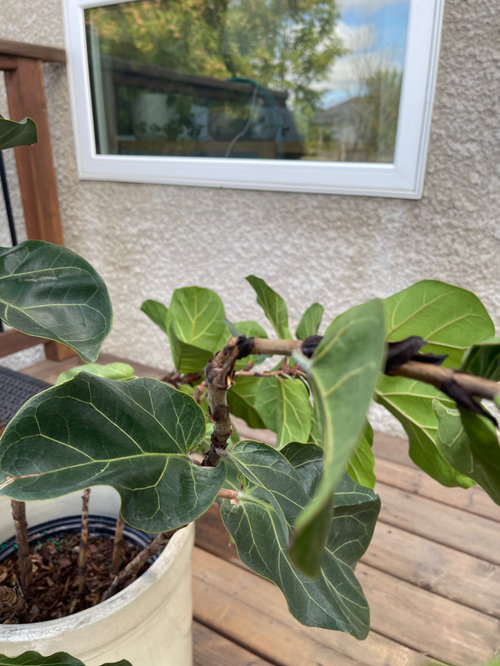
    I moved it closer to the window. It’s partly cloud and/or rainy for the next 4 days so I though it would be a good time to acclimate it. Below are the images you asked for. If they don’t give you this info you need…please advise I can take more.

  • 5 years ago

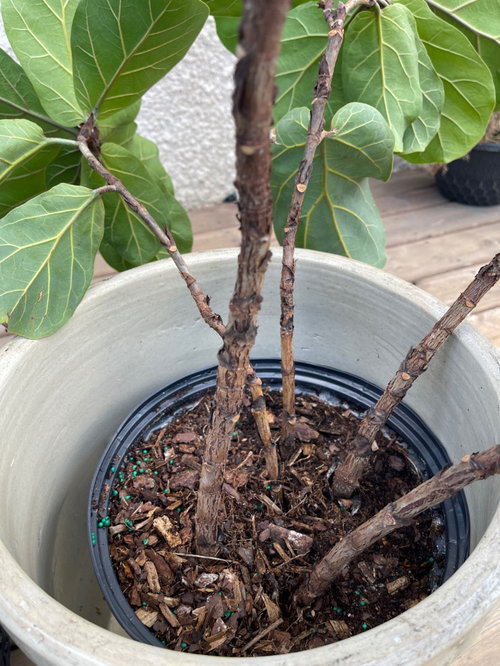
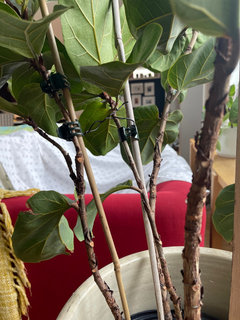
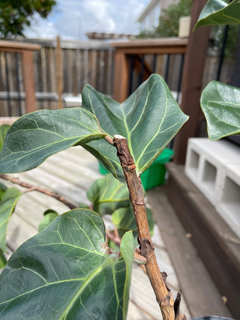
    Here are some close ups of the trunks.

  • 5 years ago

    The tallest on does not currently need any support.

  • 5 years ago

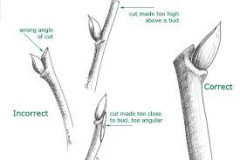
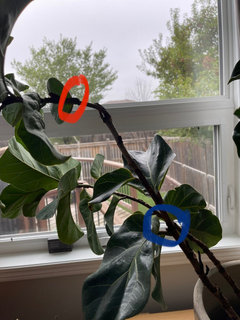
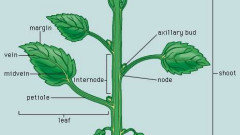
    Let's first tackle the 2 long stems which aren't self supporting. One of the long stems has an elbow where a branch was severed long ago. The other sort of lays over in a fairly smooth arc. Make a pruning cut on the stem with the elbow immediately above the first leaf proximal to (below) the elbow. Follow the image below, but instead of a bud there will be a leaf.

    Then, make a pruning cut on the stem with the smooth arc as follows. Starting from the soil line, follow the stem to the first leaf growing from the top of the stem and make a pruning cut immediately distal to (above) that leaf. After that, please provide an additional set of images. As noted, it's very difficult to get a sense of depth from looking at the images and I don't want to be haphazard with someone else's tree.

    Next we'll prune or remove the 2 smallest branches followed by determining what ht would look best for the main stem for the short term.

    Al

  • 5 years ago

    I plan to tackle this today. I have a couple questions first. Starting with the elbow stem…do you mean the first leach after the elbow (red circle) or the first leaf on the ‘trunk’ (blue circle)

  • 5 years ago

    Also, if I want to propagate the clippings…what medium should I use?

  • 5 years ago

    ...... first leaf proximal to (toward the trunk from) the elbow.


    Screened perlite.


    Sorry I wasn't around. I canned 4 bu/ 121 qts of tomatoes today starting at 5AM. TG for air conditioning.

    Al

  • 5 years ago

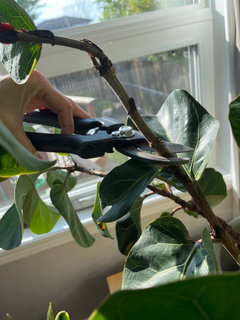
    I just want to be sure I’m understanding your instructions…see photo to reference where I think you want me to cut…

  • 5 years ago

    And thanks…that’s a whole lot of tomatoes. You must be wiped.

  • 5 years ago

    That's the right place ...... and it was a long day. TG it only has to be done every other year.

    After you prune, you'll take some more images?

    Al

  • 5 years ago

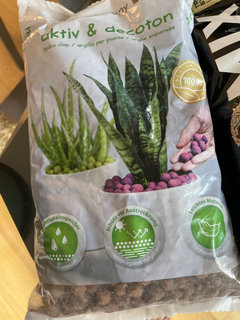
    I don’t want to cut it until I’m ready to deal with the clipping. The garden was out of perlite. They suggested this instead. Hydro clay balls.

  • 5 years ago

    Also do I need rooting hormone?

  • 5 years ago

    New roots need good contact with soil particles, which means the clay balls are too coarse for good results, and water held internally (in the balls' inner pores) is held so tightly it's essentially unavailable to the plant. You would be better off checking with nursery/greenhouse ops for coarse perlite, or using potting soil. The key, if using potting soil, is keeping it moist/damp, never wet/soggy.

    No rooting aids required.

    Al

  • 5 years ago

    Cut made.

  • 5 years ago

    I went for it with the second trunk too. See 4 90 degree pictures attached.

  • 5 years ago

    The tall one is fairly straight, definitely self supporting. It’s a very windy day.

  • 5 years ago

    Strong work!

    The 2 branches still laying over hard should each be pruned back to the most proximal leaf. That would be the leaf closest to the roots.

    There is a point at approximately 2/3 of the planting's ht (from the bottom of the pot) where the trunk is devoid of leaves. I would prune the main stem back by making a pruning cut immediately distal to (above) the top leaf below the gap. That will better unify the stems so they all appear to be part of the same composition.

    You should expect to see new growth occurring in leaf axils and above leaf/bundle scars (scars left where leaves formerly attached to the stems were shed) within a couple of weeks. You'll need to water less frequently than you did before the pruning, and using a "tell" would be the best way to avoid over-watering, which would be your primary concern.

    Questions? If/when you have them, just return to your thread. I'll be sure to see them.

    Al

  • 5 years ago

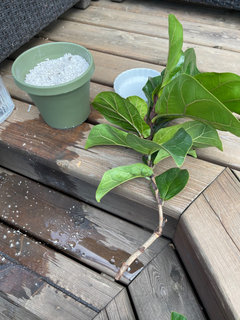
    Thanks so much for your help. Only one more question. I put the clippings in perlite…but they both have lots of leaves. I’ve read that too many leaves and the clippings won’t grow roots. Thoughts? Should I remove leaves?

  • 5 years ago

    Heather - It's difficult for rootless cuttings to move enough water to keep cuttings with large leaf surface exposure hydrated; so to limit excess water loss and prevent total collapse of the propagule, it's good practice to remove leaves or cut them in half I copy pasted the following from Lisa's thread, the one I linked you to in one of my posts upthread. The questions are hers, but the answers should be helpful.

    "Would you recommend that I cut that 4 foot section into smaller sections and try to propagate multiple plants? That would be entirely up to you. Now is a good time to start a cutting, but don't delay. As the days grow shorter, the probability of success will diminish. If so what lengths would be ideal?


    If you want a single trunk, use the top of the stem as the cutting.

    Make your cutting 4 nodes long. The bud at the top node (apex) will continue to grow and become the new trunk.

    Cut straight across the trunk immediately below a node.

    Count up to the 4th node and make an angular cut halfway between the 4th & 5th node. Important: remember the angular cut is the top. It won't root if you get it reversed.

    If there are leaves at the nodes, remove the lower 3 leaves and cut the top leaf in half across the veins.

    Stick the cutting in coarse perlite so the bottom 2 nodes are covered, keep it damp only, out of direct sun and wind.

    Tenting would be helpful.

    And I should not try to root the clippings in water and root them in perlite and peat moss instead? That too, is your call. I don't root anything in water as the roots that form in water differ significantly from roots that form in solid media, and the water roots don't transition well from water to a solid medium.

    ***********************************************************

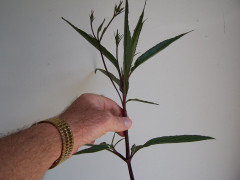
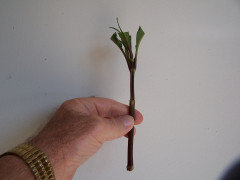
    Heather - you should have 2 nodes in the perlite and 2 nodes above the soil line. Remove the leaf from the proximal (lower) node by simply cutting through the petiole (leaf stem) halfway between the leaf blade (main part of the leaf) and where the leaf attaches to the cutting. Cut 1/2 - 2/3 of the upper leaf off by cutting with a pair of scissors strait across leaf veins (90* to the mid vein). This isn't a Ficus cutting, but it's how I generally prepare my cuttings:

    Ruellia simplex (commonly Mexican petunia):


    Propagule prepared and ready to stick (in propagation medium):

    Al