Software
Houzz Logo Print
hansenli

Hey my fiddle leaf fig lovers!!

5 years ago
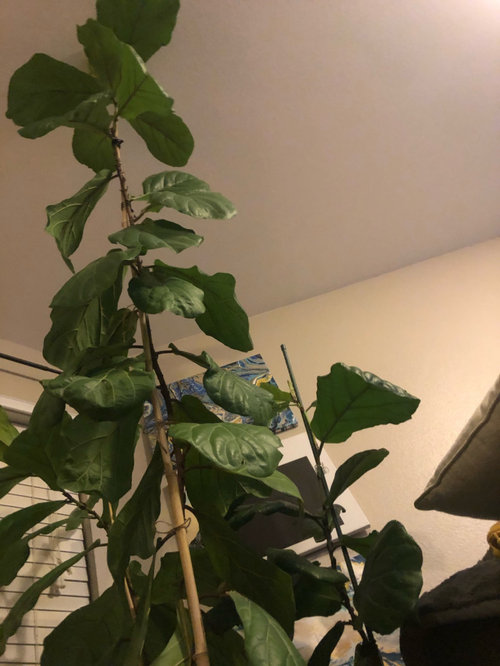
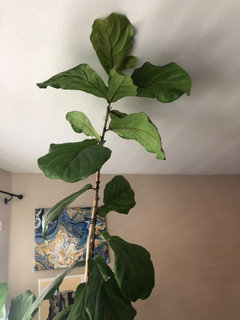
I’m in desperate need of advice on what to do about my super tall fiddle leaf fig! It has gotten so tall it’s leaning on the ceiling. Any ideas of what I can do?? It’s continuing to get taller and taller. Please help!

Comments (16)

  • 5 years ago

    Hi, L.

    ..... need to see how/where it branches to determine what the best pruning strategy will be ....... but you'll need to remove more than 2 ft from the top. Can you provide a couple of shots from different angles?


    Al

  • 5 years ago

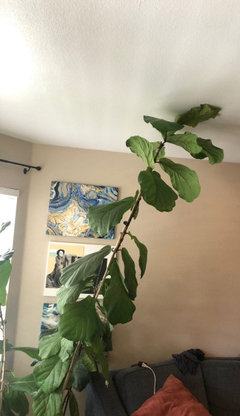
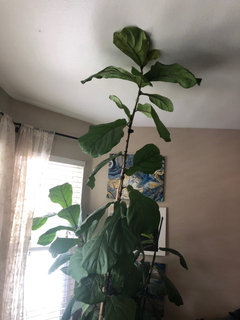
    Are these better angles?? As you can see it’s leaning really badly. The stem is really weak which I don’t know to remedy other than brace it with bamboo. If I do cut it am I able to propagate the clipping? I would like to be able to have all my fiddles branch out instead of having just the one long main stem.

  • 5 years ago

    Also will it continue to grow even if cut?

  • 5 years ago

    I looks like there are no branches on the tree?

    "Growth" is measured by the increase in a tree's dry weight, but I know you're referring to extension growth. It's possible for a tree to show extension growth on several, even all branch, but not be growing in the true sense of the word. This can occur when trees cannibalize then shed existing growth to fuel new extension. A tree can even lose weight.

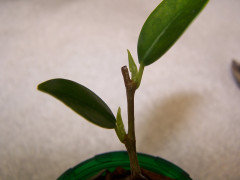
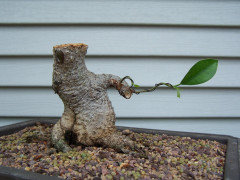
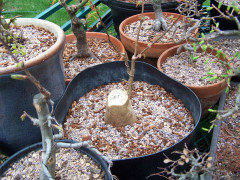
    When branches and trunks grow longer (primary or extension growth), the growth takes place at apices/ apical meristems located at the tips of stems/ branches and is a result of the rapid cell division which occurs there. Subsequent cell elongation for a variety of reasons also contributes, though minimally, to elongation. Once area where elongation occurs is removed (called 'pinching') the branch or stem can no longer elongate - ever. Fortunately, Mother Nature provided a solution in the event the branch tip is destroyed by insects, disease, weather, mechanical injury ....... or pinching/pruning, etc. The following image is a Ficus microcarpa cutting which has rooted. Notice the branch tip has been removed. The stub was left intentionally to ensure the area where I expected new growth would not dry out, and can now be removed. What looks like 2 new leaves in the crotches (axils) formed by the leaf stem and the branch, are actually new branches. This reliably occurs on nearly every species of tree on earth, with only rare exception. IOW, you can count on it as long as your tree is healthy (creating more food from the sun's energy than it needs to compensate for the food burned during respiration).

    These branches 2 new branches will continue to grow and produce leaf after leaf until the plant's chemical messengers inform plant central which leaves (or even an entire branch) is not pulling its weight. At that time, the unfortunate leaf/branch will be shed.

    When you look at the image, you can see the top branch is extending roughly in the same direction as the part that was pinched was extending, so the new branch will serve well as a replacement for the leader you will have removed. You can even provide some mechanical assistance to ensure the new leader grows in the direction you prefer.

    When you cut the tree back, it should be well below the top of the window. It would be best to maintain the tree at a ht no taller than the top of the window. Since you'll need room for the canopy to develop before it tops out at that ht, it would be best to cut back to somewhere around 1/2 - 2/3 of the distance between the floor and top of the window.

    What I would do is, turn the sparse part of the tree toward the light before you prune it. Then, find a leaf that faces away from the light/ toward you and prune immediately above that leaf. A new branch will emerge from the crotch (axil) of the top leaf and others proximal to it, depending on where you live (where DO you live?), when you prune, the tree's vitality level when you prune, and its current ability to create food when you prune. Pruning and moving the plant outdoors, or moving it outdoors asap and pruning later makes the most sense from the plant's perspective, but of course you have veto power.

    Al

  • 5 years ago

    I would prune it at the height that you want your tree to be. Prune 1/4 inch above the point where a leaf stem joins the trunk. If you want to get another fiddle leaf plant, create an air layer instead of just cutting off the top. There are many videos on the Internet about airlayering.

  • 5 years ago

    The pruned pieces with a leaf will probably root in water and can then be potted for new plants. For me that is easier than air-layering.

  • 5 years ago

    Though roots form readily and often seemingly more quickly on many plants propagated in water, the roots produced are quite different from those produced in a soil-like or highly aerated medium (perlite - screened Turface - calcined DE - seed starting mix, e.g.). Physiologically, you will find these roots to be much more brittle than normal roots due to a much higher percentage of aerenchyma (a tissue with a greater percentage of intercellular air spaces than normal parenchyma).

    Aerenchyma tissue is filled with airy compartments. It usually forms in already rooted plants as a result of highly selective cell death and dissolution in the root cortex in response to hypoxic conditions in the rhizosphere (root zone). There are 2 types of aerenchymous tissue. One type is formed by cell differentiation and subsequent collapse, and the other type is formed by cell separation without collapse ( as in water-rooted plants). In both cases, the long continuous air spaces allow diffusion of oxygen (and probably ethylene) from shoots to roots that would normally be unavailable to plants with roots growing in hypoxic media. In fresh cuttings placed in water, aerenchymous tissue forms due to the same hypoxic conditions w/o cell death & dissolution.

    Note too, that under hypoxic (airless - low O2 levels) conditions, ethylene is necessary for aerenchyma to form. This parallels the fact that low oxygen concentrations, as found in water rooting, generally stimulate trees (I'm a tree guy) and other plants to produce ethylene. For a long while it was believed that high levels of ethylene stimulate adventitious root formation, but lots of recent research proves the reverse to be true. Under hypoxic conditions, like submergence in water, ethylene actually slows down adventitious root formation and elongation.

    If you wish to eventually plant your rooted cuttings in soil, it is probably best not to root them in water because of the frequent difficulty in transplanting them to soil. The brittle "water-formed” roots often break during transplant & those that don't break are very poor at water absorption and often die. The effect is equivalent to beginning the cutting process over again with a cutting in which vitality has likely been reduced.

    If you do a side by side comparison of cuttings rooted in water & cuttings rooted in soil, the cuttings in soil will always (for an extremely high percentage of plants) have a leg up in development on those moved from water to a soil medium for the reasons outlined above.

    Al

  • 5 years ago

    That is very interesting and explains some occasional problems. Thank-you for the explanation.

  • 5 years ago

    Al, this difference in roots from cuttings propogated in water is fascinating, and it makes sense that they'd grow roots that can hold more oxygen. Could the problem be avoided by by adding oxygen to the water in a DWC-style environment, or are there other concerns with rooting in water?

  • 5 years ago

    A very high % of what we refer to as houseplants can do well in DWC or several other types of methods that utilize water instead of a solid grow medium. The main "issue" with asking a plant to do both (roots inundated for a very long interval before an appropriate amount of air returns to the grow medium). A very large fraction of houseplants, almost all, won't tolerate the cyclic change from what is essential an aquatic environment to one terrestrial or to conventional container culture.

    I know plants that root in mist chambers are able to transfer from an environment where roots are constantly soaking wet and dangling in an air space to a solid grow medium. I'm only guessing you might be asking if adding an airstone/ aquarium pump to a water culture set-up and the enrichment of oxygen that would provide to the water in which roots are immersed would eliminate difficulty of transitioning from an oxygen-rich water environment to a solid medium. I've never personally done that, and I've never read anything about it other than anecdote. My guess is, it would make some difference but not much, and I don't know how you'd measure it. I don't encourage you to take my word for it as it's just a guess based on a gut feeling.

    Al

  • 5 years ago

    Yes, that's exactly what I was getting at. I did some research and found a study or two comparing aerated vs hypoxic nutrient solutions, and a few investigating root formation in waterlogged soil. The hydroponic studies showed a significant decrease in aerenchyma formation with aerated solutions, but I haven't found any direct comparison between an aerated nutrient solution and a good soil medium. So it seems like adding an airstone should definitely help your chances, but I don't have evidence to say it's as good as growing in soil.


    Root formation aside, the reason I'd prefer to root in water is I would imagine it's less stressful to the roots if you don't have to knock the existing soil out of them when transplanting. But I may be getting a bit off topic for this thread...

  • 5 years ago

    AI, I am sorry I’m such a novice that I have a hard time deciphering all the terminology I’ve been reading in the comments. I know I started this thread months ago but I got so overwhelmed by not being able to fully understanding the information that completely chickened out and was not able to follow through. I am hoping that you may be able to give me instructions in layman’s terms basically dumb it down as much as possible.
    Anyways you had asked my location I am in southern Idaho. The tree currently stands/slants at 8’ 3”. It surprisingly continues to produce new leaves beautifully as my ceilings are only 8 feet tall. And going back to your suggestion from reviewing the photos, you recommended I should cut back somewhere between 1/2 to 2/3 of the distance between the floor to the top of the window to allow canopy growth. With that consideration I would be cutting off about 4 feet!(yikes)
    What I would like to know is:
    *Would you recommend that I cut that 4 foot section into smaller sections and try to propagate multiple plants? If so what lengths would be ideal?
    *And I should not try to root the clippings in water and root them in perlite and peat moss instead?
    I’m in the same boat with all my other fiddles- tall weak/then bases with zero branches and With your guidance I am sure I will feel confident enough to do it and have a successful outcome.
    Thank you so much for your patience and your willingness to share your knowledge with me.
    Im very appreciate everyone’s help.

  • 5 years ago
    last modified: 5 years ago
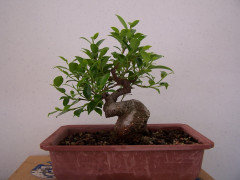
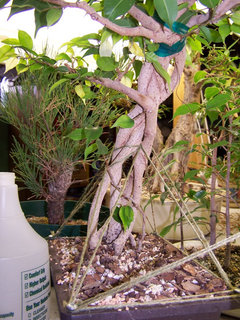
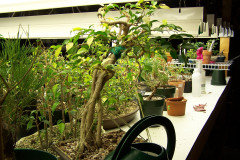
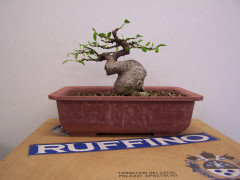
    If you decide to move forward with my advice, I want you to feel more comfortable about taking it. I've been manipulating trees in the Ficus genus and perhaps 3 dozen other genera for a very long time. I have more than 200 containerized trees that I work on regularly, so based on any instructions or suggestions I might make, I can predict your tree's reaction and describe it to you with a great degree of certainty; this because I've taken the same actions I might suggest you apply to your tree over and over many hundreds of times on my own Ficus trees. As I scroll upthread, I realized I haven't provided any images of my own trees, which would hopefully ease your mind.


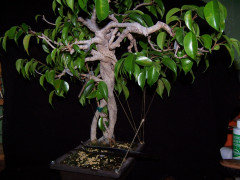
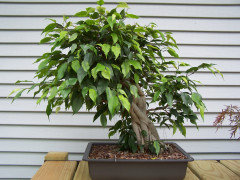
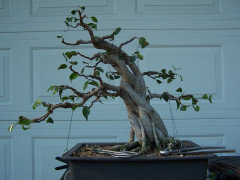
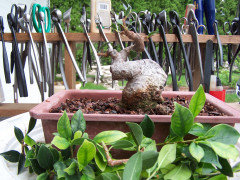
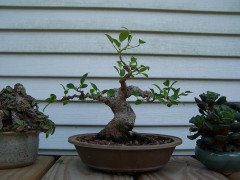
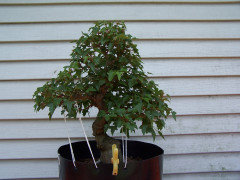
    This beauty with the green tape stared as a group of 5 tiny cuttings in a cup of soil that I paid about 80 cents for. My goal was to create a Ficus benjamina with a fused trunk. I was joking when I called it a "beauty". I know it looks hideous, but you know The Ugly Duckling story, I'm sure. Another image:

    And another:


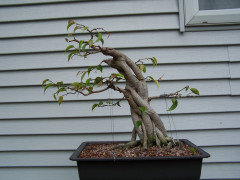
    Below, the trunk is fused. Many sacrificial branches have been removed, and the mess is on the way to becoming a tree.


    Below, more cuttings have been started, added to the composition to fuse with the trunk


    Below, it's making progress.


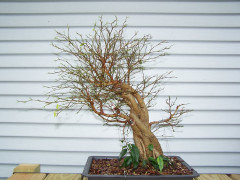
    Below: Same tree as the one above, same day - after defoliating


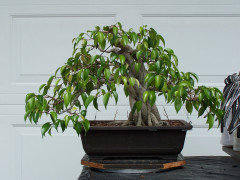
    The tree was repotted this June, defoliated and wired in late July, and this latest image taken mid- August as it's reflushing (growing new leaves). In a week it will be difficult to see the branches because of all the new back-budding (new buds/ leaves/ branches).

    Below: Ficus microcarpa pruned very hard in June


    By August, it has grown this much:


    Same tree as above, same day, after a second pruning and styling:


    "you recommended I should cut back somewhere between 1/2 to 2/3 of the distance between the floor to the top of the window to allow canopy growth. With that consideration I would be cutting off about 4 feet (yikes)!" I know the thought of cutting off 4' of perfectly goof growth is unsettling for someone who has never chopped a tree back before. Many hobby growers never get past the idea that all growth put on by a plant is sacred and must be retained at any cost; but in reality, growth control is a very real part of your tree's care regimen. Do you want growth? or an eye appealing tree? My guess is the later. Here are some trees I chopped back:

    Japanese snowbell


    Same tree, most recent photo:


    Below:

    Ficus microcarpa, a 7.5 ft tall tree chopped back to what you see.


    Same tree years later but still in early formative stages.


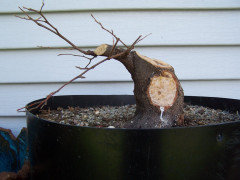
    Above middle: Maple tree about 8 ft tall. Trunk chopped to about 3".

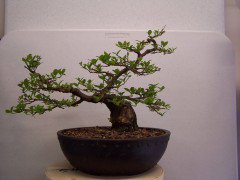
    Below: Same tree years later

    I could provide you with many dozens of other trees that were cut back (chopped) very hard. From these images, I hope you are getting the sense that topping your tree doesn't jeopardize it in any way. You'll need to be careful not to over-water because less water will be lost through the leaves because you'll be reducing the foliage mass by about half, but that should be the only adjustment you'll need to make.

    "Would you recommend that I cut that 4 foot section into smaller sections and try to propagate multiple plants? That would be entirely up to you. Now is a good time to start a cutting, but don't delay. As the days grow shorter, the probability of success will diminish. If so what lengths would be ideal?


    If you want a single trunk, use the top of the trunk as the cutting

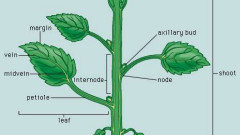
    Make your cutting 4 nodes long. The bud at the top node (apex) will continue to grow and become the new trunk.

    Cut straight across the trunk immediately below a node.

    Count up to the 4th node and make an angular cut halfway between the 4th & 5th node. Important: remember the angular cut is the top. It won't root if you get it reversed.

    If there are leaves at the nodes, remove the lower 3 leaves and cut the top leaf in half across the veins.

    Stick the cutting in coarse perlite so the bottom 2 nodes are covered, keep it damp only, out of direct sun and wind.

    Tenting would be helpful.

    And I should not try to root the clippings in water and root them in perlite and peat moss instead? That too, is your call. I don't root anything in water as the roots that form in water differ significantly from roots that form in solid media, and the water roots don't transition well from water to a solid medium.

    I hope that helps boost your confidence, Lisa.

    Al

  • 5 years ago

    If you want to propagate the tree, do an air layer. Search the Internet for instructions. I have done that successfully.

  • 5 years ago
    last modified: 5 years ago
    There are several scenarios in which an air layer is an option, but only if she foregoes the trunk chop at least until the layering process is complete. Too, F lyrata comes so easily from cuttings that layering the plant is pretty much overkill unless she decides she wants to try layering the tree for no more than the satisfaction of having done it.

    Edited to add a link to another active thread on the same topic we're discussing, L. See it here.

    Al