

At wit's end with unhappy Schefflera
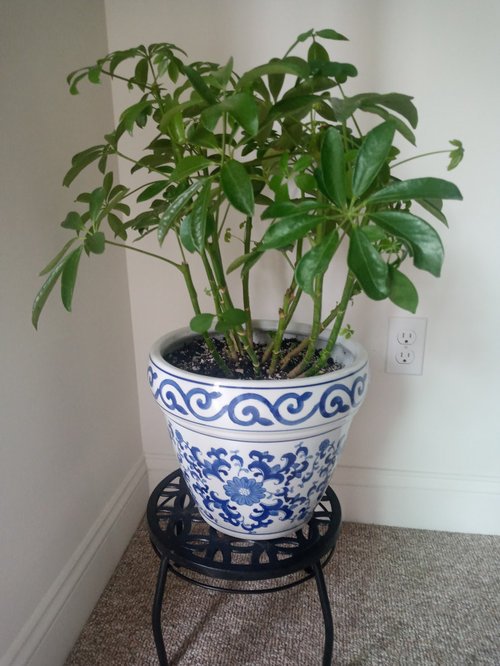
I purchased my first schefflera several months ago and still haven't hit my stride with its care. I'm hoping for some serious advice.
When I originally made the purchase, the plant was severely rootbound such that roots were all along the surface of the nursery pot and coming out of the drainage holes to strangle the circumference. The vegetation was also huge and overgrown. I did some research and was advised to prune a bit less than 1/3 of the rootball as well as some of the greenery. I couldn't find a pot big enough for the unpruned rootball, so this sounded like a good plan.
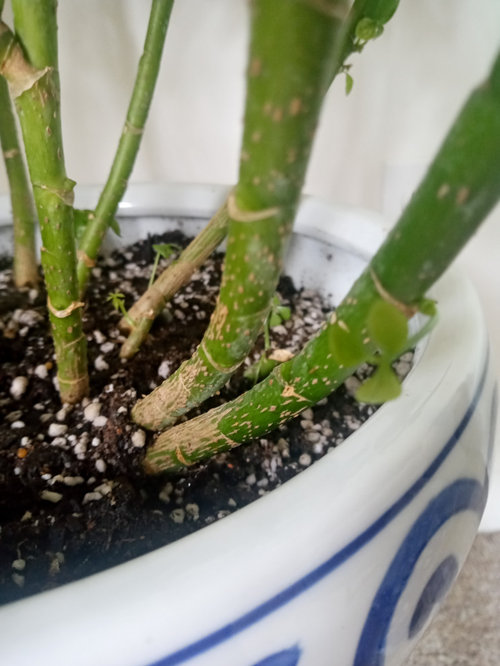
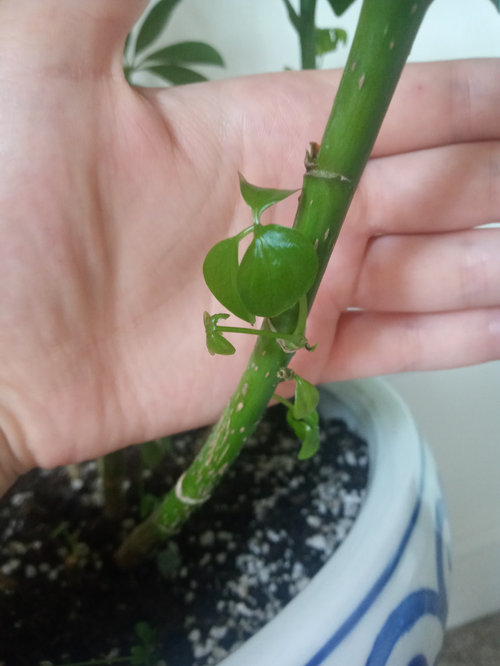
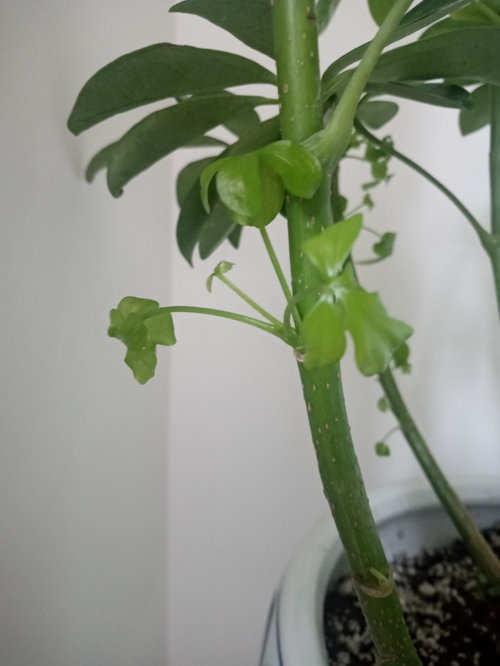
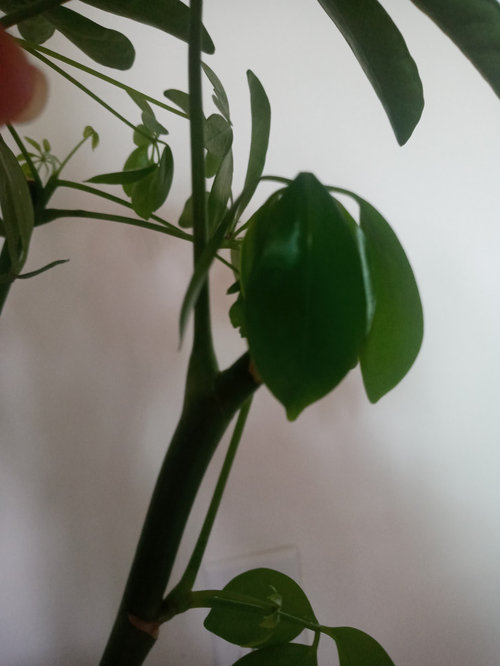
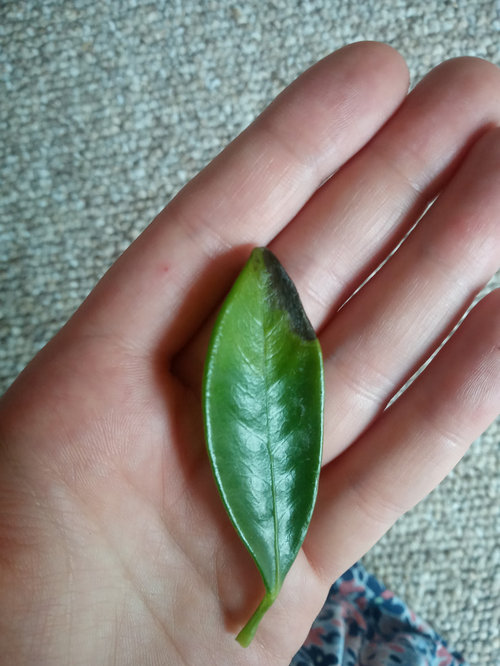
Ever since then, it is seemingly unhappy with my care. Every few days or so, the edges of a few leaves turn black and eventually completely become brown and fall off. Much of the new growth comes in with only three leaves and very much umbrella-like in their curvature. I initally suspected scale but think that it is simly barking on the stems (though i am not entirely sure). I never seem to know when it needs water despite trying to monitor it for signs of need in order to avoid overwatering.
It is currently situated to the side of a south facing sliding glass door such that it geta indirect bright light. I water until water flows out the bottom drainage hole about every othet week or 2 weeks (ie when the surface is dry).
What am I doing wrong here? Have I permanently ahocked the poor guy into a state of oblivion?
Comments (8)
Related Professionals
Aberdeen Landscape Contractors · Joplin Landscape Contractors · Abilene Landscape Contractors · Alexandria Landscape Contractors · Eau Claire Landscape Contractors · Oshkosh Landscape Contractors · Los Angeles Landscape Contractors · Napa Landscape Contractors · Buffalo Interior Designers & Decorators · Watertown Interior Designers & Decorators · Las Cruces Interior Designers & Decorators · Boise Landscape Architects & Landscape Designers · Raleigh Landscape Contractors · California Kitchen Remodelers · Montréal Kitchen Remodelers 5 years ago
Hi, AJ. The issues you outline aren't difficult to fix. First, it's a very good bet you're over-watering. What are you using as a grow medium? Are you sure it's for potted plants? How do you determine when it's time to water? ..... might as well let us know what you're doing about fertilizing, too.
If you let the soil become completely dry, you've waited a few days too long to water, BUT, allowing it to go completely dry for short intervals is better tolerated by the plant than over-watering.
Using a wooden "tell" to determine when it's time to water takes the guesswork out of the equation. I'll leave a short piece I wrote about using a "tell" before I close.
Repotting and potting up are different procedures. Repotting includes bare-rooting, root pruning, and a complete change of grow medium and is much to be preferred over potting up, at least from the perspective of the plant. Potting up ensures all root problems and root congestion in the main root mass remain as limitations indefinitely. Repotting completely relieves all stress related to root congestion and if done properly, corrects all problem roots, almost always by removing them.
Advice to water when the surface of the grow medium first becomes dry, or to water when the top inch or two of the medium is dry is commonly repeated by growers who know no better, but that practice virtually guarantees you're over-watering. This is true in any case when watering as soon as the top of the soil feels/appears dry, regardless of pot depth. And, you're also almost certainly over-watering if you water when the top inch or two of the grow medium feels dry, unless the pot is quite shallow, less than 5".
Finally, calcium (Ca) must be present in the nutrient stream at all times if cells/ tissues are to form normally. Soil saturation and the lack of oxygen that accompanies it limits the plants ability to take up Ca, which is very likely why the new leaves are coming in malformed. Don't forget to supply the info about your grow medium.
Using a 'tell'
Over-watering saps vitality and is one of the most common plant assassins, so learning to avoid it is worth the small effort. Plants make and store their own energy source – photosynthate - (sugar/glucose). Functioning roots need energy to drive their metabolic processes, and in order to get it, they use oxygen to burn (oxidize) their food. From this, we can see that terrestrial plants need plenty of air (oxygen) in the soil to drive root function. Many off-the-shelf soils hold too much water and not enough air to support the kind of root health most growers would like to see; and, a healthy root system is a prerequisite to a healthy plant.
Watering in small sips leads to avoid over-watering leads to a residual build-up of dissolved solids (salts) in the soil from tapwater and fertilizer solutions, which limits a plant's ability to absorb water – so watering in sips simply moves us to the other horn of a dilemma. It creates another problem that requires resolution. Better, would be to simply adopt a soil that drains well enough to allow watering to beyond the saturation point, so we're flushing the soil of accumulating dissolved solids whenever we water; this, w/o the plant being forced to pay a tax in the form of reduced vitality, due to prolong periods of soil saturation. Sometimes, though, that's not a course we can immediately steer, which makes controlling how often we water a very important factor.
In many cases, we can judge whether or not a planting needs watering by hefting the pot. This is especially true if the pot is made from light material, like plastic, but doesn't work (as) well when the pot is made from heavier material, like clay, or when the size/weight of the pot precludes grabbing it with one hand to judge its weight and gauge the need for water.
Fingers stuck an inch or two into the soil work ok for shallow pots, but not for deep pots. Deep pots might have 3 or more inches of soil that feels totally dry, while the lower several inches of the soil is 100% saturated. Obviously, the lack of oxygen in the root zone situation can wreak havoc with root health and cause the loss of a very notable measure of your plant's potential. Inexpensive watering meters don't even measure moisture levels, they measure electrical conductivity. Clean the tip and insert it into a cup of distilled water and witness the fact it reads 'DRY'.
One of the most reliable methods of checking a planting's need for water is using a 'tell'. You can use a bamboo skewer in a pinch, but a wooden dowel rod of about 5/16” (75-85mm) would work better. They usually come 48” (120cm) long and can usually be cut in half and serve as a pair. Sharpen all 4 ends in a pencil sharpener and slightly blunt the tip so it's about the diameter of the head on a straight pin. Push the wooden tell deep into the soil. Don't worry, it won't harm the root system. If the plant is quite root-bound, you might need to try several places until you find one where you can push it all the way to the pot's bottom. Leave it a few seconds, then withdraw it and inspect the tip for moisture. For most plantings, withhold water until the tell comes out dry or nearly so. If you see signs of wilting, adjust the interval between waterings so drought stress isn't a recurring issue.
Questions welcome.
Al
 5 years ago
Trust in Al! In my admittedly limited experience, Schefflera are very resilient. My scheffleras came back from the brink of collapse after a decade of abuse and neglect even before repotting, with just a good RO water flushing, proper watering using Al's dowel method, and being moved to get at least a few hours of strong indirect light up against an East facing window. That was in the dead of winter, and when I repotted and pruned the roots in the spring, and then pruned heavily in August, I got amazing, dense, hearty growth.
So don't despair! Your planting looks like it's got great potential, but as Al says, it needs the right conditions to become the vital thing it wants to be. And follow Al's instructions, not my babbling, to ensure you get the most from the experience.- 5 years ago
You do yourself an injustice in calling your summary of how to maintain scheff's in good health babbling. It was far from anything resembling babbling.
I wonder where the OP went? Drive-by maybe?
Al
Andy Jane
Original Author5 years agoThank you all for the input and sorry for not providing an update in a more timely manner.
Tapla, after reading your post I became very curious as to what was going on beneath the soil surface. I took the old guy out to my balcony and managed to get him out of the pot. Luckily, the root rot was very minimal but I managed to take care of it with a pair of clean scissors. I also gently untangled the roots and found that they had been clinging onto soil that was very peaty and broken down. I could physically tell from the feel of that soil that it was very very old. I was able to manually get it out.
After I made the purchase way back when and pruned the roots, I had used potting soil from Miracle Grow. It had held onto so much water as you intuited and so I ran to the shop to get a different potting mix as well as some perlite to cut it with. I also purchased a nursery pot that seemed a better size for the roots that I have with the added benefit of extra drainage holes.
The difference has been night and day. No more leaves are dropping and the new growth is not coming in droopy or malformed. All very ironic considering the potentially shock-inducing changes I made.
Tapla, I've been in this hobby for almost a year now and I've never seen anyone suggest an untangling kind of repotting. The advice everywhere is to just plop the rootball as is into the new soil. Is untangling ans removal of old soil something I should always do in the future with my plants?
Additionally, I appreciate the advice of using the wooden tell. I purchased a few to put it into practice. However, waiting for the very bottom layer of soil in the pot to be dry feels counterintuitive to what I've learned online (only wait for the top 1 or 2 inches to dry). It also seems like it could be harmful to some of my plants (such as my gardenia for example).
Admittedly, I joined this forum to ask plant questions because I felt other sources were not divulging knowledgeable information but were merely parroting sound bytes. Care to expand on this suggestion?
Andy Jane
Original Author5 years agoAnd thank you, literbuggy for your own experience. I'm very glad I didnt give up on my schefflera and it relives me to know that they are so resilient.
- 5 years agolast modified: 5 years ago
The difference has been night and day. No more leaves are dropping and the new growth is not coming in droopy or malformed. All very ironic considering the potentially shock-inducing changes I made. A plant's initial response to cultural changes is almost instant; but the difference between people time and plant time, combined with our own tendency to look for immediate changes, usually makes us anxious because we suspect our efforts weren't adequate. I'm glad you have already witnessed some of the fruit of your efforts.
I've been in this hobby for almost a year now and I've never seen anyone suggest an untangling kind of repotting. The advice everywhere is to just plop the rootball as is into the new soil. Is untangling ans removal of old soil something I should always do in the future with my plants? When I was initially bitten by the bonsai bug around 1980, I had no interest in plants beyond the need to learn how to replicate the beautiful little trees I spied on a business trip when my hotel proved to be the venue for a bonsai show. I initially failed, so I put the trees away, studied for several years (no internet back then), then returned to fine I could now keep my trees alive. One of the things I've learned is that the primary difference between a bonsai the age of which might commonly be measured in centuries or more commonly in decades' and the average hobby grower's houseplants, is how the roots are treated. The crux of the matter is, potting up and repotting are two different procedures with repotting being the much more involved of the two because it includes bare-rooting, root pruning, and a change of grow medium. Repotting removes ALL stress associated with root congestion while potting up ensures that most of the existing stress of root congestion remains because it is never alleviated in the center of the root mass, and becomes a connatural limiting factor that robs more and more of a plant's potential in terms of growth, vitality, yields (for bearing plants), and appearance. As root congestion increases, the plant will actually start regressing by shedding parts, decreasing it's mass in order to balance the amount of viable mass it can support with the limited amount of energy it can produce. So, anyone who says you don't need to repot to have a healthy tree might as well be telling you there is no sense in regularly changing the oil in your vehicle(s).
I have more than 200 trees in pots. The bulk gets repotted every other year. A few every year and others every 3-5 years if they are old trees (like older than 50 years). I can tell by looking at the trees whether or not they need repotting because the decline is very conspicuous. The thing to remember is, repotting is like fertilizing. Neither can make your tree grow better than it's genetically programmed to grow, they can only restore normal growth. That said, the huge difference in growth/vitality you'll see after a full repot is only the tree returning to a growth rate and vitality level it would have been enjoying all along but for the stress of root congestion. That 'growth spurt' you think your seeing is a good way to measure how much potential you had been sacrificing to root congestion.
Additionally, I appreciate the advice of using the wooden tell. I purchased a few to put it into practice. However, waiting for the very bottom layer of soil in the pot to be dry feels counterintuitive to what I've learned online (only wait for the top 1 or 2 inches to dry). It also seems like it could be harmful to some of my plants (such as my gardenia for example). Ideally, you will eventually get to the place where using a tell is moot because your grow medium can't hold enough excess water to seriously limit root function or health. That's how I grow. I use VERY fast draining media which can be watered at will (within reason) w/o concern for root health/ function. In the summer time, I water most plants every day , and a few every 2-3 days. I don't check to see if they need water because the media used is forgiving enough that it's unnecessary.
If your gardenias or other plants balk at waiting for the soil to dry down to almost dry, they'll give you hints they need water. Take note and adjust so you're watering before the tell shows dry or when more of the tell is wet for those plants.
The advice to water when the top inch or two of the medium is dry would be ok if the pot is 5" deep, but in a 10" deep pot, the top 2" of medium could feel dry while the bottom 6-7" could be 100% saturated with water. So for pots deeper than about 5", the advice virtually assures anyone following it will be over-watering. Poor advice runs rampant on the National Gardening Forum and anyone trying to buck the conventional advice there is met by a wall of moderators who also post and have a group of favored posters they protect from 'outsiders'. It's sad what passes for advice there.
Admittedly, I joined this forum to ask plant questions because I felt other sources were not divulging knowledgeable information but were merely parroting sound bytes. Care to expand on this suggestion? As I mentioned in the paragraph immediately above, you'll find bad advice mixed with good wherever you go, and you'll find more people who operate at well beyond the limits of their knowledge than those who steadfastly keep themselves from overstepping those limits. If you pay attention to how people qualify what they say, you can usually figure out who knows what they're talking about. People who are out over their skis talk in generalities and leave themselves lots of loopholes which allow them to say, That's not what I meant at all" when they are challenged.
My suggestion to you is, if you're serious about increasing your proficiency, learn how to do something before you try it, which eliminates close to as much trial-and-error as possible. Instead, use your practical applications to to validate what you already know. You'll leave the trial-and-error crowd standing in your slipstream. Trial and error is pretty much doing the same things over and over, getting bit on the butt by mistakes until you catch a break and finally notice since poor results usually follow a particular habit, that habit needs to be examined for it's merits or lack thereof. Learning first then validating your knowledge by applying it saves a lot of unnecessary angst and apprehension, too.
Let me know if you have questions you think I might be able to answer.

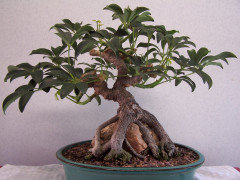
Root over rock composition ^^^Al









ken_adrian Adrian MI cold Z5