Software
Houzz Logo Print
blueberrybundtcake

Rein in my Monstera!

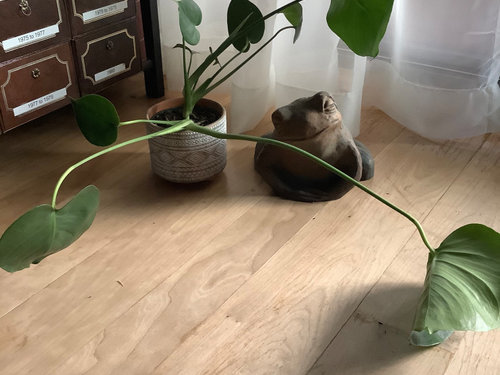
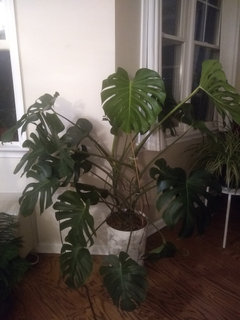
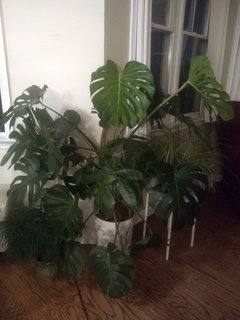
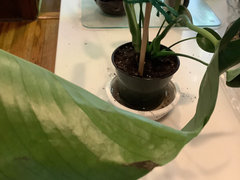
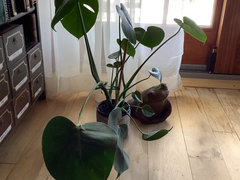
So I've had this young Monstera deliciosa about a month, and it seems pretty happy, but one of its stems is very floppy. I'd like to keep it in this planter a while longer, but I don't mind repotting it back into its same pot. It'll stand up a bit more, but if I look at it funny or water it, it flops right back out. The window behind the curtain is to a south-facing porch.


As far as I can tell, I have a few options:

1. Cut off the big leaf and hope the smaller stem would support itself.

2. Stake the whole stem to provide additional support.

3. Repot to get the roots less running across the surface and more into the medium.


The leaf I'm proposing removing is sorawling on the floor to the right:


Cut the leaf, the one sprawling left will come up.
Stake it, it needs that leaf
Repot it, it will solve all your problems.
You're delusional to keep it in that pot even for a little while longer
Let it be it'll stand up on its own.
A magical other option will be in the comments.

Comments (14)

  • 5 years ago

    It has three stems in there which will try to grow in three different direction until you tame them. The leaves often try to go horizontal and cutting off a leaf would not solve the issue of spreading haphazardly. As to repotting, theycan live in a smaller pot but it will be easier to stake in a bigger pot and eventually it will need a bigger pot to have room for growth of all three stalks. Slide it out of the pot to see how root bound it is or isn't. If you don't see very fat roots circling all around it can live in there for now. You do need to be careful to use a stake sooner than later because a horizontally growing stem is a PITA and hard to make vertical later because the stems are often thicker than the stake and quite tough to mould. I hop you are not referring to the leaf petiole as the stem. The long thing attaching the leaf to the stem is the leaf petiole.

    BlueberryBundtcake - 6a/5b MA thanked getgoing100_7b_nj
  • 5 years ago

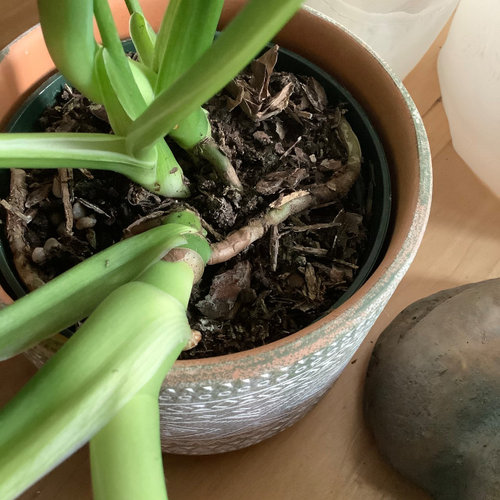
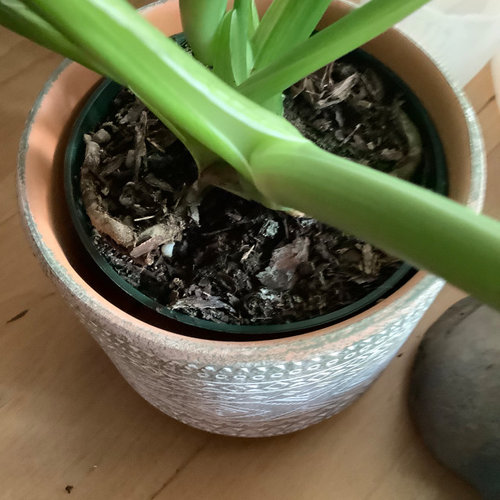
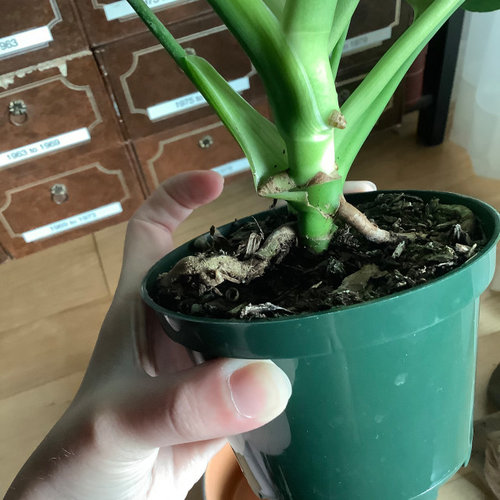
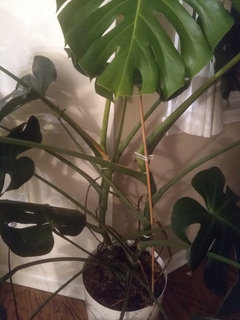
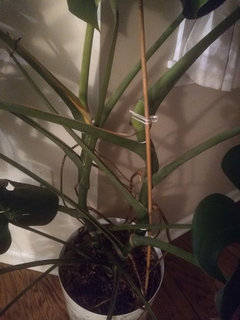
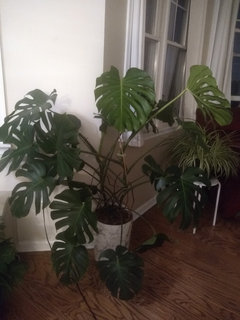
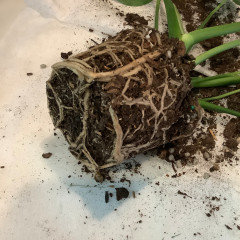
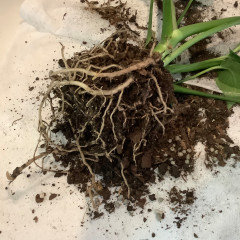
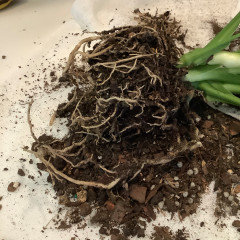
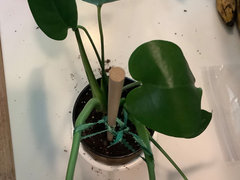
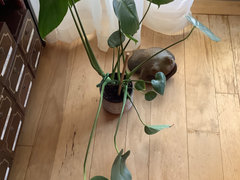
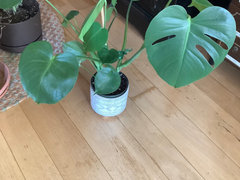
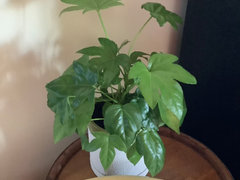
    It cuurrently flops freely, as you can see from the pictures, where I just tipped it around for pictures. Pictures 1 and 4 are how it feels like flopping, and you can see the roots sitting on the surface. Picture 2 I'm holding the stem up slightly, to show the roots better ... the front root is lifting slightly. Picture 3 I've got the whole thing tilted so the floppy stem flops back, as you can see, this lifts that left root pretty much completely up ... also shows the two nodes just getting started.


    Do I bury the surface roots in repotting for more support, or does it want those as aerial roots, like an orchid?


    I'm counting three stems, one floppy one and two stable/upright ones with shorter leaves, I think all with three leaves each ... floppy one definitely has three leaves, though the big leaf does seem to come out the end of the stem, I'm not sure where it switches from stem to petiole.


    I'm assuming a stake would hook the big leaf, and the little ones would come along for the ride, yes? How tall would the stake be (in relation to stem/leaf)?


    Side question, any estimates on how much older it needs to get to create fenestrated leaves? I do not know how old it is currently.

  • 5 years ago

    Burying the aerial roots or not is personal preference, they are fne either way. I bury them so I don't have to worry about them wandering everywhere and tangling. If you are going to use a moss stick or coco fiber stick then letting the aerial roots attach to the stake makes sense. I just have a bamboo stick for a stake.
    Yes, you do have 3 stems/stalks. It takes closer inspection to find where the stalk ends and the terminal/top leaf begins. All aerial roots will start at the nodes opposite from the leaf petioles on the stem. So, the aerial roots/nubs and leaf petioles are attached to the stem. Your plants are too small to have an appreciable/noticeable stem length.
    The minimum length of the stem depends on the highest point where you would need to tie something to the stake. Much longer and it could be an eyesore. While the stem is usually what you would stake to keep it reasonably upright and prevent it from overtaking the floor, some leaf petioles may also need to be staked to prevent them from flopping to the ground in an unseemly fashion. This is really a problem with lower leaves and younger plants. As the stem gets higher, the leaves tend to behave. Eventually, the purpose of staking is also to make the plant look more aesthetically pleasing so use your imagination to tie whatever needs to be tied howsoever to get the best look and hopefully hide the stake and the aerial roots.
    As to fenestrations, the size of the biggest leafs suggests you are close. More light means more fenestrations. Here are some pics of mine. Most non fenestrated leaves are no more but notice the hight of the stem where the first fenestrated leaves are. Good luck.

    BlueberryBundtcake - 6a/5b MA thanked getgoing100_7b_nj
  • 5 years ago

    Okay, I'll probably pull it out of its pot to get a look at the roots (I'll take pictures), and when I repot it, I'll bury those roots a bit. I just didn't want to harm it by sticking aerial roots in dirt (I'm sure an orchid would be mad at me for such an offense ... good to know Monstera don't care.) I'll stake up the floppy piece if it's still flopping at the same time. I have a couple other plants around the house waiting for repotting, too, so I'll probably do them all at the same time. (Fatsia japonica is perched is waiting to get into its new pot, and one of the African violets has a gully next to it that won't do.)

  • 5 years ago
    last modified: 5 years ago

    Okay, finally getting to potting ...

    It's root bound!


    I have a large pot that can fit into my planter, so I'm going to put it in that ... we actually had to cut its old pot anyways to pop it out.

    Old pot: 4"diam x 3"h. New pot: 4.5"diam x 3 5/8"h.


    I do also have orchid pots if it would like one.

  • 5 years ago

    Here's the roots unbound:


    And repotted with a stake (dowel):


    (Yes, I know those bananas are overripe ... they'll be banana bread soon.)

  • 5 years ago

    Nicely done, no worries about the bananas! That is not a much bigger pot but I understand you want it to fit into the decorative pot. It wasn't too pot bound so I guess it could live happily in its new pot for an year or so.

  • 5 years ago

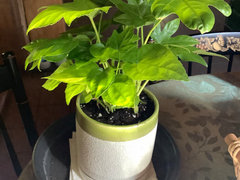
    And here's Fatsia japonica in its new pot:


    (Saucer and paper towel catching water overflow from repotting. It should just need its primary, connected saucer most of the time. It does have a drainage hole, so didn't need a pot in a pot.)

    It was also quite ready for its new pot, as we had to cut that nursery pot, too, haha.

  • 5 years ago

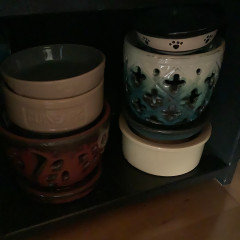
    Orchid pots (in amongst the spare pet bowls) that I could use if they would help:


  • 5 years ago

    I noticed the decorative cache pot in your initial pictures above. I get that the saucer is temporary. I had both stems of mine tied via nylon ropes to a single stake as well. They both needed pulling into the same general direction. Now, one is properly staked up close and the other is pulled in and tied to the staked stem rather than the stake.

  • 5 years ago

    It doesn't need an orchid pot. Keep them for the orchids.:)

  • 4 years ago

    Wanted to give an update on my monstera ...

    It's doing great ... I've retied and/or moved its stake a few times, but other than that, it's pretty low maintenance other than needing water fairly often.


    For its most recent watering, I did its normal top watering (which mostly just runs straight through) and then I let it sit in a dish of water for 10-15 minutes, and it seems to be staying moist a bit longer. (I thought it needed a deeper watering, but watering with a pitcher over the sink much longer was almost certainly going to cause me to hit something and damage either whatever I knocked over or, more likely, the plant. (Straight from the faucet goes poorly for the same reason, hence the pitcher.) I don't know which is better for it generally, though ... soaking or pitcher watering?


    Oh, and it has a fenestrated leaf now! That unfurled a couple months ago.


    Anyways, the most important part of any update ... the pictures!


    Fatsia japonica is doing well, too ...


  • 4 years ago

    Nice growing. I would water them where they are and then empty out the cache pot. Makes life easier if you have too many pots.

0