Software
Houzz Logo Print
ostrich0001

Is deep root fertilization really better for trees?

5 years ago

I would appreciate your advice on this!


I live in Edmonton, Alberta (zone 3/4). My property has a couple of apple trees which are several decades old. They are doing quite well but seems to have been stressed out by the recent construction on my property as the roots were probably disturbed then. Anyway, the arborist suggested that deep root fertilization this fall might help. I tried to do a search on this topic on Google but the results don't seem to be all that conclusive. Anyway, I wonder if you have any advice on this please? Is this worth it or are regular fertilizers just as good? Thanks in advance!

Comments (14)

  • 5 years ago

    was he a certified arborist.. or some guy with fert to sell??


    plz describe the depth and type of fert recommended ...


    also the construction ... what surrounds the trees ... grass??? ... do you fert that???


    and the size of the trees ... and what signs are you seeing that indicate a problem ... it is october.. so i wouldnt be impressed with leaf problems .... the trees are shutting down anyway ...


    pic or two might not hurt also


    when does your ground freeze?


    ken

    ostrich thanked ken_adrian Adrian MI cold Z5
  • 5 years ago

    I wouldn't fertilize in the fall as you don't want to force new growth on the trees. But your trees may already be dormant. Myself I'd probably fork the ground near and somewhat beyond the drip line of the trees and then spread an inch (25mm) of well composted manure or mushroom compost.

    If the trees are in your lawn I wouldn't do this now as you'll be looking at the manure all winter. If you do this shortly before the grass starts growing next year the grass will grow right thru the manure.

    ostrich thanked John D Zn6a PIT Pa
  • 5 years ago

    Hi Ken,


    Sorry for the late response! It has been very busy at work.... ken, the 2 apple trees in question are in a mulched area (wood bark) and then grass. They are decades old and are about 18 feet tall and wide each. I had them pruned twice over the last 2 years as there were years of neglect by the previous owner. Now that they have been pruned, they look truly beautiful. I will have to find some pics to show you!


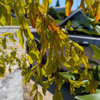
    There is an irrigation system for the grass so that is a consideration when thinking about deep root fertilization. There used to be a concrete pad nearby and I had that taken out. So I am sure that I disturbed the roots then (over a year ago), esp since the following year (last years), many leaves at the tip of the branches turned yellow during summer. This year the situation has got better already, with fewer leaves turning yellow at the tip of the branches during summer.


    It is already fall here and the apple trees are turning brown gradually. Our night time temp is already at 0 degree Celsius or slightly below at night, and we had our first frost here in Edmonton last night. The ground won't really freeze until next month???


    The arborist is a certified one, and he did the pruning for me (and did a great job at it!). He suggested Nutra-Leaf Spring, Fall, and Evergreen fertilizer. The cost is about CAD$90 per tree (about USD$70 per tree).


    So given this information, should I do this now, or in spring, or not at all, but to use the method that John suggested above?


    Thank you again!

  • 5 years ago

    If your lawn needs regular fertilization then your trees may also need fertilized, And if you used a similar fertilizer it will need it regularly. Especially if you used a similar product. I would suggest you mulch the trees with mushroom compost bought in bulk and then spread the inch in the lawn out beyond the drip line of the trees. If bulk mushroom compost is not available in your area then substitute with well aged manure.

    You disturbed the roots; a boost would be a good idea.

  • 5 years ago

    "If your lawn needs regular fertilization then your trees may also need fertilized, And if you used a similar fertilizer it will need it regularly."

    That is all pretty much nonsense! Comparing the fertilizer needs of a lawn to that of a tree is ludicrous. And it wouldn't be a similar type of fertilizer anyway. And "regular" or routine fertilizing of anything - other than plants grown in a container - is a fallacy promoted by fertilizer vendors, nothing more.

    You only fertilize when or if a need is determined, either by poor plant performance or because a professional soil test indicates a need.

    And I would also add that compost or composted manures are not considered fertilizers, despite what many uninformed folks will insist. They are soil improvement amendments and carry very low and ill-defined nutrient loads so no guarantee any plants that may require fertilizing will necessarily benefit from their application.......or any time soon.

  • 5 years ago


    My reason for my suggestion:

    "(last years), many leaves at the tip of the branches turned yellow during summer. This year the situation has got better already, with fewer leaves turning yellow at the tip of the branches during summer."


    If you spread the inch of mushroom compost out into the lawn you will notice a big difference in the the thickness of the lawn when you mow it. If you also apply the lawn fertilizer you may have trouble cutting it. Caused by the fertilizer from the MC. This will be noticeable for several years. I use nothing but mushroom compost or horse manure for all my veggie gardening, my orchard, and my lawn.

  • 5 years ago

    "(last years), many leaves at the tip of the branches turned yellow during summer. This year the situation has got better already, with fewer leaves turning yellow at the tip of the branches during summer."

    And that is no basis for needing to fertilize! All manner of things can cause branch tip yellowing or scorching, including usual weather patterns. And those have pretty common just about everywhere the past couple of growing seasons.

  • 5 years ago

    I am not going to argue with a person who brags about their education and resorts to terms like: nonsense!, ludicrous,and, uninformed folks. I also shouldn't have to repeatedly post the same NPK values for manure and then have to repeat that while the numbers are low NPK values are based on weight and with bagged fertilizers you measure by capfuls or cups instead of by spade fulls or wheelbarrow loads.

    I made suggestions based on what I would do. I have used these methods for decades. I'm done.

  • 5 years ago

    "I also shouldn't have to repeatedly post the same NPK values for manure and then have to repeat that while the numbers are low NPK values are based on weight"

    You are right - you shouldn't. And that's because the NPK's of any manure can be all over the map depending on how and what the animal in question was fed. And how old the manure is. Really just a moving target. And will always be low.

    ALL NPK values are based on a hundredweight. And rarely do you find home gardeners that are inclined to fertilize their gardens with multiple hundreds of pounds of manure or compost. That's why they opt for a prepared fertilizer when needed that will supply exactly what a soil test determines is lacking rather than throwing dumptruck loads of manure to satisfy the problem.

    btw, I have never bragged about my education....but I do have one and I can recognize inaccuracies and misinformation when I see it.

    ostrich thanked gardengal48 (PNW Z8/9)
  • 5 years ago
    last modified: 5 years ago

    I did some research on the growth of apple tree roots and found this study from the University of Nebraska-Lincoln Extension. done in 1937 and listed near the top of my Google search.

    This is a surprise to me but this quote is from that research..

    "The development of root systems was extremely rapid, the roots reaching a Maximum depth of 8.8 and a lateral spread of 12 feet the first year, and 14.8 feet and 21.2 feet the second. During the third year the maximum lateral spread reached 29.4 feet and the maximum depth reached was 17 feet. This greatly exceeded the lateral spread of three-year-old tops, which was about 6 feet, and the height of the trees, which was 7 to 8 feet.".

    I cut a peach root, this year while digging potatoes, that was near the new growth drip line of the 7 or 8 year old tree about 10 feet from the trunk.

    I didn't see where they explained whether the trees were transplants or seed grown which would effect the depth, especially, of the roots. I won't say more as I don't intend to argue.

    ostrich thanked John D Zn6a PIT Pa
  • 5 years ago

    It is always interesting listening to different areas of the country on fertilize. Here in Southeast Texas the extension service recommends fertilizing established peaches, plums, and all citrus. Many people here do not apply enough nitrogen on their citrus, while a few do apply too much. They say that figs may need a light fertilize, but usually a deep bark mulch will provide enough extra nutrients.


    And while composted manures do not provide a lot of nutrients, you apply manure with a shovel or synthetic fertilizer with a cup. I would not think twice about applying a bag of compost per tree, but would never apply even a five pound bag of granulated fertilizer. Many people use manure for fertilizer, but most manures have a ratio of 1:1;1 and plants need a ratio of about 3:1:2.

    ostrich thanked garybeaumont_gw
  • 5 years ago
    last modified: 5 years ago

    Be so careful fertilizing.... I fertilized my HUGE hibiscus last year with miracle gro, and it was already growing fast. Fast forward a week and the little pot it was in was just flooded with new growth. It just kept growing...... Make sure your trees are well spaced out. Just be careful you don't jumpstart them into growing really fast before dormancy or all the new softwood will just freeze to death in the cold. I almost never fertilize anything except my roses!

  • 5 years ago

    Agree not the time to be fertilizing. But in containers you have to add a little fertilizer during the growing season since the potting medium has little if any nutrients. Use the small part of the green spoon, not the big one. 1/2 teaspoon per gallon, once a week during the growing season is usually enough.

    ostrich thanked garybeaumont_gw