Software
Houzz Logo Print
stephaniedan

Plants dying in gritty mix

4 years ago
last modified: 4 years ago
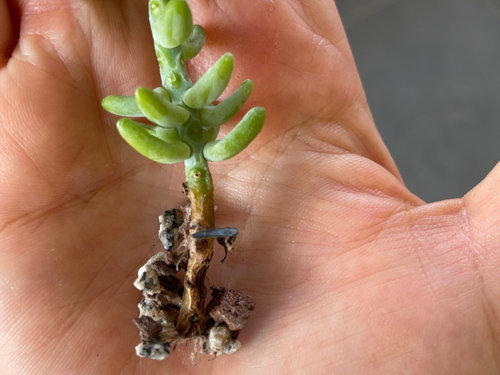
I would really appreciate some help and insight. i recently have started collecting succulents alongside my move towards making gritty mix. Unfortunately things have not been going as expected.

Most of the plants have been dying of rot. Or at least thats what I think it is.

Translucent leaves falling off. Browning stems. Roots dying or turning black. New roots that have grown shortly dying after.

At the same time the on some plants the leaves never plumped up again on some and look severely dehydrated.

The mix is composed of screened particles under 6mm and then using a ~1.5-2mm mesh to get rid of the dust and smaller particles.

Composed of 2 parts lava rock 1 part granite 1 part bark. I also added dolomite powder (I know al specified gypsum instead). Could there be too many minerals in the mix? sometimes I see mineral deposits on the bark.

i have attached some pictures


i only watered about once a week.


thank you in advance!


Comments (28)

  • 4 years ago

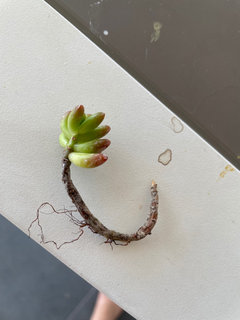
    Another photo of a different plant

  • 4 years ago

    Could be the watering. ’Only’ once a week might still be too much for small cuttings with few roots. Do you assess before watering or do you keep to a schedule?

  • 4 years ago

    Its my first time with the gritty mixes so its been harder for me to tell when its right to water. From my copious reading people have spoken about daily and twice daily watering (not succulents but still) and so i was thinking 1nce a week in outdoor sun would be okay. Is there a chance i just overwatered? And its as simple as that?

  • 4 years ago

    how about showing us the gritty mix you are asking about ...


    and never put new transplants outdoors in full sun ... until established.. and properly hardened off ...


    ken

  • 4 years ago

    I have had plants die in various gritty mixes -- and I am a BIG ADVOCATE of gritty mix as well as pure pumice. Sometimes, it was truly just a matter of weak roots and a plant that couldn't survive in anything. Oftentime, I believe that I compacted the mix too much and didn't give the roots a place to expand. Other times -- watering, over or under.


    I live in FL and my plants are in the HEAT all year long, and many are in bright light or sun -- and I never ever water twice a day. Maybe once every 5 days in the heaviest growing season. So yes, over-watering is possible.


    As others have said -- what is IN your gritty mix? You say you use lava rock and bark -- and I have reservations about that. I no longer use bark of any kind. I generally use sifted and washed Turface, sifted and washed pumice, and washed Manna Pro poultry grit in a 1:1:1 combination......or else pure unadulterated PUMICE which I love. I have Euphobia, Haworthia, Gasteria, Aloe, and Mammillaria growing in gritty mixes -- but NO Sansevieria. My Sans just love to have some soil.

  • 4 years ago

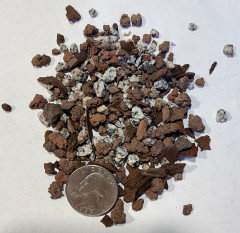
    Thank you all for the input these are the specifics and photo included with dime for reference:
    2 parts lavarock
    1 part granite (diorite)
    1 park pine bark
    All sifted using the same sieves of 6mm and then dust removed with 1.5mm screen.

    Plants are not in direct sun but theyre outside on a shelf which shades the direct sun. So not a good idea?
    Is there a chance its retaining too much water?

  • 4 years ago

    ...... virtually no chance it's retaining too much water; and a very high probability it's holding too little water.

    With a particle size that large, you need more material that has internal porosity, like pine/fir bark, Turface, calcined DE. Ideally, all water in medium would be held on the surface of soil particles, in open internal porosity of soil particles, and at the interface where particles contact each other. Overly large particles means less collective surface area which could be coated with water and fewer points of contact at which water normally collects. Also, neither the lava rock nor the granite have open cell internal porosity. The lava rock can claim a larger surface area owing to its highly irregularly shape, but the water it supports cannot find its way into internal pores like it does in a sponge, calcined clay/ DE, or bark. Couple these factors to the high volume of gas exchange afforded by media as porous as yours (due to the large particle size) and you can see why it wouldn't hold water long.

    When I stick a cutting or transplant a plant with a marginally developed root system into the gritty mix or any other highly aerated medium, I always give consideration to 'where the roots are' and water at intervals which ensure the medium is moist where it needs to be. Once the plant is established, there is little need for concern beyond what one would afford any other established plant, excepting the fact that benefits from this type of media comes at the cost of having to water more frequently.

    Al


    stephaniedan thanked tapla (mid-Michigan, USDA z5b-6a)
  • 4 years ago
    last modified: 4 years ago
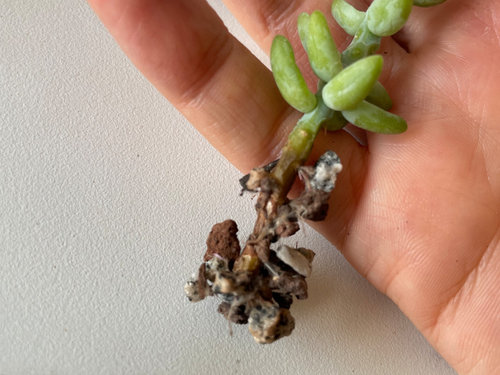
    Hi Al! Thank you so much for weighing in. I see that your particle sizes (turface in particular) are quite a big smaller. I wasnt able to get hold of it (/ceramis) no matter how hard I tried and in a previous discussion you therefore mentioned doing a 2:1:1 mix lava:granite:bark so I was really hoping it would do.

    Assuming it is underwatered can you please help me understand why the plants look like they are rotting? Is there something in the biology that I am missing? Some succulents I watered more often knowing that their roots are less established, but they just failed to plump up again no matter what, fast forward a week or two and their stems turned brown and roots died. Same with the jellybean sedum above, its stem turned brown, roots died and when i broke the stem off it was hollow inside. The bottom leaves were also a bit transparent, they didnt shrivel first.

    Im so confused with all the conflicting signs I would really really appreciate your help! Ever since I found your writings I felt so hopeful and equipped in my gardening journey. I was so happy when I finally found the closest thing I can towards creating a wonderful soil and then went to buy a lovely succulent collection but now they are dying one by one and I have no idea what to do.

    Btw I dont know if this helps but I did an experiement with the water retention of my mix and recorded how much water was left in the container (as a percentage of the container water holding capacity = Aeration porosity = amount of water left/container volume) and have added this here.


  • 4 years ago
    last modified: 4 years ago

    Because the roots dried up so bad they died, and now because of that what ever water touches them, they rot. The roots are not functioning at that point.

    I have to make my mix exactly like Al does, or use a 5.1.1 mix to root all of my cuttings. They have to be constantly moist, yes, even jade cuttings for me.

    You have to keep moisture around where the cutting is rooting until the roots grow.

  • 4 years ago

    Plants are not in direct sun but theyre outside on a shelf which shades the direct sun. So not a good idea?


    ==>> sounds perfect as compared to indoors ..


    but what i thought i said was.. dont put new transplants into sun.. and i meant until they are over the stress of repotting ...


    did or do you.. wet your media before use ... the point of your mix.. is high sharp drainage ... but you cant put a plant in a bone dry mix.. and then hope to moisten it properly with a watering pot after the plant is in it .. you will just never be sure that you are wetting the whole thing.. and not just certain pockets.. because it is designed to shed all extra water immediately ... so.. if it were me.. i would keep it just a bit damp before use.. to insure appropriate water distribution ...


    if you have extra.. and 2 pots ... fill one with moist media.. and one bone dry and water that one from the top ... and a day or 3 later.. dump them out.. and find out what happened ... just an experiment to learn something .... let us know ...once you know how the media works.. then it ought ta be easier to deal with.. after you stick a plant in it .....


    ken

  • 4 years ago
    last modified: 4 years ago

    Im confused - the mix was so dry it killed the roots off - succulents - at a once a week watering - and these are plants that do extremely well with draught - but wet enough that it caused rot?
    So im basically doomed either way? Or is it all because the root system was not sufficiently established?

    Also does anyone have insight into my graph? The water retention was at 20% at day 1 and I remember tapla mentioning his was around 10% somewhere. Also after 8 days it still didnt dry completely and so it doesnt feel so fast draining as the graph i compared to bonsai jacks gritty mix (graph of bosai jack attached below with green background and mine is below)

    Im trying to get a better understanding and really appreciate all your responses.


  • 4 years ago

    How much root did these ’plants’ have? The ones in your photos look like barely, or even unrooted, cuttings. Cuttings do not have the same water requirements as well rooted plants so care instructions for the latter do not apply.

  • 4 years ago
    last modified: 4 years ago

    I have rooted all my cutting in the gritty mix moist and have success 100 % of the time. It’s has to be for my cuttings to develop roots easily and stay hydrated. I first calloused them off.
    You used a mix even more porous which tells me it held barely any moisture at all at the little roots level and they desiccated. It’s as easy as that.
    If you are using a mix that holds too much moisture I can understand watering at all if too much.
    I can root jades on the floor of my basement because moisture is in the air down there with any that just fall on the floor.
    Jade cuttings will push roots to survive even on a window sill in nothing. Left to sit there to long though it will shrivel and die. If water touches them at all when the roots are 'dead' from lack of moisture , they will rot. You draw a fine line with which cuttings need moisture once they begin to form roots if they haven’t already.
    I have killed many cuttings like that with the same mistake that you made. It happens to all of us. Trial and error. You will get it.

  • 4 years ago

    A gritty mix for cactus and succulents (almost all of them) is necessary for their health. THE GRITTY MIX is not beneficial to many plants without additional attention paid to the plants, something some of us aren't able / willing to give them.


    You can get excellent results with plants if your soil is porous and nutritive. Or not - it really depends on the full environment of care.

  • 4 years ago

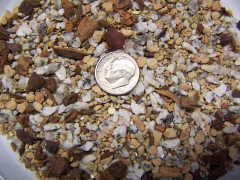
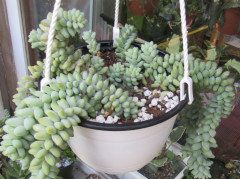
    I grow succulents in very gritty mix - very little of any soil (10-20%) & mostly sifted perlite and grit of approx. same size. Rooting is done in the same mix, & I do not water or mist the cuttings for at least a week (or bit longer). I don't use rooting hormone either. This burrito has grown from short cuttings potted in the spring:


  • 4 years ago

    Thank you all for your input!

    So based on what you all were saying I added some more smaller particles to the mix to help keep moisture, and am watering more frequently. I am also watering for longer - blocking the hole, soaking for about 20min and then letting it all flow out.
    The heat and sun are now less intense and im actually seeing a vast improvement. So the conclusion is it was too dry.

    Many thanks!

  • 4 years ago

    I will say iI am also a recent convert to the gritty mix for a lot of succulents, previously grown in standard 50/50 c&s/perlite mix. The one issue iI had was being able to tell when they needed watered, as it isn’t very easy to tell based on weight or sight.iI have to water mine twice per week to keep up the moisture for my plants, but now that iI have figured out that frequency my succulents have taken off.

  • 4 years ago

    Rina. I see bark in your mix. How much ?
    I need some bark to retain moisture or even my succulents would die in my hot window sill or under lights. And with moving air.

  • 4 years ago

    Mike;

    If there is any bark in there, it is very little. I don't use bark in the mix for succulents for few years because I can't find bark of suitable size. I can't even check the pot because I don't have it anymore. There COULD have been some if I reused some of the old mix (I don't think so thou). I use mix of sifted perlite+grit, and small amount of soil or cocopeat (abt. 10-20%). I keep most of the succulents under the ligts, bur some are on windowsill (unobstructed west-facing window). But it doesn't get hot here during the winter...maybe your temps are much higher?

  • 4 years ago

    I really appreciated seeing this thread, so thanks for starting it Stephanie. I had very similar issues to yours earlier this year. Being a new grower and finally getting serious enough about it to browse forums and threads of advice is one thing, but then actually taking that advice and putting it to use is another entirely.
     
    Back in spring and early summer when we were getting a good amount of rain here in the Midwest I was treating my plants like prized porcelain dolls, ferrying them in and out of the rain as I thought was necessary, worrying if I was providing the "optimal" conditions and so horribly hesitant to water due to the looming spectre of root rot. The result was that I had wrinkled, struggling succulents after what had been a reasonably wet Midwestern spring into early summer. Looking back now I feel like a proper moron, but it was also incredibly valuable because it forced me to reconsider what in the world I was doing.
     
    So, I had to ask myself, "Why am I doing all of this, and how am I convincing myself it's necessary?" The answer is because I had read and memorized so much information, but hadn't actually taken any time to consider what it meant in practice. And I'd seen so many photos of rotted succulents I may have been a bit paranoid.
     
    I was using the gritty mix for my plants and planting them in predominately terracotta, while mostly shielding them from the rain and being stingy with the watering can. It didn't make any sense and was like I'd gone through those multi-page and multi-year threads while arbitrarily choosing what information was important enough to retain. The next go around, I went back and read with the goal of actually doing what Al and many others encourage which, as I see it, is to understand the principles that drive healthy growth in a plant. Understand what creates a perched water table and how to avoid it, understand what a limiting factor is and how to rectify it, and most importantly, take a broad view of growing preferences in order to make the changes you need to grow successfully in your specific conditions. All that, instead of what I did which was look for a soil mix of this many parts of x, this many of y, and this many of z without thinking about what function those components are addressing.
     
    Anyway, the point of my long-windedness is that I finally got it together and realized I could water with nearly reckless abandon because I had done the work beforehand and constructed a growing medium that held no or next to no perched water table. That's the point of the gritty mix to me. You don't have to worry about anoxia developing in the root zone or the associated fungal growth that can lead to root rot, you don't necessarily have to worry about waiting until you see signs of thirst in succulent, you can actually water on a schedule or just leave them out in the rain.

    It took a few months to get through my thick skull, but it got there eventually and it's made growing a much more enjoyable and rewarding experience. Plus now I feel confident that I can cut corners from time to time without seeing ill effects or having to worry about the health of any of my plants if I have to, you know, do other stuff occasionally.

    Everyone else has already said as much, but I'm glad you got things sorted and hope your plants are doing well now.

  • 4 years ago

    John, well said!!

  • 4 years ago

    Thanks for sharing John ! You are absolutely spot on :)

  • 4 years ago

    .... a thoughtful and well-reasoned response, John.

    Al

  • 4 years ago

    @John (Zone 5b/6a, IN) Your comment of the " water with nearly reckless abandon" had me in fits, especially after your "proper moron" statement regarding ferrying the plants to and fro. (Disclaimer: I did all of that, and more, perhaps i win in the moron dept)


    Just thought i'd pop in to comment, that my journey on the 'perfect' gritty mix also went through many evolutions such as yourself. I think i've matured a little as a gardener. It is as you say. In the beginning, I went out of my way to follow Al's mix religiously, even to an obsessive point to import Lbs of the product from overseas to be shipped to Singapore (where i reside). At that time I never considered the purpose of the gritty mix - instead i wanted to build someone else's mix.


    In case anyone from Singapore or any tropical climate comes to read this comment, over the years i've found my own version of the perfect gritty mix, which in the usual 12" tall pots of various width i use for my plants has come to be my go-to mix for everything, such as eggplants, habaneros, thai chilis, winged bean, and even my flowering plants like zinnias, cosmos, marigolds, etc.


    A little preface for my own mix is due to the region I (and my plants) live in. Generally speaking, my climate is 6 months of horrendous "dry" heat (60% relative humidity) and intermittent rainfall (couple of showers every 2 weeks), night temps of 29C (84F), afternoon highs of 34C (94F). Then next 6 months is monsoon season with "wet" heat (85-95% relative humidity) night temps of 27C (81F) and afternoon highs of 32C (90F), with showers every few days and torrential thunderstorms (i.e. localized flooding) every 2-3 weeks. However, being on the equator means our sunlight here is unparalleled throughout the year, and pots are baked for 12hrs a day of sunlight.


    The gritty mix that worked for me was;

    3 parts sifted pumice (6-9mm size) <porosity is great, lots of surface air pockets for roots

    2 part bark fines (4-8mm size)

    1 part fine LECA (4-8mm size) < i'm lucky that this comes in a prepared bag, no sifting needed

    1 part coarse vermiculite (4-8mm size) <need this or i might be watering twice a day...


    Given that in my heat, there is absolutely no chance of roots being starved of oxygen, since I wanted in the mornings, but even the 2" perched water table in my mix gets drunk up by the plant, on especially hot days the eggplants even need a little drink in the afternoon. The sometimes oppressive heat means the plants respire/transpire lots daily to stay alive. I water using the garden hose, i fill the pots up to the top with water. i have these mini fertilizer baskets which has a slow dissolving general 8-4-3 + TE so that takes care of the fertilizer needs. Only once every 2 weeks i go round with the 3 gallon watering can with 0-52-38 (half strength) and pour some on the fruiting plants.


    For tomatoes, i follow the above, but i add in 2 parts of cocoPEAT, that has worked well for me in my soil structure. I had to cut back my 18ft tomato back down to 6ft because of the excessive water usage such large plant requires. Putting out new flowers as I type this and likely i will another crop of black cherry tomatoes soon.


    Sorry for the long-winded post - haven't posted here in a while but @John (Zone 5b/6a, IN) @tapla (mid-Michigan, USDA z5b-6a) both made greater contributions in this thread, felt the urge to contribute my small part.

  • 4 years ago

    I've always maintained that it's not the ability to follow a recipe that offers the greatest potential to increase the enjoyment we get from our growing experience; rather, it's understanding the basic concept that drives water retention in container media. Being armed with that understanding of the concept allows much more flexibility/ adaptability/ forgiveness, and both John and Glenn serve as witness to that thought. Strong work, gentlemen.

    Al

  • 4 years ago

    Glenn Leo -- I enjoyed reading your comment and about your experience with developing your own gritty recipe, mostly because I am so wickedly casual about the nature of a gritty mix and often feel WAY out of my element here with people who are rigid about precisely sticking to the "original specifications." I sit back and think -- my approach would probably give people heart attacks. But -- it works for me.


    Like you, I have devised a "basic" recipe I use as a foundation. It's extraordinarily simple (1 part pumice, 1 part Turface, 1 part Manna Pro poultry grit) but I know how to adapt it for large plastic pots, small clay pots, long rectangular planters, and different varieties of succulents in all of those. Living in Florida, my biggest challenge is adapting the mix and the potting vehicle to the level of heat and humidity intensity. For me, that's all "by feel." I have definitely lost plants in gritty mix -- just like I have lost plants in a soil-based mix. I suspect it's more MY fault than the pot, the mix, the water or the weather. I just did something wrong. Life happens. Anyway, thanks for sharing your particular saga. Very interesting to read, coming from Singapore.

  • 4 years ago

    Reviving this thread on the topic of dry rot mentioned above. Of late ive become rather interested and was wondering if more light could be shed on it. I live in a hot country and my plants are on a rooftop apartment so there is plenty sun available year round.
    How do i prevent dry rot? Some have mentioned its from watering in full heat and that cooks the roots and over here it was described as roots dying from heat and then you water and this matter rots. Are there any sources/resources recommended to read? Any more thoughts on the matter?
    Thanks to all!

Sponsored
Bella Casa LLC
Average rating: 5 out of 5 stars17 Reviews
The Leading Interior Design Studio in Franklin County