Software
Houzz Logo Print
debutante55

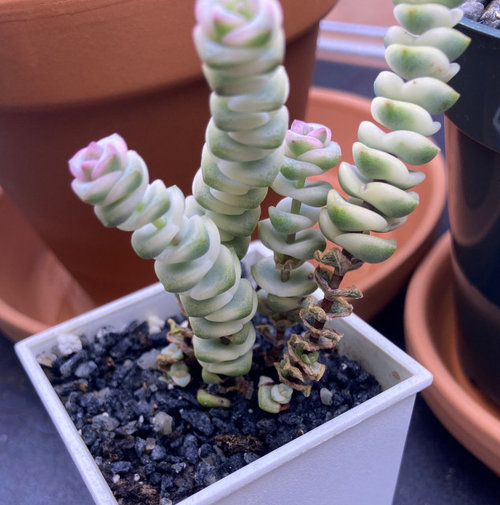
NEED HELP with Crassula Rupestris "Tom Thumb" Variegata

4 years ago
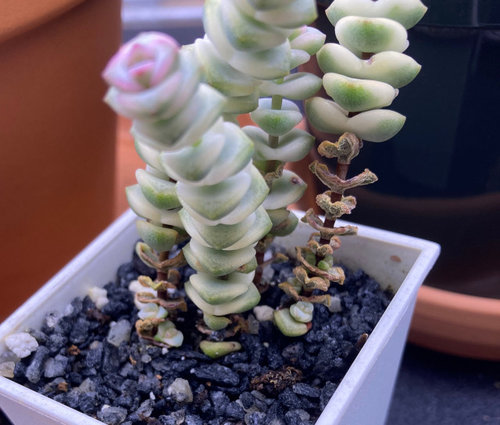
I've only had this little plant for a month or so and it's dying from the bottom up! It's planted in the same gritty, well-draining soil mix as most of my other succulents and is watered when it's dry (usually about every 10 days). The pot is about 2 inches in diameter and it lives under grow lights, about 9 inches below the bulbs. I've never had a succulent die from the bottom up like this and am perplexed. The browned leaves are 'hard and crispy' and there's no evidence of mushiness or rot anywhere. ANY advice would be very much appreciated!


Comments (9)

  • 4 years ago

    I've only had this little plant for a month


    ==>> whatever happened could very well have happened before you got it ... and im not sure we would ever figure that out ....


    you mention other suc's.. so i presume you know what you are doing on some level ...


    water when a plant needs water.. how do you know its dry down in the pot.. i presume it has drainage .... sometimes a new pot is hard to figure out.. unless it is just like all yoru other pots?????


    i might snip off the ugly part.. outta sight outta mind thing ... and try rooting the upper part .. and then maintain proper watering ... and see what happens ...


    ken

  • 4 years ago

    Thanks Ken. I do have other sucs, about 180 or so, plus a bunch of Lithops and other mesembs I grow from seed. LOL (seriously obsessed). :-) That's a VERY good idea to snip off the top and re-root the healthy part. That's worked well for me with a few Echeveria runyonii that had etiolated. As for the pot, it has great drainage but maybe too good. I think I'll repot it just to make sure and have a good look at the root system... which may be underdeveloped since it's a fancy little hybrid. UGH.

    Thanks again!

  • 4 years ago

    I agree with Ken...it probably got dehydrated & may be best to cut dry parts off & re-root. I had similar experience, and it rooted just fine.

  • 4 years ago

    Thanks Rina!

  • 4 years ago

    btw.... it might be a camera trick.. but i dont see much variegation ... isnt it supposed to be blue/green and white with the pink blush??


    which might mean.. it also did not have the light it needs for proper coloration .... which we would also blame on the grower ... as it wouldnt fade all that fast ...


    or you dont have the variegated one ...


    i might start wondering about the seller/grower in that case ... have you bought from them before....???


    ken

    debutante55 thanked ken_adrian Adrian MI cold Z5
  • 4 years ago

    Tapla, thank you VERY much for the detailed information. I really appreciate it. To answer your questions, the shale is a very shallow top dressing and the substrate appears to be about 70% peat-based soil/30% grit, similar to quite a few of my other succulents. Due to the very small pot size however, it does dry out even faster than 'usual' so I've increased my watering frequency and increased ambient humidity. As for the two lightbulbs, they are Sylvania Gro-Lux wide-spectrum 40 watts, which seem to generate a fairly low level of heat at a distance of 6" below the bulbs, which is roughly where the top of the plant is. Interestingly, in the short time since I posted, the plant has generated a tiny bit of new growth at the bottom and looks like it *may* survive after all. {Pics attached] THANK YOU again for all your help and insights!


  • 4 years ago

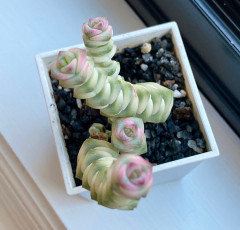
    Ken, Thank you for your comments. The plant does have a moderate degree of white/green variegation with a small touch of pink blush at the tip of each stalk. The jury is out on this particular grower.... this plant was part of my first order and I was a bit 'underwhelmed' overall. Here's a pic that shows the variegation and the pink blush a little better. The plant seems to be holding its own but it's definitely not one of the 'top 10 plants' in my collection! LOL


  • 4 years ago
    last modified: 4 years ago

    If you start with a pint of water-retentive medium and add a particle the size of a BB or a peppercorn. It increases the o/a volume of the medium by the volume of the BB/ peppercorn without increasing aeration, so aeration on a per volume basis decreases. As you continue to add the BB-size particles, even by the hundred, aeration continues to decrease until you've added a volume of BB size particles large enough to ensure there is no longer enough fine material to fill all the spaces between the BB-size particles.

    The point at which there is exactly enough fine material to fill all spaces between the coarse particles is called the "threshold proportion", and it is the most difficult combination of the 2 materials to grow in; however, if additional coarse material is added to a mix of materials at a threshold proportion, aeration and drainage begins to increase exponentially. Ideally, you would start with a mix of very coarse material (particles in the 1/10-3/16" size range) and add only enough fine material to ensure you are comfortable with watering intervals, making sure there is nowhere near enough fine material to decimate the medium's potential for aeration and drainage. See figure 2 (PDF file)

    Al

0
Sponsored
Peabody Landscape Group
Average rating: 3.5 out of 5 stars8 Reviews
Franklin County's Reliable Landscape Design & Contracting