Software
Houzz Logo Print
pritch28

Question on variable speed furnace for dry climate

4 years ago

I’m planning on replacing my old furnace for my condo, and have been looking at a two stage or variable speed model. Main reason is for having the fan on at low speed to increase air quality and freshness. But I have seen that these models reduce humidity. And being in Denver which can be a very dry climate during the winter, would that be a major issue? Would the humidity be reduced enough to where it wouldn’t be worth it?

Comments (31)

  • 4 years ago

    The OP is talking about the FURNACE during heating season.

  • PRO
    4 years ago

    @Austin Air Companie,


    We all get that you service the Katy, TX area and that air conditioning is required there most of the year. HVAC stands for Heating, Ventilation and Air Conditioning. You need to consider the "H" and the "V," too for other climate zones, if not yours. The OP is located in Denver, CO which is in a much different climate zone than yours. Indeed, their question is about a furnace-- not an air conditioner. To be clear, Ray, that's the "H" in HVAC.


    It is well established that running the fan continuously in A/C mode (specifically when the compressor is not operating) can reintroduce moisture into the living space by reevaporating condensate from the surface of the coil. This is clearly demonstrated in the video, and, again, well known in the industry. However, it's not relevant to furnaces, which are heating appliances.


    Heating mode and air conditioning mode are mutually exclusive--at least for residential applications (that means they don't run at the same time, Ray.) Accordingly, your assertion that the OP might not need a humidifier on their furnace because condensate would be available on the air conditioning coil is ludicrous. It's even more ridiculous when you consider that monthly average dewpoints in Denver, CO don't get above 50F except in the months of June, July, and August. In 2021, those average monthly dewpoints were 51F, 56F and 52F. While there are months where air conditioning is appropriate in Denver, CO, the cooling load is sensible heat load, not latent load.


  • PRO
    4 years ago

    "The OP is talking about the FURNACE during heating season."


    Indeed they are! If it can't be inferred from the text of the OP's post, the title of the thread "Question on variable speed furnace for dry climate" is at least a hint.

  • 4 years ago

    A good variable speed furnace would also have a modulating gas valve and electronic logic controls to analyze data sensor signals and adjust gas and blower speed for the most efficient burn with multiple degrees of operation.

    A two stage has only two degrees of operation and why it's called a two stage. A true variable speed furnace is more expensive to buy and repair. You're completely confused here thinking any one of the three options, signal speed, variable speed or dual stage will effect humidity differently, they all do the same thing, and with any of the three you will need a humidifier.

    pritch28 thanked outpaientzero
  • 4 years ago

    A 2 stage/variable speed furnace can improve dehumidification in the summer in AC mode. It won't really have any effect on humidity in the winter in heating mode. However, it will be a lot more comfortable than a single stage/fixed speed system (it will operate in low stage/low speed mode, avoiding blasts of air when it starts up and noisy air delivery). If you can afford it, go for it.

    pritch28 thanked sktn77a
  • 4 years ago

    Thanks everyone for your comments.

  • PRO
    4 years ago
    last modified: 4 years ago

    However, it's not relevant to furnaces, which are heating appliances.

    Oh it's not relevant to furnaces? What provides the air flow to operate the AC? This air is provided by osmosis? You don't operate an AC without a furnace or AH.

    Any furnace (on it's own without AC) can reduce humidity --- regardless it's naturally drier in the winter in many areas clearly you would need to venture out more Charles to realize this. Drier climates have unique challenges all their own. I actually referenced this with *may* or *may not* need a humidifier. There are as many pros as cons or challenges to installing a humidifier, of which I also listed. Imagine that? WOW.

    So a rebuttal to this from a know it all builder: installing a humidifier is easy.

    But a builder is gone after a year or two... what happens to a humidifier after that? "The bigger picture" ---A builder can't tell you that... they build. AKA Middle Man Festival --*contractual obligations--- shhh!* (consider your sources people... as always)

    But for people who can't read, understand & comprehend what is being written?

    You Charles, as well as many others often like to look at one thing.... rather than the bigger picture. The OP said "But I have seen that these models reduce humidity."

    Any air conditioner is capable of removing humidity, while that is not it's primary function if the AC is of single speed on or off. Any furnace during heating season can reduce humidity. (It's not rocket science as you say Charles.)

    Denver is a low humid environment year round... so the challenge is different than where I live, because comfort decisions vary like the wind and the seasons?

    good ole fill in the blank time _______________________________________

  • PRO
    4 years ago

    What provides the air flow to operate the AC? This air is provided by osmosis? You don't operate an AC without a furnace.


    There are plenty of air conditioning systems that move air quite well without a --"furnace" you'll find them in south Florida, for example. What moves air in a forced-air system is properly referred to as an "air handler." Some people refer to them as "fan coils." The air handler moves air which is heated or cooled by another device such as a furnace or air conditioner or heat pump.


    With respect to this particular post, the OP is debating the replacement of a furnace. There was no mention of an air conditioner so we don't know if that's in the mix or not. The OP is rightfully concerned about the need for humidification during heating season. That will require a humidifier of some sort.

  • PRO
    4 years ago

    What moves air in a forced-air system is properly referred to as an "air handler."


    It's like saying the OP is referring to using a furnace in heating season and not thinking about summer time use...


    So Charles the rebuttal to your foolishness... we are talking about gas furnaces here. There isn't anything you can say that will change my stance so I don't know why you "think" you should try?

  • 4 years ago
    last modified: 4 years ago

    The OP said, quite unambiguously, "But I have seen that these models reduce humidity. And being in Denver which can be a very dry climate during the winter, would that be a major issue? Would the humidity be reduced enough to where it wouldn’t be worth it?"


    "Stance?" You obviously mis-read or misunderstood the OP's post and refuse to admit that...

    You might consider moving to a Texas Spam Forum and leave this forum to people trying to help others and not spam -

  • PRO
    4 years ago
    last modified: 4 years ago

    "Stance?" You obviously mis-read or misunderstood the OP's post and refuse to admit that...

    Uh, no. You misunderstood what was intended by the manufacturer's nomenclature that these particular models have certain functions built into algorithms that reduce humidity.

    Systems are often sold as "complete systems" or a "complete solution".

    It's quite easy when you don't do this for a living to make mistakes you do not understand.

    Any furnace can and will reduce humidity (while running in heating mode*) --- WHY? #1 the weather is normally drier in the winter and you're heating the air. AND heating air does what to moisture content of said air?

    What happens when after you get out the shower of the morning and there is fog on the mirror you use the "hot air dryer" on the mirror to clear said fog?

    So now with this new found information who is it that is mis-reading and misunderstanding what?

    Hint: It isn't me.

    My stance still hasn't changed because? I know what I am doing.

    It's not what you know that gets you into trouble. It's what you know for "sure" --- That just isn't so.

  • PRO
    4 years ago

    Any furnace can reduce humidity (while running in heating mode*) --- WHY? #1 the weather is normally drier in the winter and you're heating the air. AND heating air does what to moisture content of said air?


    Heating air does absolutely nothing to the moisture content of air. It does, however, decrease the relative humidity, which is the amount of moisture that air can hold at a particular temperature relative what it can hold at the saturation point. Knowing the nomenclature and the physics are important in design of HVAC systems.


    It's quite easy when you don't do this for a living to make mistakes you do not understand.

    Nuff said.


  • PRO
    4 years ago

    Heating air does absolutely nothing to the moisture content of air. It does, however, decrease the relative humidity, which is the amount of moisture that air can hold at a particular temperature relative what it can hold at the saturation point.


    Well you can argue all you want Charles. It still does not change the facts... of which you and your brother clearly do not understand.....


    Like hey I am going to run my furnace at 90F to clear the humidity out of my home in the summer. This subject requires some common sense. (No one is going to do that.)


  • PRO
    4 years ago

    Ray,

    The OP's post is about replacing a furnace in Denver, CO and concerns about low humidity during its operation.


    There was no discussion of air conditioning or dehumidification during during summertime operation. We don't know if the OP's HVAC system includes air conditioning or if it's simply a heating system. You were the one who introduced air conditioning into the discussion:


    You can set the furnace to keep the blower on all the time --- as the AC cycles on an off because the blower continues to run it will re-introduce humidity into the air stream from the wet AC coil. This *may* be enough to where you *may* not need a humdifier."


    The notion that condensate would be available on the air conditioning coil to humidify the air during wintertime operation of a furnace and obviate the need for humidification is preposterous. You got called on it. Your prior posts the video you posted have since been deleted (they were inaccurate, but not offensive so I don't think houzz.com deleted them) and readers of this thread can't reconstruct the evolution and defense of your ridiculous notion.

  • 4 years ago
    last modified: 4 years ago

    "But I have seen that these models reduce humidity. And being in Denver which can be a very dry climate during the winter, would that be a major issue? Would the humidity be reduced enough to where it wouldn’t be worth it?"

    Again, that's the OP's question.

    Who among us believes that the OP would be concerned about excessively lowering humidity in the summer? No, he's concerned about lowering the humidity more than usual in the winter!

    A valid concern!!! (Except maybe to some Texan wannabes.)

  • PRO
    4 years ago

    When are you two going to step back and look at the bigger picture?


    When ANY furnace runs (IN HEAT MODE) what occurs? Why is heat needed to begin with?


    What, how, when, why, where does a furnace running in heat mode depreciate humidity levels in the home. (design of system also plays a part.) --- they all do it.


    Because Charles says: HVAC isn't rocket science --- you should be able to figure it out yourselves. No fine dining, no fine accommodations, no contractual obligations necessary.


    What you say you bring on yourselves, If someone wants to listen to a 27 year veteran of the HVAC industry they can do it or don't do it. Foolish things are done every day in this industry nothing I say will change that.


    Who would buy a furnace only considering what it does in the winter?


    The OP has left the conversation, I see no need to continue with you two. Have fun.


  • PRO
    4 years ago

    Who would buy a furnace only considering what it does in the winter?


    Climate zone is an important consideration when designing any HVAC system. Not every climate zone is the same as yours in--do I even need to say--Katy, TX? Indeed, the state of Colorado has four different IECC climate zones-- 4, 5, 6 and 7. Climate zones have been debated on houzz.com in the past. The climate zone designations and associated design criteria are ones specified in the International Residential Code which forms the core of most statewide building codes. I know you like to refer to your climate zone as "tropical-like," but that's not how the IRC and IECC classify it. If you'd like to change the designations, you can start with the IRC folks, and from there you'll likely need to work backwards to the IECC. I don't know if they'll be open to a change, but I suggest you lead with "tropical-ish" ("ish" seems to be fashionable these days.)


    Denver is in IECC climate zone 5 ("Cold,") but just west of Denver, you'll find counties in climate zone 7 ("Very-Cold.") Air conditioning is not generally indicated for climate zones 6 and 7, but folks living in those climate zones would be well served to have central heating. So the answer to your question "Who would buy a furnace only considering what it does in winter?" is anyone who lives in climate zones 6 (Cold,) 7 (Very Cold,) or 8 (Sub-Arctic.)

  • PRO
    4 years ago
    last modified: 4 years ago

    The bigger picture...

    Denver doesn't need any air conditioning?

    Why then are there so many air conditioning repair companies?


    Stax what do you do for a living? Imagine if I came there everyday and asked you why you don't just go away? Why do you keep coming in to work?

    If you're not thinking about the whole picture in HVAC, you're not doing it right. You won't like the outcome 9 times out of 10. IE: The bigger picture.

    Even places like Virginia need air conditioning. It may not be on the high list of priorities as comfort means different things to different people, that however doesn't mean you won't want it.

  • 4 years ago
    last modified: 4 years ago

    Who among us believes that the OP would be concerned about excessively lowering humidity in the summer? No, he's concerned about lowering the humidity more than usual in the winter!"

    Tex just won't stop spamming and go away! lol

  • 4 years ago

    Your tail is dragging stax.......Boo!

  • PRO
    4 years ago

    @Stax,

    I defies logic that we're a pair of "knuckleheads" for attempting to focus Mr. Austin on answering the OP's question instead of substituting his own. You can lead a horse to water....

  • PRO
    4 years ago

    Mr. Austin on answering the OP's question instead of substituting his own.


    There is a difference in how I answer questions compared to how you "try" to answer questions.


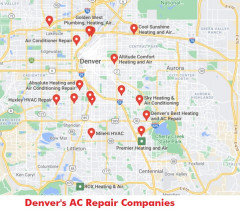
    Your goal is just to argue, so I presented you with a map of air conditioning companies because you somehow think there is no need for air conditioning in Denver's climate, of which you are wrong again as usual. Why don't you address this in your post? Because you have no answer for it... as usual.


    If the OP's goal is to only choose a "furnace" without considering ac needs how likely will they be happy with that purchase considering what I know?


    Oh wait a minute... look who I am asking?


    Now you say "you can lead a horse" -- that argument goes both ways Charles. I bet you're not challenged that often in your ivory tower looking down upon your "contractual obligations" your argument skills are lacking...

  • PRO
    4 years ago
    last modified: 4 years ago

    Ray,

    It appears you missed this portion of one of my earlier posts:

    It's even more ridiculous when you consider that monthly average dewpoints in Denver, CO don't get above 50F except in the months of June, July, and August. In 2021, those average monthly dewpoints were 51F, 56F and 52F. While there are months where air conditioning is appropriate in Denver, CO, the cooling load is sensible heat load, not latent load.

    To be clear, if the air temperature leaving the coil in air conditioning mode is 55F, then the only time condensate would be available for your rehumidification "strategy" would be during July. The OP's question is about wintertime furnace operation. Despite Denver's elevation, July isn't a winter month.

    If the OP wants to control relative humidity--at any time of the year-- they'll be best served by installing a humidifier controlled by a humidistat.

  • 4 years ago
    last modified: 4 years ago

    Your only post in this thread is unintelligible. lol

    (And makes absolutely no contribution to the thread.)

  • PRO
    4 years ago

    Charles,


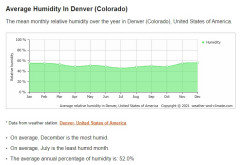
    Average humidity in Denver is 52%.


    Click to enlarge if necessary.


    More to this than just dewpoints Charles, consider your sources people as always. Wink, wink.

  • PRO
    4 years ago

    Ah, my psychrometrically challenged friend,


    Relative humidity--indoors or outdoors-- is a function of temperature. R.H. data should be accompanied by temperature data to give a more complete picture.


    HVAC systems manipulate temperature-- and relative humidity varies as a consequence. The dewpoint temperature is an important design consideration. It determines whether or not you'll get condensation. The average dewpoint in Denver, CO is 28.8 F, but a lot gets lost in an average.


    Let's look at an example to illustrate the point. The temperature data for Denver from the National Weather Service on 11/1/2021 can be found at the following link:


    https://w1.weather.gov/data/obhistory/KDEN.html


    The recorded daily high temperature was 40F and the associated dewpoint was 32F. The relative humidity was 73% Would that be comfortable? Does it suggest we need to increase or decrease the relative humidity? Well, if we heat that same 40F air to 70F for comfortable indoor conditions, the resulting indoor relative humidity drops to around 22% +/- (a psychrometric chart is an eye chart, after all.) Humidification would be appropriate, in my opinion.


    Outdoor relative humidity applies outdoors. We live indoors-- and we can control the conditions.

  • PRO
    4 years ago

    Outdoor relative humidity applies outdoors. We live indoors-- and we can control the conditions.


    Homes are built tight and need fresh air brought in thru the HVAC system and delivered thru the home via what? (system blower)


    Controls can be used to keep fresh air damper closed during times when it's counter productive, the implementation of ERV or HRV in some situations maybe beneficial.


    The bigger picture Charles, remember?


    But because comfort means different things to different people... there *could* be trade offs. Use your imagination as to what I might mean with those words.

  • PRO
    4 years ago
    last modified: 4 years ago

    @Austin Air Companie

    I don't know about you, Ray, but I've designed and built a number of tightly constructed homes including a SIP home that we just completed. The calculated natural air infiltration rate for that home, based on a blower door test at 50 pascals, is 0.1 air changes/hr (ACH.) That's pretty tight. The home includes an energy-recovery ventilator (ERV) and a fresh-air make up system for the range hood which is typical in the homes we build. HVAC systems are an important point of difference in our homes and I collaborate with my HVAC trade partner on every design.

    While ERVs and heat-recovery ventilators (HRVs) can be integrated into the same distribution system used for heating and air conditioning, a better approach is to configure them to exhaust air from particular points in a home (e.g., laundry, bathrooms) and direct fresh air to particular rooms (e.g., bedrooms.) To be clear, that makes them a stand-alone system. While ERVs and HRVs can be programmed for on/off control or modulated based on occupancy, I prefer to operate them continuously which is both simpler, and provides continuous fresh air.

    You made a point about Denver's nearly constant outdoor relative humidity which was, well, pointless. However, it can be used to make a point: While the relative humidity in January and July are nearly the same, the moisture content of the air is significantly different. 52% R.H. air in January in Denver would have roughly half the moisture content of 52% R.H. air in July. With respect to air conditioning system design, the important design conditions are the outdoor air dry bulb and dewpoint temperatures. In fact, July is the only month, on average, when an air conditioner in Denver will produce condensate, because dewpoints in other months of the year are lower than the air temperature leaving an air conditioner coil.

    Comfort does indeed mean different things to different people, but the good folks at ASHRAE researched the topic and established a comfort range that works for the vast majority of folks. It is a useful reference for HVAC design. You might not find it in Wikipedia, but you can access ASHRAE's comfort range chart on the internet.

    "More to this than just dewpoints Charles, consider your sources people as always. Wink, wink."

    Ray, you can probably change out a condenser unit faster than you can correctly spell psychrometrics, but that doesn't make you a HVAC designer. Houzzers will be well served to take your design advice with an appropriate grain of moisture.

  • PRO
    4 years ago

    In fact, July is the only month, on average, when an air conditioner in Denver will produce condensate, because dewpoints in other months of the year are lower than the air temperature leaving an air conditioner coil.


    Well Charles you can argue all you want but there's more than just outside humidity too. You build a home based on no one living there. People in that home produce humidity (some more than others). So again I refer you to the bigger picture. (The picture as it often is a builder chooses to ignore.)


    The bigger picture is: Looking at the whole job site (in person -- not from a forum board window), how it's being used, the intent of the occupants, the complaint etc. So what I say here is primarily around facts that no two homes are the same, comfort requests often vary widely... from the start of this thread I also said that a humdifier *may be* necessary, but not without additional problems. (IE: the truth without sell, sell, sell attached to it. I'm looking for repeatable service not to build something and then have a year or two later escape clause attached to it.)


    Builder grade? what does it mean to you? (the reader, who doesn't respond... this thread is for you.)


    I service the Katy, Texas area.


    (PS: I don't do new construction, I fix the problems new construction often creates another important difference to consider.)

  • 4 years ago

    The OP signed off a week ago. Can we all follow his lead?

Sponsored
Haus Studio
Average rating: 4.8 out of 5 stars28 Reviews
Franklin County's Preferred Custom Cabinetry & Design Studio