Software
Houzz Logo Print
webuser_572303360

Steam Shower Vaporproofing Questions

4 years ago

For our steam shower, our contractor hot mopped the floor. For the wall and ceiling, he put black paper, white flashpaper, hardie board, and then HydroGard 2000. But he's not using hydrogard for the ceiling because he said he's concerned the tile may not stick. Is he doing this right? We're in California, if it matters. Many thanks!

Comments (15)

  • 4 years ago
    last modified: 4 years ago

    Nope. Not at all correct. You need to stop now before it goes further. Hire someone more qualified. If they don’t own a TCNA handbook, don’t even talk to them. They should have it in the truck, and bring it out, to discuss the detailing.

    https://www.tcnatile.com/images/pdfs/Membranes%20in%20Steam%20Showers%20_%20Revised.pdf

  • 4 years ago

    Thanks Verbo. Could you please help me understand what part of what he's doing is incorrect? I looked at the image in the article you sent and was checking off the things that were listed: (1) slope ceiling - check; (2) cement backer board - using Hardie Board; (3) tile - using porcelein; (4) bonded waterproof membrane - waterproof flashpaper; (5) vapor retarder membrane - Hydro Guard 2000; (6) insulation - yes; (7) shower pan membrane - hot mop. Specifically which item is inadequate or needs to be corrected? Many thanks for sharing your expertise.

  • 4 years ago

    I should mention that this is a residential remodel that Supermom and I are undertaking.

  • PRO
    4 years ago

    1. The membrane must be continuous. The TCNA spec allows for an option of two membranes, but they can't be partial. If your guy is using good thinset mortar (and he should be...), there should be no bond issue on the ceiling.

    2. Is the board actually Hardiebacker, or could it be cement board?

    Super Mom thanked Ripped Jeans Construction
  • 4 years ago

    Thank you, RJC. The back of the board says HardieBacker Cement Board. So as I understand it, if he uses the Hydro Guard 2000 on all sides including the ceiling (but not the floor since it's hot mopped), we should be OK? I very much appreciate your expertise in answering this question.

  • 4 years ago

    Thanks, Mint Tile. Unfortunately for California, hot mop is required, I think. I viewed the video for the HydroGuard 2000 and they say it's used for steam showers, but I'll verify with thei tech support. Thank you for the suggestion. Assuming it's acceptable, I understand from your reply that not only should he use the product on the ceiling but on the floor as well, regardless of the hot mopping on the floor? Thanks so much for sharing your expertise.

  • 4 years ago

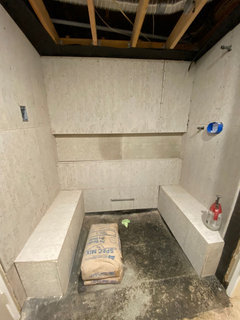
    Also a sollow up question. If Merkrete Tech support says it is not a vapor barrier, what alternative would you suggest? Attaching a photo of where we are now in case this is helpful.


  • 4 years ago

    CA accepts topically waterproofed/vaporproofed shower membranes. Hot mopping isn’t a “requirement”. It’s the lazy, uneducated, ”we’ve done it this way for 30 years” type of contractor approach.

  • 4 years ago

    Shows you how little I know about code. Which raises a question: does vaporproofing need to pass inspection? Given how critical vaporproofing for a steamshower sounds, one would think there would be explicit code for it.

  • 4 years ago

    Hi Mint Tile, I just heard back from the Merkrete technical rep. He said the vapor permeance rating of the Hydro Guard 2000 is .5, which is suitable for steam room. He added that even Better to use is Hydro Guard Sp-1, which a vapor permeance rating of .01

  • 4 years ago

    Yes we have permits and inspections and we passed hot mop. It's a curbless shower, which is not uncommon nowadays, right? Inspector had no issues with anything.

    As grateful as I am for your your advice, I agree I'm even more confused now. The hot mop is a given & I can't do anything about it now. So the best recourse as I understand it is that he uses the Hydroguard from the drain flange out all over the entire floor, up on all walls and ceiling in a single topical application (with many layers - the hydroguard, fabric, hydroguard again for 3 more layers). Am Iunderstanding correctly?

  • 4 years ago

    You can start over and remove everything that was done, and redo it correctly, with a different, more qualified, tile contractor. That can happen now, when it’s a mere inconvenience to you and your schedule. Or it can happen later, after all of the water damage, mold, and rot occurs. And it will be a LOT more expensive then.


    It’s not often that you get the opportunity to correct a bad hiring decision before they do major damage to your home. You have the opportunity to prevent tens of thousands in damage here. You should jump on that.


    What you paid him is a sunk cost. That money is not coming back. And it won’t produce acceptable results. It physically cannot. Start over, or pay for the worse fail that will rear its head in just a few years.


    https://thedecisionlab.com/biases/the-sunk-cost-fallacy/

  • 4 years ago

    I don't understand. What specifically is still the issue with applying Hydro Guard 2000 from the drain flange, all over floor, all walls and ceiling as one topical unit? Isn't that what the other posters have said is needed?

  • PRO
    4 years ago
    last modified: 4 years ago

    So called "water-in-water-out" shower installation systems with a "Pan-Liner" like Hot-Mop, Vinyl, Copper etc. capped of with a sponge-like porous water permeable screed are still listed as approved methoths in the handbooks, but they are absolutely not a good approach. - For several reasons. (Perhaps later, when i get more time I will explain more in detail why you should stay away from these "water-in-water-out" shower installation systems.)

    Here is my advice: (Leve the hot-mop in there, but kind of ignore it.)

    1.) Finish the ceiling. Make sure you have aufficient slope on the ceiling, so the "drops" will run towards a wall. Otherwise you'll feel like in a rain forrest, when the heavy drops hit your head and body.

    2.) Tape ALL seams on walls and everywhere you have a "change in plane" e.g. at your benches, by applying thinset first, embed alkali resistant tape, press it into the thinset with a putty knife and immediately smoothen the seam(s). Do not adhere/stick the self-sticking tape to the seams and then apply thinset! This is wrong!

    3.) Install the mud-bed to the desired height (Finished floor minus tile thicknes, minus thinset thickness, minus waterproofing layer thickness) by using the so called "divot methoth" (Divot Method and let cure properly.

    4.) Water/vapor proof the ENTIRE shower, includin the ceiling, the shower floor-screed and the divot and, since it is a curbless shower you should also waterproof your entire bathroom floor. If your contractor is concerned about adhering problems to the waterproofing membrane, check with the manufacturer of your water/vapor proofing product. There are many other alternatives on the market. I personally would switch to a suitable sheet membrane.

    5.) Fill the divot with a poorus 4:1 or 5:1 mortar. Do not waterproof the filled divot area!

    6.) Tile walls and floor with a suitable setting mortar AKA "thinset" - IMPORTANT !!! Leave "true" expansion joints which means no thinset and no grout residue in them, everytime you change plane. E.g. between wall and wall, wall and ceiling, wall and floor, bench and floor, bench and wall etc.

    7.) Fill all expansion joints with 100% silicon in your desired grout color and let cure. Pretty much every grout manufacturer has color matching silicone. If you grout before filling the expansion joints with silicone, A) your joints will be wet, which prevents the silicone fom proper adhearing to the tiles and B) Grout will most likely particularly pressed into the expansion joints, which will render them useless. Think of it as having a small wedge under the door. Altough the rest of the door gap is completely free, the small wedge in just one spot prevents the door from "mooving."

    8.) Do yourself a favor and grout with epoxy. - For several reasons.