Software
Houzz Logo Print
jlarsen321

Vent Hood - Is Vent a Hood the only option?

4 years ago

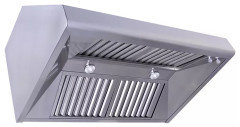
I know this is a topic that has many threads to it, but I just can't seem to make a decision! We are remodeling our kitchen and have a BS RNB 30 in range coming. Is there any vent that is comparable, but less expensive than a Vent a Hood? I can't seem to pull the trigger on a $1700 hood!

Comments (10)

  • 4 years ago

    I was tempted to rave on about how quasi-pro cooking appliances require quasi-pro ventilation, but I won't ... yet. Instead, let me suggest that the OP first define his goals with respect to grease escaping into the house, odor escaping into the house, and noise; and what minimizing these is worth. Then define actual limitations on cost, size, duct path, how MUA can be introduced and heated (where applicable), etc.

    Generally, one must trade among performance, aesthetics, and cost, but doing so requires understanding of what is being traded. If full use of a high performance range is contemplated, expect to spend a "comparable" amount on the ventilation.

    And with respect to VaH, in contrast and or comparison with more conventional hoods, the pressure losses that it will have to work against need to be understood, just as they will need to be for the alternatives.

  • 4 years ago

    P.S. Even if traveling only part way to somewhere we might call pro functionality, one has to know where that destination is. I suggest reading the first dozen or so pages of the 'Greenheck Guide' available here: https://www.tagengineering.ca/wp-content/uploads/2015/02/KVSApplDesign_catalog.pdf.

  • 4 years ago
    last modified: 4 years ago

    Vent-a-Hood is most certainly not the only option. There are some "Pros" on this forum who always recommend Vent-a-Hood, but I doubt they actually have one in their own kitchens. While these hoods work well, the squirrel-cage system is a pain to clean. There are other exhaust hood manufacturers that have baffle filters that you just put in the dishwasher and done. Vs VAH hoods with several parts that need to be cleaned, and the squirrel cage itself which only comes off for cleaning with a hex wrench - life is too short.

    I would look at Best or Broan, and make sure you get baffle filters (not mesh filters), a canopy shape, and try to get 24" depth, or no less than 22" depth if the 24" depth hoods are too expensive.

    Make sure your duct from the hood to the outside is sized properly - it should be 8" or 10" diameter depending on the hood specs.

  • 4 years ago
    last modified: 4 years ago

    VAH is actually a quite bad option. They are one of the noisest hoods available.

    Some noise charts here: https://bamasotan.us/range-exhaust-hood-faq/

    I'd suggest looking at Prestige HC and Wolf. @kaseki, is there a Wolf hood that you thought equiv of the Prestige HC?

    jlarsen321 thanked opaone
  • 4 years ago
    last modified: 4 years ago

    OP said: "I can't seem to pull the trigger on a $1700 hood!" @opaone said: "I'd suggest looking at Prestige HC and Wolf."

    @opaone - Prestige and Wolf cost more than the OP's budget that she emphasized with an exclamation point. Though it looks like Wolf hoods are available on eBay or as refurbished for significantly less. AFAIK, Wolf hoods are rebadged Best/Broan but I might be wrong, but if it is true, may as well buy Best/Broan for less money. Not sure what "HC" is - is that Faber?

    An OT (somewhat) question about the Prestige hoods. I see their filters are set up as a "V" shape. Is that better or different in some way than the more typical baffle filters that are parallel to the cooktop? I would think you'd get grease collecting on the middle strip where the lights are.


    jlarsen321 thanked Shannon_WI
  • 4 years ago

    Wolf specifies (or at least did a decade ago) Broan/NuTone blowers. We can't easily know whether they are exactly the same, or have some additional or tighter requirements imposed.

    The Wolf hoods are very heavy and nearly perfectly welded. I have not seen a Broan/Best hood for comparison.

    Slanted baffles allow the grease to run to a collection channel. Steeper than 45 degrees is required of commercial baffles. For residential baffles, the tilt angle allows a modicum of reservoir below the baffles, thereby slightly improving containment over perfectly horizontal baffles. Also, the plume reflectance angle is better suited for flow entrainment if not initially achieved.

    Lower priced hoods may prove to be noisier if insufficient effort went into the baffle design.

    My Wolf Pro Island hood (ordered in 2008) was built by Independent, but I understand that Wolf have moved production into Wolf. The drawings in the Wolf Design Guide are the same.

    I hope it is obvious that on-site performance of a lesser quality hood that one buys and installs is better than a higher quality hood that one doesn't buy. On the other hand, if one can squeak out the necessary funds, more happiness (or less annoyance) is likely with the higher quality selection. The Blue Star will be more of a monument than a cooking tool if it can't be operated at full power for aesthetic or health reasons.

    jlarsen321 thanked kaseki
  • 4 years ago

    I doubt that the VAH is a complete package. They price their components separately, and that confuses people. The cmolete cost is likeky at least double that.

  • 2 years ago
    last modified: 2 years ago

    Took a quick look at Rangehoodmaster - these are decorative and not functional. E.G., zero containment volume, shallow, flat baffles, etc.

    I'd stay far away from them.

  • 2 years ago

    Unfortunately, @jlarsen321 did not return with a description of the system selected, or its observed performance in the context of the cooking to be performed.

    If one imagines near-perfect capture and containment from a commercial system, and then attempts to squish this mechanical system into the space available in most residential kitchens, including duct placement limitations, MUA system limitations, etc., one eventually finds that the path of commercial system approximation leads to one of two endings. In the first one spends a lot of funds on the higher air flow hi-end residential system that is almost as good as the commercial system, but it fits and is more aesthetic. In the second one spends lesser funds on a system that may be good enough for one's cooking style, or at least better than no system.

    A story from the past: Once upon a time (1984) a good friend of mine, a coworker and part-time professor, brought his Chinese student to our house to cook Chinese food on our then coil electric cooktop. This cooktop was part of a cooking center with low ventilation flow rate, but perhaps a tad better than the standard ventilation put into kitchens of the time.

    When it was all over, we were full of great food and the kitchen surfaces were full of oil, requiring a major cleaning job the next day. That began my quest for better ventilation, initially limited to boosting the flow rate in the duct path. Actual competent ventilation was not achieved until the end of my kitchen renovation starting in 2008.

    So it is not trading off performance against cost that is bad, it is not knowing what the result will be versus one's goals that is bad. My hope is that review of the many kitchen ventilation threads here will lead the wannabe renovator to a considered solution, if not an out-of-reach ultimate solution.

Sponsored
Mary Shipley Interiors
Average rating: 4.8 out of 5 stars34 Reviews
Columbus OH Premier Interior Designer 10x Best of Houzz