Software
Houzz Logo Print
sultry_jasmine_nights_fl9

Wildlife Friendly Privacy Hedge Ideas

We will be moving to a zone 8b property in the FL Panhandle. This property is mainly surrounded by woods and has a large pond on one side.
We dont have any really close neighbors but can see some from afar on one side. I want to make a large row of wildlife friendly hedges on that side. I am thinking about Southern Wax Myrtles.
This area is about 1000 feet long before it hits some adjoining woods. The shrubs can get as tall and wide as they want. The area gets plenty of sun and has good drainage.
-Does anyone have any negative experiences with Southern Wax Myrtles?
-How close would you plant them? I was thinking 10ft apart. Is that too close?
-Since its such a big area, what other tall shrubs would grow tall and dense? It would be good if they were somewhat drought tolerant once established.
I am also thinking maybe some Camellias scattered here and there might be pretty.
I can't do Azaleas because they are posionous to our goats which will be near that area.

Comments (13)

  • 4 years ago

    contact your local county extension office and find out what they recommend ... in many states they offer small plants at very good prices ...


    never plant a monoculture ... just in case something comes along and starts destroying them.. a vast collection of differing plants is the key to avoid that ...


    spacing is rather irrelevant to the plants ... its more about how fast you want to accomplish your goal ... and if you are in no real hurry .. 10 feet sounds just fine ..


    ken


    add your county name: https://duckduckgo.com/?q=FL+county+extension+office&t=ffcm&ia=web


    same here: https://duckduckgo.com/?q=FL+county+extension+office+plant+sales&t=ffcm&ia=web


    as an example .. find the shrub link: https://ffl.ifas.ufl.edu/plants/

    sultry_jasmine_nights (Florida-9a-ish) thanked ken_adrian Adrian MI cold Z5
  • 4 years ago

    Camellias are drought tolerant when well established.

    sultry_jasmine_nights (Florida-9a-ish) thanked D M PNW
  • 4 years ago
    last modified: 4 years ago

    Southern Wax Myrtle, Morella cerifera is native to Florida. I would still use a few different species for wildlife and aesthetics. A few came to mind, Calycanthus floridus, Senna ligustrina, Aronia arbutifolia, Sabal palmetto, Hamelia patens, Melochia tomentosa, Illicium floridanum, Erythina herbacea, Viburnum obovatum, Lycium carolinianum, Pavonia bahamensis, Ilex, (12 species native to Florida). There so many more that I can't think of at the moment. This link might help

    https://www.fnps.org/plants

    sultry_jasmine_nights (Florida-9a-ish) thanked Jay 6a Chicago
  • 4 years ago

    “Camellias are drought tolerant when well established.”

    I stand corrected. I suppose I’ve just never seen them anywhere dry.

    sultry_jasmine_nights (Florida-9a-ish) thanked floral_uk z.8/9 SW UK
  • 4 years ago

    floral_uk, the goats will be well fenced away from the plants like they are now. I just dont want to plant any more toxic stuff at the new place and stick to non toxic things for landscaping, going forward :)

    Floral & Ken, that makes sense. Good point on not planting a monoculture.

    Hoping to find mostly stuff that is evergreen (keeping its leaves over the winter).


    I will be planting an orchard of sorts, so there will be different kinds of plants there.

    So far, I found a huge Pecan Tree, a Crab Apple, and a Blackberry (that doesnt look like our scraggly wild ones), planted on the property. Everytime I go out there I find something new. We havent even went into the wooded part yet because its too overgrown to get into 😅


    Jay, thank you for those suggestions. I will look them up!


    DM , I have found the Camellias to be drought tolerant once established here.

    I also have some banana shrubs (Michelia/Magnolia figo) but I dont know how tall they would get in the ground. I have had 2 in pots for about 12 yrs and they are about 7ft tall. They get bare legs but it might because they are potted. They smell so good.

    Gardenias do well up there too because there is a huge lovely one by the back deck that has managed to survive on its own for a year while the place was in foreclosure.


    Another question...

    I found one website that said you must buy a male & female Wax Myrtle plant to get the berries. Is that true? I didnt know there were female and male wax myrtles, I thought they all just made berries..never had Wax Myrtles before lol. Our local nursery just has them in different sizes not labeled by sex!


  • 4 years ago

    Camellias can dry out once established, but not for long. It's recommended they get 1" of water per week when flowering. They could probably go longer without water in the milder PNW, but not in the intense summer Florida heat.

    sultry_jasmine_nights (Florida-9a-ish) thanked Jay 6a Chicago
  • 4 years ago

    Thank you. Our summers see a lot of rain in the afternoons. We are going to put in a faucet on that side of the property so I can water them when needed. There is a metal workshop/garage on that side that doesnt have water to it so we were planning to run a line out there anyways.

    That way, I can water the front end of the Privacy hedge.

    There are random faucets out in the pastures. There is a seperate deep well for them. When we first bought the place, we found that, that well wasn't working. Hubby chased the waterline from it and found a faucet that had been strangled by a tree near an old livestock tank! It was spraying water and so he put in new pipes etc and luckily, that well now works. I think we can run a line towards the back of the Privacy Hedge from there. Maybe we can put in a dripline or something.

    It has been like a weird treasure hunt with all the crazy stuff we have been finding.

  • 4 years ago
    last modified: 4 years ago

    Also Forestiera segregata, Florida Privet, Clethra alnifolia, Cyrilla racemiflora, Hypericum fasciculatum, and Baccharis halimifolia. I never checked each species for toxicity to goats.

    sultry_jasmine_nights (Florida-9a-ish) thanked Jay 6a Chicago
  • 4 years ago

    my experience with Wax Myrtle- when I first moved to my farm in 9B, I planted a few lovely wax myrtles during summer with daily rains. It still wasn't good enough.

    My soil is very sandy and well drained but doesn't hold any moisture. All the wax myrtles

    slowly died off. They like low lying area w/ better soil and moisture.


    What I love for fast growth in dry areas is Eastern Red Cedar trees. Many animals eat the berries and birds also nest in them during winter and in springtime also.

    They grow fast and provide a solid privacy block.


    I agree with others, plant a variety of natives that provide food and habitat.

    sultry_jasmine_nights (Florida-9a-ish) thanked mr1010
  • 4 years ago

    Thanks jay. I will look all those up :)


    mr1010 Good to know about your experience with the wax myrtles. Maybe I will try a little strip of them in the place that I want to block the view the most and see how they are doing in several months. We can run drip irrigation if we have to.

    I think there might be some Red Cedars on that side of the property and in the back just before the heavily wooded area. I will have to check my photos and then I can post them to see if that's what they are.

  • 4 years ago

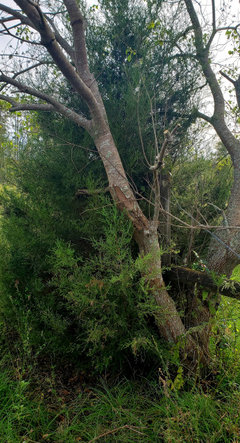
    Ok I did find a photo of a tree that *might* be red cedar? These are all over the place in little groups around the property. Ignore the invasive bad tree in front of it..we are gonna cut that down.


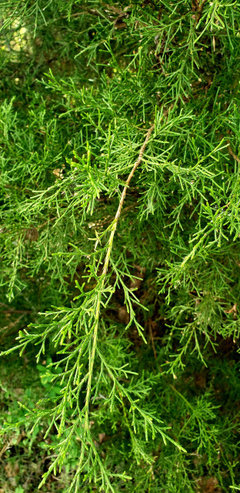
    Here is the foliage


  • 4 years ago

    that looks like Red Cedar. You can easily transplant the small ones and put them where you want them. They are great for food and shelter for many birds and mammals.

    LUCKY YOU FOR HAVING SO MANY. I found one growing naturally on my farm and learned that birds must eat the berries and then deposit them on the ground for them to

    grow.

    Maybe I'll try propagating some from branches.

    sultry_jasmine_nights (Florida-9a-ish) thanked mr1010