I have been researching as much as I can on this forum about range hoods (thanks especially to @kaseki and @opaone for their excellent posts and FAQ) and have settled on doing a custom hood with an external blower and silencer. My great room and kitchen are being gut renovated, so I have a decent amount of leeway on rearranging internals in the wall and making a new roof penetration. The ceilings are about 10.25' high, with a 30" attic above that + some space for the ceiling joists. I'm going to have a 36" Thermador Freedom induction cooktop on 24" deep countertops with the oven under it. The hood is currently designed to be about 6' from the ground (36" high countertops, 36" from countertop to hood), though this is adjustable. But with those specs, this gives me about 8' from the bottom of the hood to the roof.
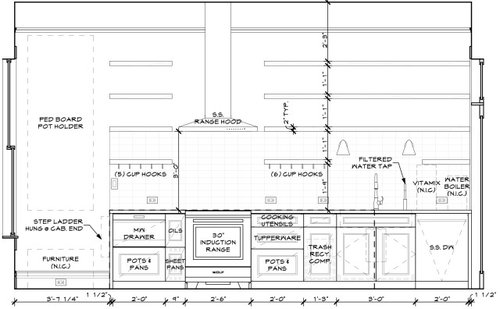
Here is a an older draft elevation for the kitchen wall with the hood (ignore the part where it has an S.S. chimney hood -- that's just a fill-in):
Our kitchen is being planned with all open shelving so I'm pretty keen on getting a hood that performs well enough to keep my shelves as grease-free as possible while being as quiet as possible (the kitchen has an open floor plan so I don't want turning the hood on to stop all conversation!). It also means I have no cabinetry to blend the hood into.
I'm currently leaning towards a 42" wide x 27" deep hood, but as I've been trying to actually find a hood I've had a few questions that I'm curious if anyone in this extremely helpful forum knows the answers to:
- Most hoods and hood liners give you the external dimensions of the hood, but am I right in thinking that for capture, the more important dimensions are the dimensions of the actual opening of the hood (so the external dimensions minus any light bar, trim, etc.)?
- I love the high capacity hood liner from Prestige because of its increased containment volume compared to most residential hoods, but it is only 21.5" deep externally. Does anyone know what the actual aperture of it is if you exclude the trim?
- On the other hand, I'm attracted to the idea of just making a custom hood from Modernaire, Rangecraft, Coppersmith, or Havens (I'm also open to other suggestions of custom hood makers -- it's something I've only recently started looking into). With a custom hood, I could create a 27" deep hood with a larger aperture. Modernaire let me know that on their standard liner, the light bar (5.25") + trim (2") + flange (1") is 8.25". So on a 27" custom hood, I should get a 18.75" deep aperture, which beats the Prestige hood liner. For performance in removing effluent, is it better to have a larger capture area (which I believe the custom hood could get me) or a larger containment volume (which I believe the Prestige high capacity liner would get me)? I would instinctually believe capture, but curious if the real engineers here know better!
- I have seen tons of glowing reviews here about Modernaire (and the brand performed well noise-wise on @kaseki and @opaone's noise charts), but does anyone have experience with Prestige, Rangecraft, Coppersmith, or Havens Metal hoods?
- If the blower is external and the duct is a straight shot with a silencer, how much does the hood itself matter for noise? And on that note, does anyone have experience with Prestige High Capacity hood liners, Rangecraft, Coppersmith, or Havens Metal hoods and know how loud they are? My primary concerns are performance and noise followed by aesthetics.
- Can you create more mechanical containment in a custom hood by simply installing the baffles at a higher angle or higher up inside the hood?
Know that's a lot, but I appreciate any insight on any of these questions! Thanks!




kaseki
kaseki
Related Professionals
Oklahoma City Kitchen & Bathroom Designers · Chula Vista Kitchen & Bathroom Designers · Lewiston Kitchen & Bathroom Designers · Syracuse Bathroom Remodelers · Phoenix Bathroom Remodelers · Honolulu Bathroom Remodelers · Spring Kitchen Remodelers · Las Vegas Kitchen Remodelers · Rochester Kitchen & Bathroom Designers · Grand Island Kitchen Remodelers · Ogden Kitchen Remodelers · Baltimore Custom Countertops · Rocky Mount Custom Countertops · Rockford Custom Countertops · Saint George Custom CountertopstassadarOriginal Author
kaseki