Software
Houzz Logo Print
jason_carlton26

Transplanting wild American holly trees

I have a TON of wild American holly trees growing throughout my property, and I'd like to move them around to more strategic areas that could use evergreens.


Last year I transplanted 10 of them, ranging in height from 2 to 7'. Only one of them survived :-(


I made a point to dig up as much soil as possible, and put them in areas with similar sun to what they'd been getting. But still, 9 out of 10 just didn't like it. Which is weird, seeing as how they seem to take root anywhere the wind blows... except for where I want them!!! LOL


Any other suggestions on how to successfully move them?

Comments (11)

  • 4 years ago

    I'm not sure how relevant this may be as it's a different species altogether but English holly, Ilex aquifolium, is borderline invasive in my area. And there is a lot of it around - like a Christmas holly farm just up the road. So bird sown seedlings pop up all over the place. Even at just a few inches tall, they are almost impossible to pull up due to a significant tap root that anchors them in pretty firmly.

    Although it shouldn't have much impact on transplanting success, I wonder if the tap root thing is an issue?

  • 4 years ago

    The holly trees that grow here (which I'm only guessing are American holly) grow everywhere, too, but I don't think they're considered invasive. They're really just not all that pretty, so most people hand-pull them from their yard and let them grow wild in the woods.


    My goal was to use them as a mid-size evergreen background, though, to help balance the pretty shrubs and ornamental trees before you see the large field pine, oak, beech, etc in the woods. And they'll help be a sound barrier in the Winter.


    The ones I dug up didn't really seem to have a deep taproot or anything, just long branches (tendrils?) that are relatively shallow. Unless I screwed up and cut off the taproot! Which could definitely explain the poor success rate...

  • 4 years ago

    I have never tried to move a wild Holly tree but have successfully transplanted a Bay Magnolia. Both are found in the southern coastal woods.


    While I made several attempts, the ones that succeeded were the ones that I went out of my way to maintain moist soil around the root ball, after they were transplanted.


    In the woods they were growing in a moist environment covered with leaves so the soil was always moist. Replicating that in the yard, final led to a successful transplant.

  • 4 years ago
    last modified: 4 years ago

    All I can say is they do tend to form strong roots early on...but they are not especially sensitive to root disturbance. Still that is a surprisingly low success rate. Hollies, generally, are indestructible. What time of year did you try this? Fall to early winter (now) would probably be best.

    Do you use a mattock, digging bar, or axe to sever the roots?


  • 4 years ago

    I guess I should make sure that I'm talking about the right thing, cause I thought they were indestructible, too!


    The ones I transplanted were September of last year, which I thought was prime time?


    Do you use a mattock, digging bar, or axe to sever the roots?


    Nope, I just followed the rule of digging along the line where the branches reach with a shovel, and digging as deep as I could.


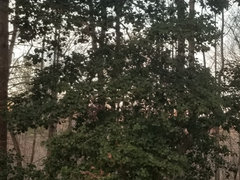
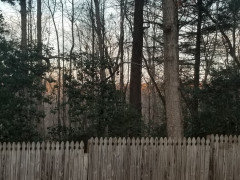
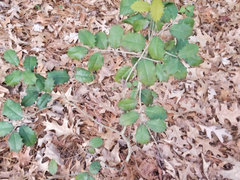
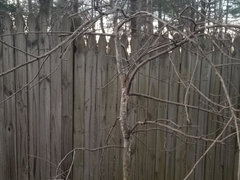
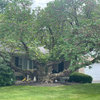
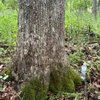
    Here are some pics for you...


    This one is to the North of my house. Please ignore the fence, I'm slowly rebuilding it as time and money allow:


    You can see that there are 3 in a row. The one in the above pic is the one to the far left of the below pic:


    Of the ones that I transplanted, this is the sole survivor (maybe 18" tall):


    This one is 10-15' to the West of the survivor; it was closer to 7' tall. All of the leaves fell off, but then I had a few new leaves come up in July-ish (along the trunk, not the limbs) so I thought it was going to recover! Then they died away, too:


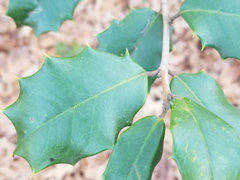
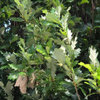
    Close up of the leaves, in case you don't think it's American holly:


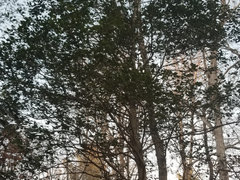
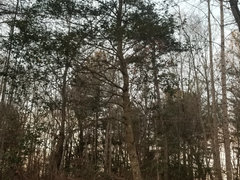
    These next two pics are of the largest one I have, it's 30' or so. It was in the mix of a bunch of trees I've been cutting back to build an orchard, so I THINK it's kinda thin from a lack of sunlight. I honestly can't decide whether to leave it or take it down:


  • 4 years ago
    last modified: 4 years ago

    Those are hollies, prb'ly Amer ones. The ones you show are prb'ly too big to transplant. If you could find more small ones like your survivor....

  • 4 years ago
    last modified: 4 years ago

    definitely American hollies...TBH I've moved plenty of my fancier, prettier Eurasian hollies* over the years including a huge one - and that was way before I had a backhoe - and they did fine. If you got enough of the roots I'm at a complete loss to explain what happened. Either over or under watered after being replanted is the only thing that comes to mind. With hollies, probably the latter. (under)

    * - which, btw, the robins eventually feast on just as they feast on the American ones, and so far, no piles of dead robins about 'cuz they wuz 'totally toxic' non-natives! Sorry Dr. Tallamy!

  • 4 years ago

    @bengz6westmd, oh yeah, the big ones I showed are staying where they are :-) I just wanted you to see what they looked like fully grown to be sure that I'm dealing with what I think I'm dealing with! LOL


    As I've walked around the property, I have probably 50 saplings that either need to be moved or removed. One of them is around 7' tall and I'd LOVE to save it! The rest are more like 18".


    Either over or under watered after being replanted is the only thing that comes to mind.


    @UpperBayGardener (zone 7), the sole survivor IS in a section with a sprinkler (20 minutes, every other day). But the larger one that didn't survive (and 2 others that didn't survive) is ALSO in that same section! LOL


    @nandina, thanks for the detailed info! We're having a warm period in my area right now, so I'm going to start on your recommendation today :-) There are a few that are in my new orchard area that I'm going to try to just transplant immediately, but if they don't survive then it won't be a tragedy.

  • 4 years ago
    last modified: 4 years ago

    IS in a section with a sprinkler (20 minutes, every other day).

    Ok to me that sounds like more than they needed, especially with 'naturally occurring' rainfall, unless you had a drought during that period. But even then...I have never watered any woody plant I transplanted more than: once, heavily, on planting, maybe a little bit the next day to make sure it was really soaked, then once a week.

  • 4 years ago

    This particular sprinkler is an impact sprinkler, so it covers a section of the lawn as well as this garden area. The garden area is dappled-sun with rhododendron, azaleas, bulb flowers, and hostas.


    I transplanted a mature rhododendron in this same area that (tragically) died. But I also had layered rhodo cuttings there that did well!


    Next year everything will be a bit more established, though, so I could back the sprinklers off to weekly or something if you think that's better. I wish the system had a gauge to measure water in the soil and just running as needed, but... maybe some day!