Software
Houzz Logo Print
danielle_reiss19

Soil Retaining Too Much Moisture

4 years ago

Hi! I bought some ProMix HP soil 6 weeks ago and repotted/ root pruned my monstera deliciosa into that and some pumice.
At the time the soil seemed perfect, it had great consistency and normal runoff when I watered the plants in.
After a few weeks I started to get concerned as every time I checked the soil it was still wet. I thought maybe it was due to the root prune and it being winter (don’t start, it had to be done regardless of the season and this was the only time I could do it), but I’ve had this plant for years and it’s never gone a month without needing water.
Today I checked it with a skewer and the soil seemed dry enough for me to water, so I slowly watered it hoping to see some runoff, but after 1 gallon I never got any runoff. It’s in a 14” wide 10” tall terracotta pot. The plant has never needed that much water before.
I checked the drainage hole and poked around to make sure there wasn’t something clogging it, but I used a screen and everything seemed normal. The soil just felt very, very wet and heavy.

Anyone have any advice or any experience in using ProMix before? I’ve read the threads about the recommended mixes but I had trouble finding small enough pine bark and other ingredients without breaking my budget, and read great reviews on this soil (specifically that it had great drainage) so I went ahead and bought it. Also should I keep watering until I get some runoff? I’ve never had this happen before with soil so any advice is greatly appreciated!
Thank you!

Comments (10)

  • 4 years ago

    i only use promix.. its the best ...


    and so what if you only have to water once a month .. to some of us.. thats the point ...


    the plant will wilt.. when it needs water ... so since you watered it ... take note of the date ... and dont water again until it shows you it needs water ...and there is your new schedule of sorts ...


    you dont mention where you are ... or if you have a forced air furnace ... i found clay pots to be near impossible to use in my house because of the furnace.. the pot wicked all the moisture out of the media.. thru the sides of the pot ... and when you water.. you have to water the media and the pot ....ya ...


    anyway .. new media mean new watering regimen ... dont focus on how you used to do it .. because.. it really doesnt mean much anymore ... as noted.. the plant will tell you when it needs more water .... Al can tell you about all the other tells ...


    also.. i never water more than a cup or so at a time ... i cant imagine putting a whole gallon of water in a pot ....


    ken


    ps: i dont understand root pruning ... peeps seem to do it.. i just dont know why .... if its your thing.. all the power to

  • 4 years ago

    I would be very stressed out if my plant was still wet after that long too. I'd repot in a different soil.

    I just bought some new soil and I did a test. Mind you, I've never done this before. But I didn't want to be in the same predicament you have found yourself. I filled a 4" pot with the new soil and watered it all the way through, let drip drain in the sink. Then set that pot on a saucer and it has been sitting empty for a week now. I can now see that the soil did compress quite a bit and after a week, it's still a bit damp but the top 1" or so is now dry. I didn't really love the way it compressed so before I use it, I will likely add more pumice or coarse perlite to it. Experiment was worth it before using it and having to find out after a plant was already in it.


    You sound like a good plant parent and already basically knew that the situation wasn't right. You'll do fine!

  • 4 years ago

    @popmama that’s a great idea to test out the soil! I’ll definitely be using that in the future. Unfortunately I also replanted my long time fiddle leaf fig in this soil as well so I’ll have to repot both into some bark based media like @gardengal48 suggested.
    The good news is they both responded wonderfully to the root prunes and since then I’ve gotten more new growth from the fiddle than I’ve seen in nearly two years!
    Thank you both for the tips!

  • 4 years ago

    Buy a water meter ($15 at the hardware store) and use it.


    The reason you need to root prune is that water and nutrient absorbtion are much more effective in small, new roots. The white, fuzzy "hairs" you see on roots. Older, woodier roots don't have as many and they take up a lot of space in the pot.

  • 4 years ago

    Inexpensive water meters do not measure moisture levels - they measure EC (electrical conductivity) which fluctuates significantly with the level of dissolved solids (salts) in the grow medium. To validate, simply fill a clean cup half full of distilled water, clean the probe, then insert it in the water, noting it will tell you the water is 'DRY'. Sprinkle a small amount of table salt in the water and watch the meter move to 'WET'. Too, these gadgets are more often than not too short to measure moisture levels near the bottom of larger pots where the medium actually holds the key insofar as whether it's appropriate to water. In order to accurately gauge moisture levels deep in the pot, a homemade wooden "tell" made from a 1/4 or 5/16" dowel rod (any hardware or home improvement store). Just cut a 48" dowel rod in half or cut it into 2 pieces 28 and 20" long and sharpen all 4 ends in a pencil sharpener.

    If your pot is 5" deep or less, by all means, use the finger test and follow the commonly offered advice to "water when the top 2" of the soil feels dry". For deeper pots, this advice is inappropriate; reason being, in a 10" deep pot, when the top 2" feels dry to the touch, the bottom 6" can still be 100% saturated with water. A "water meter" might read 'wet' or 'dry', depending on how long since the planting was last fertilized and whether or not you habitually flush the soil when watering.

    It's very difficult to "amend" a medium too water-retentive; reason being, it takes a LOT of coarse material to 'improve' a medium that holds too much water. If you had a medium that was made of peat and perlite and wanted to "amend" it to increase aeration/ promote drainage, you would need to add enough coarse bark to get the mix beyond the 'THRESHOLD PROPORTION' which would be when the mixture percentages were such that there is exactly enough peat to fill all air spaces between the larger particles. This generally occurs when the mix is made up of 80-95% coarse material larger than 1/10". Until the threshold proportion is achieved, aeration in the medium actually decreases. Example. Imagine you have a jar partially filled with sand and the total air space between the sand particles is 5 cu in. If you mix a dozen marbles with a volume of .5 cu in each into the sand, you increase the volume in the jar by 6 cu in, but there is 0 increase in aeration. Adding coarse material to a water-retentive medium works exactly the same way.

    That said, there are some tricks you can use to limit the amount of excess water a planting can hold. What size pots are the plants being discussed in?

    BTW - I agree with Pam that root-pruning or some other mechanism that eliminates root congestion (like dividing plants) is an essential part of any care regimen if the grower's intent is to maximize opportunity for the plants (s)he grows to realize as much of their genetic potential as possible. Potting up is a half-measure which only partially reduces the stress of root congestion while ensuring most of the stress remains as a permanent limiting factor, at least until someone actually gets their hands into the root mass to correct problem roots and congestion. This is just as true for plants moved from nursery cans, 3-6" pots, cell-packs, or B&B plants, into the landscape. Odds of a tangled mess of roots self-correcting are so low it might as well said it simply doesn't happen.

    Al

  • 4 years ago

    Hi Al! The plants mentioned are in 14” diameter terracotta pots, one is 10” tall and the other is 14” tall.

    I haven’t had any luck finding the right size pine bark for creating my own potting mix using your formula, I’m in North Texas. Do you have any advice on where to find it, an alternative bark mulch, or even a reliable brand of ready-made potting mix?

    Thanks so much, your threads on here have always been a tremendous help for me!

  • 4 years ago
    last modified: 4 years ago

    First, finding a source of pine bark in an appropriate size seems to be getting more difficult, and I think it's because bark is being used as a source of fuel for many production facilities that need lots of high heat. The bark isn't actually burned, it's baked at high heat and the gasses the process yields are then burned to create live steam. I have helped people in TX find bark, and it's always been located at operations that provide landscape mulch in bulk or through nursery/greenhouse ops that mix their own soil. My fallback source is a wholesaler about 40 miles distant that sells a perfect size mix in 3 cu ft bags, but I have 3 other sources within a few miles of home where I can usually count on having bark in the spring. I know that doesn't help you, but there are sources out there. I guess it depends on how motivated we are when it comes to doing the sleuthing it often takes to locate it. The way I look at it is, if someone is serious about offering their plants a better opportunity to thrive, it's undoubtedly worth looking for. A medium you don't need to fight in order to gain control over your plants' state of vitality makes a significant improvement in the ratio of effort expended to results realized, so much so that it makes growing things a 'whole new ball game'. I know this is true because it was not only my own experience, but I have received so many notes from other growers essentially saying that their growing experience was also transformed by gaining an understanding of how water behaves in container medium.

    We all run up against issues when using media based on very high %s of fine material. Some of us get over that hump and others are content with what limitations are imposed by water-retentive medium. We're all different in how our priorities are ordered, and it's essential we make allowances for the differences.

    Whether or not you decide to keep an eye peeled for bark or search it out, there are some things (most growers wouldn't think of) that can help to limit the amount of excess water a planting can hold. It reduces the amount of water BETWEEN soil particles, which is the water that is most detrimental.

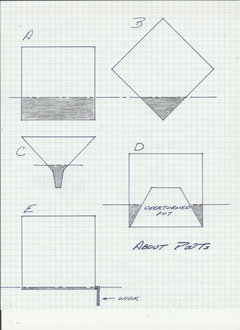
    1) Tipping your pots after you water thoroughly will eliminate a good measure of excess water. Compare B to A below to see a realistic representation of the difference it makes:


    2) Doing a little planning and using a pot a little larger than you normally would so you can add a smaller overturned pot at the bottom (as in D above) does a remarkably good job of passively limiting a planting's ability to hold excess water (cover the drain hole in the over-turned pot). If it's set up right using other forms of ballast can eliminate more than 90% of a planting's potential to hold excess water.

    3) A wick through a drain hole also "fools" the excess water into acting as though the pot is deeper than it is. Water moves down the wick and the weight of additional water moving down the wick pushes water lower on the wick off of the end. Another passive plan.

    4) Finally, for smaller easy-to-manage plantings, you can put Newton's First Law of Motion to work for you. This will remove ALL excess water (and then some) from a planting. See Newton's Law below.

    You asked about finding a medium you can order. Most of those will be expensive if only for the shipping, but American Bonsai in FL has a wide assortment of materials from which you can customize a medium to do practically anything you need. THIS PAGE lists all of their premixed media as well as all of their soil ingredients/amendments.

    Newton's First Law

    For conventional container culture, it's a given that saturated/partially saturated media rob roots of the oxygen they need to function normally and efficiently. At best, soil saturation robs your plants of immense measure of potential in areas like growth, appearance, yields, ….. At worst, plants unable to cope with the strain of drought stress caused by saturated media will succumb to it. This isn't a 'scare tactic, it's a very simple and straightforward observation that will be difficult to disagree with a straight face.

    Newton's First Law of Motion states that an object will remain either at rest, or in motion at a uniform rate and in a straight line unless acted upon by an external offsetting force. In this case, we will designate the 'object' as excess water in your potting medium. At risk of my being redundant, the 'law' can be seen as a simple statement about inertia, that objects will remain in motion and in a straight line unless a force acts to change the motion. To put the law to work for you/your plantings, you should water to beyond the point of total soil saturation - so the medium has been completely saturated and at least 15-20% of the water you have applied has exited the pot. Unless your soil is purposefully constructed to eliminate all/nearly all excess water, it's extremely probable, when the pot has stopped draining, there will be too much water in the potting medium for the plants' liking.

    To eliminate this excess water: immediately after a thorough watering, hold the pot in one hand over the sink, lawn, or over-sleeping significant other and move it downward, then sharply reverse the direction to upward. You'll immediately note that a good measure of 'excess' water will “continue downward in a straight line” and exit the drain hole. The sharper the reversal of direction, the more water exits the drain hole. When you have repeated the exercise until water no longer exits the drain hole on the reversal of direction, you will have eliminated all excess water and your plants will regard you with a newfound sense of awe.

    Let me know if you have any other questions or concerns you think I might help with, and thanks for the kind words.

    Al

  • 4 years ago

    If you are concerned about your plant being too wet, put a chunk of newspaper under the pot. It will draw some of the moisture out. I’m doing that now with a soggy holiday plant I was given.

  • 4 years ago

    Good thought, Socks.

    In severe cases, remove the plant from the pot entirely and allow it to rest on a stack of newspaper, paper bags, paper towels, old towels/sheets ..... . Usually a half hour will do the trick so long as the absorbent material isn't fully saturated. If it does become fully saturated, you'll need to depend on a measure of water evaporating before additional water can be 'pulled' from the planting.

    Setting a pot on a stack of newspapers works IF there is contact between the paper and the soil column. IOW, once natural gravitational flow has ceased, potting a pot on a stack of absorbent material will not induce water in the pot to 'jump the gap' between the soil and the paper. This might not be much of an issue if the pot has a very thin bottom, but it's crucial (if we're seeking drainage beyond what occurs due to water's normal gravitational flow potential in soil/media) that there is an unbroken connection between the medium and the paper. A small wad of paper towel or newspaper pushed against soil showing through the drain hole would do nicely.

    Too, It's even more important when the grower has employed a screen, pot shard, or equal to prevent media from migrating out of the pot via the drain hole(s).

    Al