Software
Houzz Logo Print
nate_harris32

Rubber tree issues/where to prune and propagate

4 years ago
last modified: 4 years ago
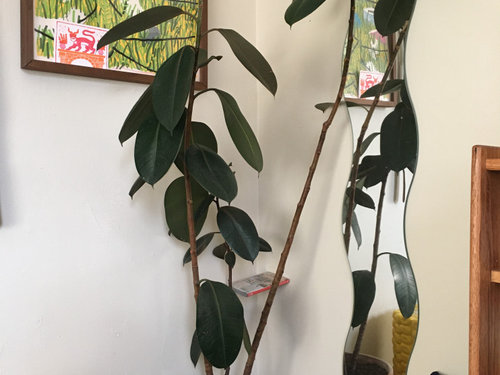


Hello,

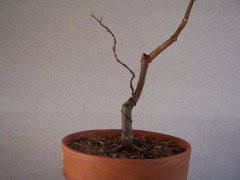
I would like to give this rubber tree some attention.


Question 1:

Every time I water (which is not often) it drops a leaf - typically on that right branch (which is why its so leggy)

What is the common cause of this?


question(s) 2:

How should I prune and propagate the branch to the right?

If I cut, say, 12" from the soil, will it produce new growth from that cut?

Then I'd trim the majority of that stem and propagate the top?

What would you do with that branch?


Thanks!

Comments (7)

  • 4 years ago

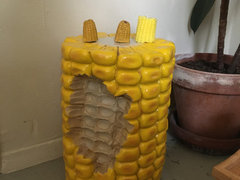
    ok.. lets start with the important part first.. i just love the corn on the cob.. lol ...


    watch many of these ... and note how big and what type of cuttings they use ...


    https://duckduckgo.com/?q=Rubber+tree+propagation&t=ffcm&iax=videos&ia=videos


    and even though i havent watched them.. i suspect they arent rooting 5 foot trunks ...


    so the only question left for me.. is can you root a piece of the trunk without leaves.. if so.. you could get 20 or so cutting rooted ...


    i never had much success with clay pots in the house ... and it looks like it hasnt been repotted in a while ... and i would use a pot in pot system.. so you can use any pretty pot you want .. to hide the nursery pot inside it ... maybe you can find a corn on the cob planter ... lol ... get a real theme going ...


    come spring.. i would probably hack the heck out of the top... propagate all the pieces ... and repot the mother plant ... timing can be an issue .. presuming its winter for you ...


    and i would probably do it all outdoors.. and put the plant in full bright shade ... if appropriate for wherever you may be ...


    ken

  • 4 years ago

    btw.. every where down the trunk.. where a leaf fell off.. there should be a node.. and a dormant bud ... which will trigger new growth when you take the part above off ...


    so you will get new growth from the node below the cut...


    and if you root the part above.. you should get a root from that node ... and leaves from a node above that ...


    i hope i got all the terminology right ... and sure hope rubber trees dont have some special rules that only apply to them .. and if they do.. i will defer .... though i doubt it.. this must be all rather easy.. or they wouldnt be so available and rather cheap in every store you ever go to ... if it were hard.. they would be rare.. dont you think ....


    ken

  • 4 years ago

    @ken_adrian Adrian MI cold Z5 thank you for this information!

    I will dig into those videos.


    Yes I am curious about rooting bare stem too. I'd hate to waste all of that if its possible. Might as well try it at least!


    I am glad you like the corn. here is a pic with some other corns for scale lol

    If you find a corn pot, do let me know =)


  • 4 years ago

    @tapla (mid-Michigan, USDA z5b-6a) Thank you so much for this informative response! I will wait until spring/summer to do this work.


    All I can say about the leaves that drop is that they turn yellow before they do. I don't get any wilting. So perhaps we can rule underwatering out? I haven't checked the pot in a very long time, nor have I fertilized in a long time. I will look into these.


    As far as cutting back the trunks, my overall goal is for the plant to look balanced. I suppose what I am confused by is: if I cut the trunk to, lets say, half of its current height, will the lower half produce leaves at other spots of the trunk or just at the top (where its been cut)? I am afraid that if I don't cut low enough, I will still end up with a significant amount of bare trunk


    Thanks again @tapla (mid-Michigan, USDA z5b-6a) your response was very educational

  • 4 years ago

    Thank you for the kind words, Nate.

    I will wait until spring/summer to do this work. Growers who work in concert with their plant's natural rhythms are able to get the most from their plants in several ways, not the least of which is the personal satisfaction that comes from knowing you're being as good as you can be when it comes to the nurturing part. Just before the summer solstice (21 June), your Ficus's current ability to make food will be higher than at any other part of the growth cycle, and it should have a higher level of stored energy. Together, these factors mean there is no better time to do the work; this, because the plant's ability to tolerate heavy work like repotting (different than potting up as it includes bare-rooting, root pruning, and a change of grow medium) and heavy pruning, and its ability to quickly recover from it will be at peak levels. I look at working with our plants instead of against them insofar as timing of operations sort of elevates the plane on which we interact with our plants, and that's decidedly a plus for any nurturer.

    All I can say about the leaves that drop is that they turn yellow before they do. I don't get any wilting. So perhaps we can rule underwatering out? I haven't checked the pot in a very long time, nor have I fertilized in a long time. I will look into these. It's not unusual to find a grower puzzled about what constitutes an appropriate interval between waterings. For your tree and trees in pots deeper than about 5", the advice to "water when the top inch or two of the soil feels dry is entirely inappropriate for any using a medium that isn't highly aerated and very free-draining. When using a water-retentive medium, in a 10" deep pot the top 2 inches of medium can feel completely dry, even while the bottom 6" of the soil column is 100% saturated. It's important to know what moisture conditions are deep in the pot as there are usually few of the fine roots which do the lion's share of the work in the top 2" of the soil for the simple fact it dries out quickly and fine roots cannot survive in a dry environment. For anyone thinking, "Well, that's why we should water when the top 2 inches of the soil is dry", risk analysis will quickly reveal it's unwise to court root growth in the top 2" of medium in exchange for poor or no root growth in the bottom 6".

    As far as cutting back the trunks, my overall goal is for the plant to look balanced. As a bonsai practitioner of some 40 years, things like balance and form of any tree is a second in consideration only to it's health. It also has endowed me with the ability to see what a composition can or will look like long into the future. Example: I might do something to one of my trees today that only comes to fruition 5-10 years down the road. My suggestion was based on the idea that 1, 2, or 3 trees look good in a planting. Thereafter, up to 9 trees, an odd number of trees look good. I chose the trunk with the most leaves as the main focus and because it should be thickest. I chose the second trunk to be subordinate because of the lack of foliage; and the trunk with more leaves will thicken faster than the one with fewer leaves. The small trunk, because it's the thinnest, should be shortest, as that is how it would be in nature. The different lengths of the trunks accentuates their caliper (thickness) and it will provide the option of having a foliage mass at 3 levels. You can do the same thing with 2 trunks if you like, and can be assured that will work as well as 3. No problem, you shouldn't build your tree to suit me. I'm just here to give you the info that will help you make good decisions.

    I suppose what I am confused by is: if I cut the trunk to, lets say, half of its current height, will the lower half produce leaves at other spots of the trunk or just at the top (where its been cut)? I am afraid that if I don't cut low enough, I will still end up with a significant amount of bare trunk. Your concern kind of brings us full circle to the timing part. A healthy F elastica that's growing robustly will be a prolific back-budder, while one that's just sort of hanging in there won't respond with as much pizazz. As I mentioned upthread, you can cut these back as close to the soil line as you want; and, as long as they're not over-watered (or under-watered), they'll back-bud. So you have a lot of room to maneuver.

    Keep in mind that you aren't limited to chopping the tree back only once. If it doesn't response as you hoped, you can always cut the trunks back to a lower branch (which currently grows only in our imaginations. Then, through pinching of the branches, it can be as full as you could ever hope for; so full, in fact, that you'll need to thin the canopy to allow light into the interior of the tree so it back-buds, which provides the branches you then cut back to.

    Example:

    This Japanese Maple has already been chopped where the trunks turns to the right. The entire large branch moving right is a 'sacrifice branch'. Its only purpose is to thicken the trunk so the tree has rapid taper from base to top. The next pruning cut will be to remove that big branch by cutting it off immediately above the small wired branch moving left. Then, I'll start another sacrifice branch to thicken that branch (and everything below it).

    I wanted to make sure I mentioned that fertilizing is an essential tool and should be a regular part of every growers care regimen. I use Foliage-Pro 9-3-6 for all my Ficus (40 or so) and actually for almost everything I grow.

    Al

  • 4 years ago
    last modified: 4 years ago

    I just cut mine back this fall, after bringing it in for the winter. The branches were all leaning outward from the center, (happened gradually over spring/summer) & although I wouldnt normally prune at that time, I had to in order to have enough space for the plant in a well lit area. (I probably have more plants than I need. LOL) The ficus started back budding everywhere that it was cut about a week after being pruned. I put the tops in a glass vase w/ water & am rooting them there till spring, when I’ll repot them. They had roots forming in about 3 wks. This ficus, like yours, has also lost a few leaves since coming indoors for the winter. only 3 or 4, but they do yellow before falling. I chalk it up to getting less light than when it was outside (despite being in front of a south facing window); less humidity and also from being put in a room that has a fan running all night. Its fertilized weekly & planted in 5-1-1. I have increased watering intervals and moved the plant to a west window in the same room. less light but no more fan blowing directly on it each night. No more yellow leaves. Its been about a month since the move to the west window.