Software
Houzz Logo Print
carolyn2134

Ornamental crabapple with longest lasting persistent fruit?

4 years ago

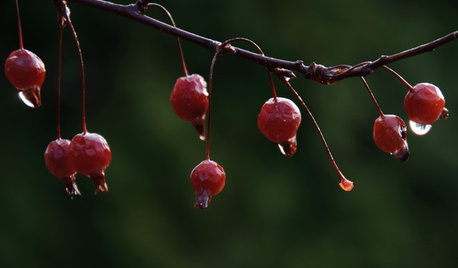
Hi, I'm hoping someone has some personal advice to share. I'm looking to plant a crabapple this spring, although I would really love one that has fruits that stay far into the winter. I've tried searching online but can't really find information about which crab apples hold on to their fruit the longest. I just love the look of winter trees with little red fruits on them. Does anyone have any advice? Thanks!

Comments (8)

  • 4 years ago

    the fruits are there for the winter birds to eat .. and they stay there.. until the wildlife decides they are hungry enough to eat them ,.. and the usual joke is.. they stay they until they ferment.. and you have have drunken birds trying to fly into your windows ..


    ergo ... it doesnt matter how long you want them to stay there... its not your decision .. and probably why you cant find info on such ....


    btw.. you best searching for info.. will be if you use malus rather than crabapple as the search term ....


    ken


  • 4 years ago
    last modified: 4 years ago

    I often refer to this cultivar comparison chart from Schmidt Nurseries for info on crabapple varieties, and revisiting it now, I do see notes on which cultivars have more persistent fruit:

    https://www.jfschmidt.com/pdfs/JFS_CRAB_CHART.pdf

    'Donald Wyman' seems to be one of the best for persistent fruit, but several others are recommended there.

  • 4 years ago

    "Persistent" means the fruit remains on the tree until eaten or it rots away. When that might be depends on your location and bird/other predator activity rather than specific cultivar. But not all crabs offer persistent fruiting :-) Sugar Tyme, Donald Wyman, Red Jewel, Prairie Fire and Royal Raindrops are ones I'd be looking at. I'd also pay very close attention to disease resistance as well....in fact, that would be my primary deciding factor.

    There are some excellent crabapple charts available that list many popular cultivars by a variety of factors (and they are listed as 'crabapples, not malus, as that applies to much more than just crabapples). I like the one offered by J. Frank Schmidt, as they grow and supply more flowering crabs than just about any other US supplier.

  • 4 years ago

    Thank you both! Sah, that's a really great chart! ὠA

  • 4 years ago
    last modified: 4 years ago

    Carolyn doesn't say where this crabapple may get to grow, but that absolutely makes a difference among the 1000s of named selection across the Flowering/Ornamental Crabapple spectrum. I would recommend you consult with your local county Cooperative Extension Service office, and look for publications on crabapples pertinent in your state. Growers (and the International Ornamental Crabapple Society which used to be based in Chicago - at the Morton Arboretum IIRC) were quite interested in demonstrating the performance of various selections under varied climatic and cultural conditions. Thus, there were ornamental crabapple research plots at nearly every land grant university as well as at most upstanding horticultural institutions. I got to indulge my crabapple cravings at Bernheim Arboretum, where many stellar selections of Fr. Fiala flagrantly flowered in reps of five.

    I will not argue with gardengal48's recommendations; I've planted most of them, and observed each in collections and landscapes around eastern North America. Here are a few:

    DONALD WYMAN


    SUGAR TYME


    PRAIRIFIRE


    If you are really a Malus x-ophile, consider Father John Fiala's epic Flowering Crabapples: The Genus Malus (https://www.amazon.com/Flowering-Crabapples-John-L-Fiala/dp/0881922927).


    This is chock-full of great information, and has graced my shelves for nearly 20 years. I have been trialing his selections at the Valley for almost that long - up to 20 clones at last count.

  • 4 years ago

    Of the crabs I can grow here in the north, Adams is the persistent fruit winner. When I get bare root trees in to plant in the spring, Adams always have moldy berries hanging from their branches still. Robins love to pick our field trees clean in the spring when they return.


    But as other have said, you may also want to factor mature tree size and shape, flower color, leaf color, and disease resistance into your decision as well.

  • 4 years ago

    Agree with Gardengal that persistence is more about holding into late fall and winter, but when they disappear is variable. I have two crabs in my yard both considered persistent: Adams and Prairiefire. Adams gets picked pretty clean by the squirrels and cardinals by the end of the year. Prairiefire seems to not get eaten much until the robins come back in late winter/spring.

  • 4 years ago
    last modified: 4 years ago

    I believe the OP is near Chicago. Keep in mind that a few of the varieties mentioned above (Adams, Donald Wyman, Prairiefire) are considered to be at least moderately susceptible to apple scab disease here in the Midwest. See this fairly recent (2019) publication from Purdue: CRABAPPLES RESISTANT TO APPLE SCAB AND JAPANESE BEETLE IN INDIANA

    Many online references (including the JF Schmidt chart) still list Prairiefire as resistant to apple scab, but based on observations in recent years it apparently has greater susceptibility than originally thought (at least in this region). Also, Sugar Tyme was noted as having high susceptibility to Japanese beetle damage. The Purdue publication lists Adams, Donald Wyman, and Sugar Tyme (among others) as "Cultivars Not Recommended for Wide Scale Planting in Indiana" .