Software
Houzz Logo Print
roshni_ricchetti

Side-by-side ranges

4 years ago

Just out of curiosity, has anyone installed side-by-side ranges? (Can it be done? Is it advisable?)

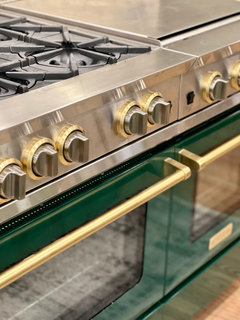
I’m specifically interested in the BlueStar Nova (RNB) range and am looking to install 60” of range/oven for various reasons. One thing that gives me pause, however, is having two large ovens instead of one larger and one smaller. (The 60” has two 30” ovens.)

This situation could be remedied by instead purchasing a 36” and a 24” range and installing them flush against each other side-by-side. The price point doesn’t even seem to be different.

Thoughts?

Comments (14)

  • 4 years ago

    Roshni Ricchetti-

    I don't understand why you would want a 36" BlueStar Nova range WITHOUT a self-cleaning oven plus a 24" range. There are no 24" ranges with self-cleaning ovens (Steam doesn't clean). Also two 30" ranges gives symmetry when placed side by side see pinterest.


    You can buy a 30" range with double ovens from KitchenAid, GE, GE Profile, LG, Maytag, etc.

    With a GE 30" range so you could have 3 to 4 ovens that match. Look at GE. Profile, & Cafe for 30" slide-in double oven ranges that look good together.


    I bought TWO 30" slide-in ranges, gas range & dual fuel range for baking. My kitchen has TWO windows above a 36" corner cabinet located next to 18" cabinet & then my two 30" ranges. I always crack open a window when I use either gas cook-top or the gas oven.

    The 2 windows provide air needed to safely pull out any gas, smoke, odors, etc. without putting pressure on HVAC/ home envelope. I don't pull outside air into the house from any bathroom exhausts, the gas fireplace, dryer vents, etc. It is best for respiratory systems to open a window, turn-on the exhaust, & then ignite a gas/ propane cook top or oven.


    I have a custom hood with TWO Vent-A-Hood 22.5" Deep inserts; Hood has a METAL interior surround liner and center so there is no wood above the ranges.

    I wish I had done more research because I would of done a 65" Vent-A-Hood insert to get the extra width which is ideal to capture the fumes, odors, etc.

    Exhaust hoods should be wider than cook-top they are over. I think 72" wide hoods over 60" cook-tops is overkill. I have seen 66" wide hoods that are very effective so no smoke, grease, steam, etc. is going out wider/ past the sides.


    Why have TWO 30" ranges? Here- It's harder to get appliance repair people out of the city & into the county, even being 5 minutes from city border. With 2 refrigerators & 2 dishwashers you have back up when one fails and many people have bigger houses in the county.

    Neighbors encouraged me to get an expensive outdoor kitchen set-up & it's back-up if the cook-top dies. My set-up is cheaper. FYI- Covered outdoor kitchens need range hoods to exhaust fumes away from the house.


    It was actually cheaper for me to get two quality 30" ranges compare to getting the special cabinet for a wall oven & paying for a quality 30" wall oven. Quality 30" wall ovens that are well-built cost the same as a good quality slide-in range. My two 30" ranges with self-clean ovens cost less than any 54" or 60" range. Many 54"+ ranges have manual clean ovens like your 36" BlueStar Nova.


    Now I can start cooking/ prepping food early in the morning without having space issues when I cook breakfast or use my cast-iron griddle.

    When the kids bake, I cook over the other range so our kitchen is great when 2+ people are cooking or baking. No fighting with kids, aunts, in-laws, etc. over who gets the range or oven to cook their food items or who uses the range next.


    For us, a 36" cook-top still has issues with our griddle and large/ wide pots during party & holiday food prep. People who cook know that a 36" wide range doesn't have a storage drawer or a warming /proofing drawer at the bottom.


    My kitchen qualifies as Kosher once a Rabi does their ritual in there.


    Multiple realtors stated the kitchen adds serious resale value.

  • 4 years ago

    Serious health liability is more like it if all that is done for ventilation is to crack a window. Thats really a messed up bad design that detracts from the home value in a major way. Its a 100K deduction to be able to rip that out and put somethng actually legal and functional in.

  • 4 years ago

    I think an active (with blower) MUA system that compensated for whatever flow rate is achieved by the VaH inserts, fireplace, bathroom fans, etc. would not reach $100k, but admittedly some house architectures could cause impediments. It would need to be pressure differential controlled.

    The issue with cracked windows, or even open windows with screens, is pressure loss causing back-drafting of many types of combustion appliances that are connected by air paths to the kitchen and have relatively cool exhausts. Fireplaces also have weak drafts compared to adequate kitchen ventilation, but can at least not be used when cooking.

  • 4 years ago

    We are putting a single 66” hood over the double range set-up.

    The aesthetics of color choice on Blue Star supersede that of asymmetry for us - not to mention, some degree of symmetry is achieved by mirroring our 36” fridge/24” freezer set-up.

    Self-clean isn’t issue for me - I’ve been living with ovens with self-clean features for 12 or so years now and have used self-clean once. Unfortunately the market value of our home would be diminished by furnishing our kitchen with GE/LG/Maytag etc. We are currently replacing a 48” Wolf range, and before that (in our prior home), I had a Thermador cooktop with double 30” Thermador wall ovens (and before then a 36” Viking range). I realize that not all locales are like this, but that’s simply the reality of the type of home/community we have. The extra 10-15K on a luxury appliances easily translates to 50k in real estate value.

    For the duration of having a 30” as my largest oven, I’ve found myself missing the 36” a few times a year. The current 18” oven on the Wolf range is too small for much of anything (not to mention I routinely accidentally prep pans that are too small for it), but I do appreciate the fast pre-heat. That’s why I’ve settled on the 24”/36” combo. It was a tough decision between the double Blue Star vs Thermador 60” with steam oven and warming drawer, and honestly it’s the custom color option that’s the final driver in that decision - that said I thoroughly enjoyed the Blue Star showroom burner demo I attended, so that’s justifying this final choice.

    @acdclosgatos - good point about the Kosher kitchen option - that was brought up by our appliance sales rep too, so it’s definitely done!
    Thank you all for the feedback.

  • 4 years ago

    Rosh R: I understand about some appliance brands having a higher perception of value and some are quality.


    Respect on BlueStar color choices. They do look great. IF a GE Cafe rep is reading this then GE Cafe should consider custom color options since many customers would pay the extra cost for blue or red. We do love the GE range warming drawers during holidays.


    I can understand the extra 6" real estate on the 6 burner cooktop really helps with large pots and pans

    Serious question for you and no shade- The BlueStar 36" range has 5.1 cu ft oven while my GE slide-in ranges each have a 5.7 cu ft oven- So what are you cooking that doesn't fit in a 30" wide oven? Is it an extra-large cookie tray or baking tray? Are you slow cooking a quarter of a whole pig or a whole rack of pork or beef ribs?


    If anyone else is reading this then look at the best in appliance category & the brands' repair history i.e. Bosch & Miele rank best for dishwashers. If your appliances are all the same color then you really should not have an issue. Just make sure you have people in your area that can repair your appliances you purchase. Even Samsung & LG do not have repair people everywhere.


    Verbo:

    FYI- We have TWO 36" W X 48" T windows that are close to the side-by-side ranges plus another 54" W X 60" T window (cross ventilation) over the sink, which is opposite the other two windows. Our kitchen windows are covered so no rain or snow can get pulled inside. I am well aware that ONE window open only one inch is not enough to provide adequate makeup air while actually cooking. We open at least one window and have one exhaust on low prior to igniting the gas cook top or gas oven.

    The plans were reviewed by HVAC guy and multiple inspectors. Our friend, a chef, came to test the two windows being open while cooking & agreed it works even when one or two of the exhausts are on high.

    There is not a draft or rush of air upon opening any other windows in any other rooms since TWO kitchen windows are open so airflow is adequate once cooking is started.


    The newer kitchens with multiple windows on more than one wall can work if at least two windows are open to allow actual air flow once cooking has started.


    In places like Florida, with major wind during rainstorms, a MUA system would work better than rain coming inside the windows if those windows have no cover/ overhang to stop the rain.

  • 4 years ago

    The safety issue for MUA is that it has to be available without human interaction if combustion appliance back-drafting is to be avoided (where such appliances are present). This is why window opening (even ignoring screen pressure loss) is considered not compliant.

    Automatic passive MUA without human interaction or damper-controlled ducting is possible, but may not meet everyone's taste in housing:


  • 4 years ago

    @acdclosgatos

    I’m actually seldom (if ever!) cooking a single item that doesn’t fit in a 30” oven! It’s when I’m cooking multiple things that it becomes an issue.

    I cook a fair bit of Indian cuisine, and often have multiple large pots/dishes in the oven at once. Take this past weekend: I had an 8qt biryani dish, a 6ft lamb curry, an 11x13 casserole dish with fish curry, a sheet pan of fish/potato croquettes, a potato/cauliflower curry, a green bean dish, and an eggplant dish. (And this is the white rice, daal, chicken, and chickpea dishes on the stove notwithstanding)!!

    I apologize but I’m not following the venting conversation. Are you guys saying that code requires that 36”+24” ranges have different venting requirements than a 60” range? That a 66” vent cannot possibly vent 60” of range?

  • 4 years ago
    last modified: 4 years ago

    Rosh R: Wow you really are doing big dishes at one time. You must be a primary house for family gatherings. I end up making the same dish in 2 casseroles dishes at holidays so it fits in the 30" and I have the 2 warming drawers too. I asked because in building my house I took into consideration multi-generational cooking, international cooks, and kosher cooking in case we sell. It's one of the reasons I choose GE Cafe slide-ins w/ a Dual Fuel range & a Gas range.

    In reference to ventilation, your hood width is ideal for your 60" range combo. What most people are not aware of with gas or LP cooktops and ranges is that you need to open a window & put your hood on low when you ignite/ turn-on your gas/ LP cooktop or oven because gas stoves produce harmful PM 2.5 particles. Gas stoves also produce nitrogen oxide, nitrogen dioxide, formaldehyde, and carbon monoxide. Heavy exposure to these pollutants can be deadly. see this link for info (many people don't like these hoods): https://www.prolinerangehoods.com/blog/do-gas-ranges-require-venting/

    When you have a strong or truly powerful hood especially in a "tight" new build, rebuild, or complete kitchen remodel then you must plan on providing air to the exhaust hood, to safely pull out the fumes and smell.

    If your house is in an area with a mild climate or temperate climate and has covered windows that you can keep open while cooking when a powerful exhaust hood is used, then you don't necessarily need a Make up Air Unit or system/ MUA.

    Houses in very cold, very hot, or very wet areas with exhaust hoods over 400cfm are better off getting a Makeup Air unit.

    "Tight" new build-- means your home is literally wrapped in Tyvek, is well sealed/ caulked, and has thick/ effective insulation so inside/ conditioned air stays inside while hot or cold outside air stays outside your house.

    "Chef's/ cook's" kitchens with large gas ranges & powerful hoods like a Vent-A-Hood 600-1200 CFM, actually need a Makeup Air Unit if you live in a very cold, very hot, or very rainy & windy place and in mild climates if you do not have a way to safely bring fresh air into your kitchen.

    Powerful hoods (400CFM+) need airflow to get the noxious fumes and smells out of your house. The air needed gets pulled from outside through bathroom exhausts, clothes dryer vents, and worse yet a gas water heater flume/vent, which is as dangerous as a gas/ LP or "lit" wood fireplace. People have ashes getting pull out of their fireplaces when a strong range hood is running & lacks fresh air or a Make Up Air System.

    You can actually stress a "tight" house when a strong exhaust hood is used without proper ventilation. You stress the building pulling out more air than what is inside & can create a negative pressure system in your house. You don't want to damage sealed walls or windows with a negative air pressure or even create cracks in you home especially within your attic.

    see: https://ccbinnovations.com/content/8-about-make-up-air-negative-air-pressure-and-fresh-air-infiltration

    https://www.proremodeler.com/makeup-air

    https://kitchenambition.com/make-up-air-for-range-hood/

    Since I am in a very mild climate and my range hood exhaust vents well above my covered porches, I can safely open the windows to get fresh air inside my house to pull out the fumes and smell through the exhaust hood, using the lowest 2 settings.

  • PRO
    4 years ago

    Opening a window doesn’t satisfy the code inspector anywhere. You have to have the makeup air system or or you are out of code compliance. The next home occupant might not open a window and might end up dead because of that.

  • 4 years ago

    [Sometimes we write assuming that everything previously written has been followed.]

    "I apologize but I’m not following the venting conversation. Are you guys saying that code requires that 36”+24” ranges have different venting requirements than a 60” range? That a 66” vent cannot possibly vent 60” of range?"

    No. Venting performance requirements have to do with capture and containment, and if the hood overlap is adequate and the flow rate is adequate, the details of how these are achieved are secondary to meeting those requirements. The details may be primary with respect to cost, or aesthetics, or architectural integration practicality, but use of two hoods vs. one larger hood is only a matter of not doing something wrong, such as having two blowers feeding into a single duct.

    (For example, two abutted hoods with their own blowers and separate ducts can be used separately when only cooking on one or the other range. However, cooking at the edge of one range will produce a plume that partly intercepts the other hood, and this hood should also be operating, perhaps at a lower flow rate for this example. Some experimentation required.)

  • 3 years ago

    For anyone researching the possibility of side-by-side ranges somewhere down the line, I wanted to share that it's not only possible to do this in a code compliant way, but also that it's awesome.


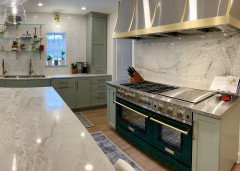
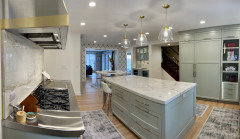
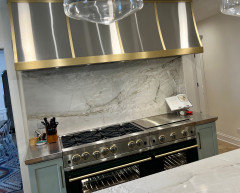
    We put in Bluestar all gas ranges installed side-by-side: 1) a 36" all-burner RNB and 2) a 24" all-griddle RNB. The hood is a 66" custom build with two vent-a-hood liners/assemblies inside. We usually turn on the fans on both sides when using anything on either range.


  • 3 years ago

    No one even notices that they are two separate ranges!