

It's All 'Tina Marie'
Comments (63)
 4 years ago
According to the LA Almanac, the area where my waterless garden is located gets an average of 17.4 inches but it's important to realize that soil type is just as important. That is, how much water the soil can store for plants has very strong effects on survival. I'm sure everyone remembers the poster Ingrid, also from southern California--I suspect she would not have been able to grow 'waterless' roses because of the sharply draining decomposed granite type soil she had. She had mentioned how frequently she had to water her plants, I believe she had said every day. According to the web soil survey: "Available water storage in profile: Very low (about 0.8 inches)"
The landscape beds at the waterless garden are 18 inches of clay/loam, heavily amended with compost, overlaying the forementioned decomposed granite type soil, albeit not quite as dry as Ingrid's. My understanding is that moisture tends to accumulate at the 'interface' where the two soil textures meet. In the two areas where roses were planted into the native D. G. soil, they died out rapidly. Also, even some plants of Lavandula dentata, which is more drought hardy than many California natives, died out on the D. G. soil.
Nate 4 years ago
Those plant bush photos are fabulous Nate. Keep us posted. We get similar rain to yours here, and I too, like Jackie said, would love to know what can handle these conditions. I hope you try Tea roses.
I miss Ingrid.
Related Professionals
Fort Smith Landscape Architects & Landscape Designers · Pittsburg Landscape Architects & Landscape Designers · Lebanon Landscape Architects & Landscape Designers · Elmira Landscape Architects & Landscape Designers · Anchorage Landscape Architects & Landscape Designers · Edmonton Landscape Architects & Landscape Designers · Cambridge Landscape Contractors · Chattanooga Landscape Contractors · Lynchburg Landscape Contractors · Logan Landscape Contractors · Mount Vernon Home Builders · Bloomington Home Builders · Rochester Home Builders · Akron Home Builders · Clovis Home Buildersjerijen
Original Author4 years agoNate, I grew up a handful of miles from you, in El Monte. And I know Irwindale well.
I am in Camarillo. Our "average" annual rainfall is 16.0" . . . However, our total rainfall for the season just ending was .21-in. Not good.
To be honest, the only thing I could grow here without supplemental water is cacti.- 4 years agolast modified: 4 years ago
As long as your soil is good, you're away from big shade trees (oppressive root systems), your not planting in reflected heat, and you water them through the first year, my suspicion is that you should be able to find 'waterless' roses, Jeri. They would have to be brought in as young plants though. Waterless roses are much smaller than the same variety under watered conditions, and a fully mature, watered plant would be too stressed by the change in conditions to ever do well, even if it didn't die.
IME roses are 'smart' and don't send up new basals during dry years. My own criteria for selection were for heat resistance, desiccation resistance and ability to grow in winter (could be wrong on these). From my study list, Bishop Darlington, Grandma's Hat, International Herald Tribune, and Radiance are potential varieties to try for the coast. Many of the California specials like Reve d'Or, many other noisettes, teas, and chinas, and the general run of hybrid teas, would probably not do well if my criteria are correct. Don't be surprised if you try and try and end up just finding one good waterless rose!!!!!
And of course, my project is just an experiment. We don't know how waterless roses will work out long-term in my garden and in soCal.
Sheila, I DID try tea roses--Mrs B. R. Cant was vigorous for a waterless rose, but got mildew, bad sunscald, and flowers did badly with rain. Marie van Houtte also scalded badly and developed ugly brown leaf edges right next to other roses that had beautiful foliage. About to test Safrano (mildewer, at least as a young plant) and Papa Gontier (lacking in vigor, this one won't make it waterless until it starts growing so I think I'm going to water it another year). I also tried Le Vesuve which IMO is somewhat like a tea rose. I had planted in soil that was too 'native' (mainly D. G.) and while some plants survived a couple of summers, they all gradually burned up. They also appeared to not be as winter active as Mrs. B. R. Cant and some of the others.
Looking at the Rogue Valley I think the selection criteria would be different, because plants that have just leafed out upon the fall rains would be subject to low temperatures, some years. The new, lush growth would make them more vulnerable to frost than a watered plant which would have done more growing during the summer. Just thinking out loud: what about Russeliana?? That's a common found rose in norCal, and it probably would laugh at whatever you threw at it climate-wise.
Nate - 4 years ago
Nate, I grow Russeliana and even with irrigation, I know some of my roses are too hot. I'm wishing for the best for you, raingreen, but Jeri might be right about this area too.
I do have some sunscald and more damage from heat than cold. I bet your Tea roses would have done better if they were watered a few years so they could get a good canopy to cool the soil down.
I took down a few trees that were stealing from the plantings and that might help here. My "soil" is in the needs improvement class too. Your improved soil sounds great.
In any case we are all interested in what you are doing and wish you the best.
 4 years agolast modified: 4 years ago
This is a fascinating experiment !
I wish you all the best and I would love to hear more as it progresses.
I think what you are doing is actually very important, as water restrictions seem to be something that will become more prevalent in the years ahead.
As a zone 11 gardener I have been wishing for a while that there was a ADR-type of award that would be specific to heat and drought tolerance. Your experiment is as close as it gets to that, until rose societies and the rose industry at large wake up to the changing times and breeders start hybridizing with those factors in mind. Considering how long it takes to develop new roses, I'm not holding my breath for that.
Great to learn that Old Blush seems to be performing well! I will add her to my list for next year.
- 4 years ago
FYI seasiderooftop Old Blush, while incredibly beautiful, does get mildew under my conditions. Every once in a while the skies part and it gives out the most amazing flowers, but most of the time more normal blooms.
We don't know whether the experiment is going to work or not. Just the two varieties, Old Blush and Madame Alfred Carriere, appear to be doing well out of several already tested. I would say Madame Alfred Carriere is the best performer so far--somewhat less mildew prone than Old Blush and while Old Blush flowers for longer, MAC gives off more consistently beautiful, high quality flowers when it does bloom. It's also more fragrant. And guess what--due to the harsh conditions it's staying as a medium sized shrub!! Doubtful it would ever be a house eater in drought, based on what I'm seeing. - 4 years ago
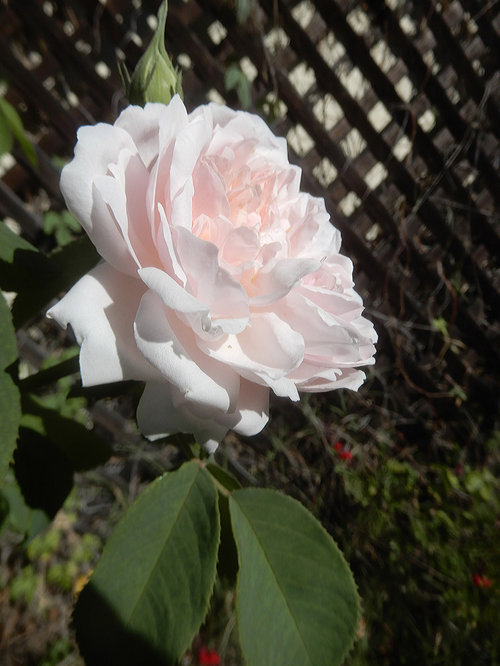
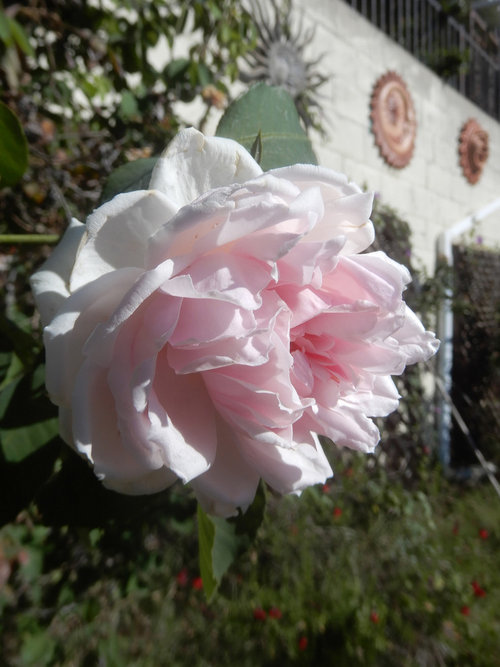
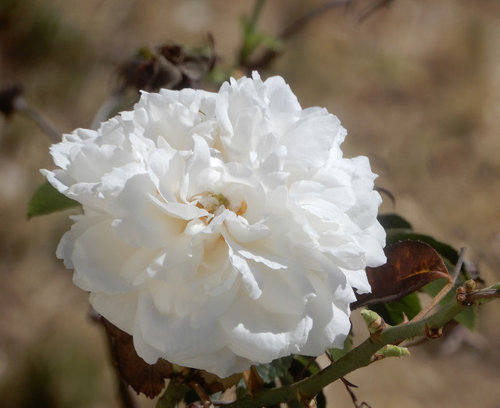
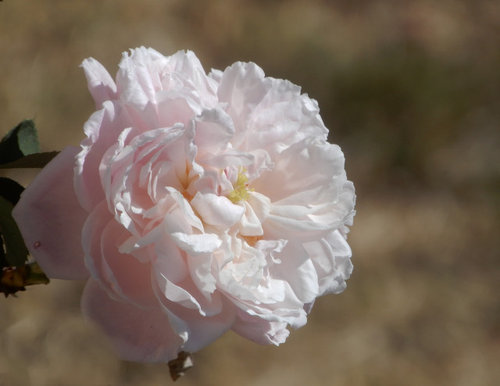
"Tina Marie' -- I have a plant of this that I believe I bought from Ashdown Roses years ago. It is about 3.5 feet tall, and blooms at the end of the once-bloomers season. It is lovely and hardy (I don't winter protect at all). For about 2-3 weeks it is a thing of delicate beauty, and then it goes about its business of growing.
jerijen
Original Author4 years agoYou're in 5a? WOW! i'd think that was pretty marginal for this rose. In California, "Grandmother's Hat" and her daughter, 'Tina Marie' bloom almost continuously through the year.
- 4 years ago
Because of your reviews of GH, I bought a small starter plant from Annie's Annuals two years ago. It came through its first winter without any visible damage, albeit the plant was only 8" tall going into winter. I'll report back this spring about its status after winter #2.
 4 years ago
Is Ingrid no longer posting on the forum? I dip in from time to time, and had not realized she was missing.
- 4 years ago
Ingrid bowed out and has not posted for a couple of years, I think. I loved her postings and garden. The drought and some health issues became very challenging for her. I wish she would come back.
 4 years ago
'Fortuniana' has grown "waterless" here for more than 5 years, and considerably longer than that at some nearby old homesteads/wineries. I discovered this by accident in my garden when it unintentionally got taken off a water circuit, something I only came upon months later, in the fall, when it had already survived pretty much the entire summer with no irrigation. Since then, no irrigation and it's fine (our average annual rainfall is 15 inches). A huge 'Golden Showers' grafted on 'Dr. Huey' growing on an empty lot (house torn down) in town here, for years and through the last severe drought, was quite a sight (housing development got built over it recently), but that was in an area with alluvial-origin soils and a generally shallow water table,
I've seen 'Mme. Lambard', 'Alba Odorata', 'Laure Davoust', diverse Chinas, and 'Mme. Alfred Carriere', among others, all growing without irrigation in Sonoma County, but the average annual rainfall there is more than twice what it is here.jerijen
Original Author4 years agoYes. We are able to enjoy many roses BECAUSE they survived with no water or care in NoCal.
SoCal has always been drier, with a lesser water table. Very, very few old plants have survived here.
- 4 years ago
Bart bart and I live in Italy, I in the north and she in the central part of the country, both inland. Both of us have a lot of roses and have been working on our gardens for a couple of decades, and both of us don't water after the first year or so. We live in areas with a significant summer drought but good average rainfall: usually in my area (northern Apennine foothills) about 40"/one meter a year. With climate change this may not remain the case; it has been dry much of last fall and this winter, traditionally our wet season. The climate is temperate, not very cold in winter but with enough winter chill for old roses, lilacs, tulips, fruit trees. My soil is mostly extremely dense gray clay, poor in sand and organic matter.
The best roses for me are the once-flowering old roses of European origin: Gallicas, Albas, Damasks and their hybrids, Centifolias, Mosses derived from these. My experience of Teas and Chinas is that they need a lighter soil and better drainage: my established plants grow in terraced beds, in soil dumped over rubble and organic matter, where they flourish mightily, while those planted out in clay, even amended, have failed. Currently I'm preparing planting holes amending with vast amounts of old hay and sand, and hoping I'll be able to get warm climate roses to grow there.
I don't know whether any kind of garden rose can take consecutive years of drought without watering. I do know that mine have gone unharmed through one year of very little rain indeed, fall 2016-fall 2017, and high summer temperatures. They came through that very well. I'm worried this year may prove another such, but, we'll see.
I think shade is important, also a soil covering of organic mulch or greenery. My main garden began as an open field, and I've put a lot of work into planting hedges and trees, though in our conditions their growth is slow. Trees are important to hold the soil, cool the air, provide shade, and soak up excess water during rainy spells. All our (DH's and my) property is sloping, mostly steeply, and we live in an area susceptible to landslides.
jerijen
Original Author4 years agoI only WISH we had as much rain as you do. Our "average" rainfall is 16 inches. But this rainy season has given us less than two inches. I think it's 1.17-inch.
We get 0 chill hours, so the old European once-bloomers simply do not succeed, here.- 4 years ago
Ahem. According to Camarilloweather.com the rainfall year has brought about 8 inches to date, but we have been bedeviled by a midwinter dry spell lasting 2 months. We often have dry spells midwinter, which is a definite source of frustration for anyone who's gone waterless in soCal (a small crowd).
The climate actually is not desert--provided you have reasonable garden soil, there is lush weed growth every year (trust me, I've been gardening waterless for 14 years). Even during the driest period in 800 years, I still had weeds.
In evaluating plants in the waterless garden, it's typical for there to be abject failure. For example, Lonicera etrusca (from the northern Medit regions) during the establishment period was a star performer and was stunning in full bloom but then burned up after the first waterless summer. Some plants survived but were essentially half-dead.
Considering this backdrop of failure, even with several native plant varieties, I've been somewhat surprised by a couple of the roses. It's important to realize the huge range of variation in the genus. Looking at the factors I believe are involved, which themselves are somewhat rare: 1) desiccation resistance, 2) heat tolerance, and 3) ability to grow in winter, only about 1 in 1,000 varieties grown would fit the bill for POTENTIALLY being waterless in soCal. At this point, there is cause for speculation (nothing more) that there will be a short list of varieties that are suitable for waterless cultivation. I would say once candidate roses have been tested in 3 different gardens then we could tell people to go ahead and plant them.
Once-established, plants dislike a decline in baseline conditions. Case in point, the 2011 summer in Texas, where many roses and other plants died after having lived for decades. According to Bill Welch, even the hardiest types found in abandoned cemeteries were lost.
My plants are being tested under the current trying climactic conditions. Provided the conditions under which we are gardening now don't change for the worse (further decline in rainfall, higher summer temperatures, more high wind events, etc) then it makes sense to try to find those that are hardy. For the time being, the persistent green surge of the winter weeds tells me we're still 'Medit'. BUT, if southern California actually does become a desert, then even the hypothetical short list won't make sense for the future.
Nate - 4 years ago
Sobering, Nate. I feel for Ingrid and all in the drought stricken areas including so much of the West.
jerijen
Original Author4 years agoI'd be ecstatic if we'd had 8 ins. of rain. I assure you, we have not.
- 4 years ago
Re Lonicera etrusca and other Mediterranean-climate plants, the frequent inability of relatively drought tolerant plants from Mediterranean climates other than California's to survive without at least a bit of irrigation seems to hinge on their inability to withstand the length of our dry season, which is usually absolute (no periodic summer storms in most lower-elevation parts of the state) and the longest of any of the Mediterranean climates around the world.
A labmate of mine in graduate ecology studies at UC Davis, Jeffrey Clary (some of his papers) did his thesis work around the question of why European perennial bunchgrasses have, for the most part, only succeeded in naturalizing along the foggy, mild-temperature coasts here in California and not inland, unlike the wildly successful European annual grasses, which of course only need to weather summer extremes as seeds. For example, smilo grass (Stipa miliacea), among the first of the European bunchgrasses deliberately introduced in California (ca. 1869) to try to lengthen lower-elevation livestock grazing seasons, is, in my area, is pretty much never found outside riparian areas and spends it life hugging creekbeds, apparently incapable of surviving without at least a bit of summer water. (Sidenote: the only European rose species I've seen naturalized in California have also been near the coast or in mountain areas where there are summer thunderstorms, e.g., Rosa canina and R. rubiginosa.)
During the last drought, all the fatalities in my unirrigated "multi-cultural" chaparral at the back of my garden were European- and Australian-origen species, not the native species of California. So, while total rainfall means something, because areas with higher amounts of rainy season precipitation dry out more slowly and have more deep water available into the dry season, the pattern of precipitation also seems important. It will be interesting to see which roses, if any, can meet these tests. Very interesting, Nate! - 4 years ago
Just to avoid confusion, I was speaking of the rainfall year which starts in July rather than January. We had had a couple of weeks of heavy rain in December which made up most of the total. I'm sorry if I've miscommunicated.
Interesting comments, catspa. You're right about the other Mediterranean climates being milder. According to Olivier Fillippi, forget about rockroses and lavender for the drier sections of California. You're saying it's the same with Australian species. One Medit plant I've found that appears to be as hardy as many of the native sages, and which "goes" well with roses is Lavandula dentata. One plant that I really like is Iris albicans which looks GREAT with roses but count on perpetually browning leaf tips in dry years, even in the run-up to bloom.
If people don't mind non-rose related plants, Calliandra californica (hardiness in norCal??) is an absolute star under waterless conditions in Irwindale (east of L. A.), leafing out about a month after the first soaking rain, and providing a transcendent beauty with the winter light shining through the leaves. Aloe dawei (again, don't know hardiness) is STUNNING during the summer drought with maroon-colored leaves and on my form yellow-orange flowers: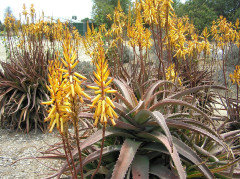
- 4 years agolast modified: 4 years ago
So glad you mentioned Filippi.
His website is a treasure trove of information about drought tolerant plants, and also rates for lots of other criteria such as salinity resistance and even scent!
Unfortunately there are only nine roses listed there, but still great info about the other plants. I don't think he means to exclude other roses necessarily, just that roses really aren't the main focus of his website.
The website is in french but with a translator tool it should be manageable. (Search term: "rosa" to see all nine)
https://www.jardin-sec.com/jardin-sec_web/fr/Database.awp
I agree that the term "Mediterranean" is pretty broad and not always a good indicator of how well plants will do in your specific climate. I am in Malta (zone 11), and lots of "Mediterranean" plants from the northern shores of the Med don't do well here in the south.
(Sorry if this is getting OT from Tina Marie!).
- 4 years ago
I, for one, would love to find 'Tina Marie' -- maybe it will come around in some of the upcoming Friends of Vintage Roses sales...
jerijen
Original Author4 years agoI'd like to think so. I'm going to donate cuttings to some nurseries.
- 4 years ago
I wish yearly rainfall stats were more synchronized. Here, our rain year is Oct 1- Sept 30. I did not know California was July start. That makes no sense to me. I was thinking our was when rain starts, but obviously that is not July in California I did not think.
I also wonder why we have different hardiness zones than Canada. I just want us to be together.
 4 years agolast modified: 4 years ago
Shelia, i think there year tends to start when the rainy season starts. At least, that's what I assumed. So in the PNW that would be October. In Arizona where I grew up, the big rainy season is the summer monsoon season which starts in July (although they have a second smaller set of rains in the winter).
- 4 years ago
GREAT thread! I hope to have time soon to contrubute and to look up some of the links mentioned. Definitely let's keep this going, if possible...
- 4 years ago
Caveat: I'm not a meterologist. My understanding is that the rainfall year is July 1 to June 30. Even though there almost never is any real rain, whatever amount does fall is recorded. When does the real rain start?? I think it's been anywhere from October to January, since I started the waterless gardening, and the gardener/author Pat Welsh (based in San Diego) says the rainy season starts in November.
As catspa was saying, our climate tends to be more harsh than other Medit areas. Our rainfall is not always, but often lower than other Medit climate regions, and our dry season often lasts longer. We have higher variability in rainfall, defined as interannual variation in monthly and seasonal rainfall, than other Medit regions.
(For info on rainfall variability see: Global Ecology and Biogeography, (Global Ecol. Biogeogr.) (2005) 14, 509–519 Rainfall reliability, a neglected factor in explaining convergence and divergence of plant traits in fire-prone mediterranean-climate ecosystems).
Nate jerijen
Original Author4 years agoNate. Southern California's Rain season runs from October through February.
As things stand, now, we are in a historic drought.
(During that period just passing, my Camarillo garden received 1.71 inches of measurable rain.)
An article in today's L.A. Times explains our current situation better than I ever could:=========================================
2022 is off to driest start on record
Lack of rain in January, February was worst in 100 years, and snowpack is waning.
By Hayley Smith
The months of January and February were the driest ever recorded in most of California this year, and state water officials are now sounding the alarm for a third year of severe drought, shrinking water supplies and the growing threat of extreme wildfire.
The California Department of Water Resources announced Tuesday that statewide snowpack had dwindled to 63% of average for this time of year, following an extraordinarily dry start to the year.
That sobering assessment came during the third snowpack survey of the season at Phillips Station near South Lake Tahoe. The reading marked a tumble from the initial survey at the end of December — when statewide snowpack measured 160% of average — and from the second survey last month, when it measured 92% of average.
“That is not enough to fill up our reservoirs,” said Sean de Guzman, the DWR’s manager of snow surveys. “Without any significant storms on the horizon, it’s safe to say we’ll end this year dry and extend this drought a third year.”
California’s water year runs from Oct. 1 to Sept. 30. De Guzman said the last two months marked the driest consecutive January and February on record in the Sierra Nevada.
The findings are particularly worrisome because those months are typically the crux of California’s wet season. Traditionally, Sierra snowpack serves as a natural reservoir, providing California with about a third of its water.
Snowpack at Phillips Station was 68% of average for this time of year, with a snow water equivalent of 16 inches, de Guzman said. But it’s not only the Sierra that is feeling the dryness.
During a State Water Resources Control Board meeting Tuesday, Deputy Director Erik Ekdahl compared January and February’s precipitation in the Central Valley to that of other critically dry years in California history. Even in the drought years of 1976-77, the Central Valley got about 15 inches of precipitation during those months, he said. In 2013, that number was 7.5 inches. This year, it’s 2.4 inches.
“It is the driest January-February time frame by far in California’s more than 100 years of records, almost by an order of four,” Ekdahl said. “We’re starting in a pretty bad spot.”
In fact, nearly every part of the state has seen below-average precipitation this year, with many areas seeing almost no moisture at all.
National Weather Service meteorologist Drew Peterson said San Francisco recorded its driest January and February ever, with a scant 0.65 inches of precipitation over the last two months. The Eight-Station Northern Sierra Index, a collection of weather stations in Northern California, picked up 1.74 inches, also its driest January-February stretch.
“For many locations, it’s the driest since records began,” Peterson said.
What’s more, the Sacramento area on Tuesday was poised to break its record for the longest stretch of dry weather during the wet season — 53 consecutive days without rain, officials said.
The Los Angeles area fared slightly better, with a quarter-inch in January and February. But that was still only 4% of normal, and the fourth driest start to the year since records began in 1877.
“It’s way below normal,” said David Sweet, a meteorologist with the weather service in Oxnard. “February is typically our wettest month of the year, and we got 0.06 inches — it’s pathetic.”
The bone-dry months follow the driest 22-year period to grip the American Southwest in 1,200 years — a megadrought that researchers say has been greatly intensified by climate change and the release of greenhouse gasses.
Many have warned that the hazards are only likely to get worse, with a landmark United Nations climate report this week outlining a future of more intense drought, wildfire and heat waves — among other consequences — unless nations take urgent action.
The current dry spell has already hit the state’s reservoirs hard. Lake Shasta, California’s largest reservoir, is now at 37% of its average capacity for this time of year, according to state data. The second-largest reservoir, Oroville, was at 47%.
The numbers could potentially affect water supplies in the state. Water suppliers in Southern California have already been told to expect just 15% of their full allocations this year from the State Water Project, and the federal government has put the Central Valley on alert that it could receive minimal-to-no water from the U.S. Bureau of Reclamation.
“With only one month left in California’s wet season and no major storms in the forecast, Californians should plan for a third year of drought conditions,” DWR Director Karla Nemeth said in a statement. “A significantly below-average snowpack combined with already low reservoir levels make it critical that all Californians step up and conserve water every day to help the state meet the challenges of severe drought.”
The dryness also spells trouble for California wildfires. Already this year, dry vegetation and strong winds have contributed to a handful of unseasonably early conflagrations.
Peterson, the meteorologist, said the parched start to the year has only dried vegetation further.
“All we’ve done with this very wet start and then dry end to the water year is provide more fuel for that fire,” he said.
A fourth snowpack survey will be conducted March 30.
“We are well below normal conditions,” de Guzman said. “Barring any unforseen ‘miracle March,’ which we don’t actually see coming, we’ll end this year below average.”
While some parts of the state, including Los Angeles, are slated to see some rain later this week, the latest monthly precipitation outlook from the National Oceanic and Atmospheric Administration offers no promise of measurable moisture in California in the weeks ahead.
- 4 years agolast modified: 4 years ago
The official rain year runs from July 1 to June 30 in California, a time span chosen probably because there tends to be zero significant rain over most of California during the summer, so therefore no doubt as to what year a given storm's precipitation should be credited. Actual first significant rain (or in range terminology, "starting" rain, which is a minimum of 3/4" in one event, enough to wash the germination inhibitors off annual grass seeds, etc.) can be as early as late September/October (in which case it will be a "grass year" in the large areas of California dominated by annual grasslands, since rain when temperatures are still relatively warm favor annual grass germination) or as late as December/January, in which case it will be a "forbs year" that favors annual wild flowers rather than annual grasses, since annual forbs germinate better in cooler temperatures.
We got close to 10" of rain during the first part of this rain year (mainly in November and December), but pretty much nothing since.
jerijen
Original Author4 years agoSee -- That's where Location matters.
Catspa, you got close to 10" of rain?
WE got 1.71 Inches.
Here, on our south-facing hillside, newly sprung California poppies are dying before they can bloom.
- 4 years ago
My goodness. Yes, it's been extremely dry. I am in complete agreement with that. It's disheartening for me personally.
The "rainfall year" includes the heavy rainfall southern California received in December. We had a series of storms in the second half of December where almost all of our rain fell. My study site received more than 9 inches of rain during that time. SINCE then, it's been dry as a bone. Beautiful weather, no doubt, but foreboding. I want to wake up in the morning and see storm clouds, not never-ending blue skies.
I believe what's happening is we're all saying the same thing but we aren't communicating effectively. I am sorry if I've caused the problem.
Nate - 4 years ago
Rain season and rain year seem to be different meanings Nate. Not your fault.
 4 years ago
Thanks, JerJen for the info re Grandmother's Hat. I bought mine from Annie's Annuals as a 4" plant -- and now it's finally looking like a shrub. Despite the small size, it blooms regularly. I can't wait for a big shrub full of those pink blooms!
Re origin of GH -- is there anyone who does actual genetic tests on roses? Or is that too costly for hobbyist rose folks?
And thanks for the drought info. I put Mme Alfred Carriere on a slope with hope that it will put down deep roots and not need to be "babied" - my "High Hopes" climber on a slope can literally go without any supplemental water for a couple of years. It doesn't bloom a ton, but it also doesn't look horrible. I'm hoping MAC, GH, and Mel's Heritage might do the same...
In Santa Barbara we got a ton of rain in December, but totally dry in Jan/Feb. We're hoping for maybe a 1/4 " starting tomorrow...- 4 years ago
I am SOOOOO in agreement about how wearisome week after week of lovely sunny weather gets to be. I would adore a heavy thunderstorm, or seeing as it's still winter, a foot of snow. But there's no rain in the forecast.
jerijen
Original Author4 years agoMalcolm Manners has overseen some rose DNA testing in FL, but one limitation (aside from $$$) is that you must have something to compare a rose to. And with things like "Grandmother's Hat" there's no pedigree trail to test against. So, she may remain a mystery for a long, long time.
To complicate matters further, there are two known color sports of "Grandmother's Hat" AND there are differences between different clones of her. So it seems possible that she could be a sport or chance seedling of something else.
Here is 'Tina Marie' sporting back to "Grandmother's Hat" (which she does, from time to time):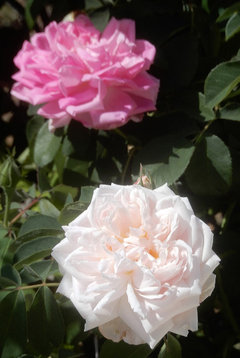
I have often also wondered if she might not have been something which had limited use as rootstock, since she seems as indestructible as "Ragged Robin." 4 years ago
So far my rain gauge has recorded 16.2 inches during the 2021/2022 rain season, but the previous rain season was only 7.5 here. I live at 2000ft at the base of the Angeles National Forest. That seems to put me into higher rain levels than what is recorded in most areas of the LA Basin. We should start getting a sprinkling of rain tonight, but I was already seeing rain falling at the tops of the mountains as I drove home today. They have already restricted us to two days a week 10min per station on sprinkler systems, since it’s not nearly enough to end our 22 year ongoing drought. I am very interested in the more drought tolerant roses. The Tea class seems to be adapted to go dormant in the summer heat, which should help them survive our summers with zero rain.
- 4 years ago
IME the few Tea roses I tested are also able to grow upon the rains, after experiencing the full length of summer/fall drought, which is somewhat unusual. Most roses, even if forced into dormancy by drought, prefer to start growing in late winter, rather than with the first soaking rain in fall. This, along with the summer dormancy you had mentioned, appears to indicate Tea roses would be good 'waterless' candidates. BUT, they get bad sunscald eventually, leading me to conclude they would need afternoon shade during the summer or some other intervention like whitewashing branches. For my project, which is located in full sun, I want varieties that don't need detail-oriented life support. I took out 'Mrs. B. R. Cant' and 'Marie van Houtte' because of the sunscald issue. This summer, I'm going to test 'Safrano'.
Part of the problem is the way Tea roses grow. That is, they appear to develop a permanent framework of branches and don't send up new basals quite as easily as other roses. The same, permanent canes gradually develop worse-and-worse sunscald. On other types of roses, you can prune away the sunscald because it's usually the worst on the oldest canes that would be removed in the 'renewal' process. - 4 years ago
I have sunscald on some of my Teas, and I am leaving the injured canes because I know Teas do not want pruning. Some do have a better canopy than others. I also have fillers and grass shielding some of the crowns that theoretically could help them. I guess time will tell.
- 4 years agolast modified: 4 years ago
Grow low plants to protect their legs from sun. Of course, I don't live in an area with low rainfall, for all our summer drought, and don't know how much water such plants consume. But it's one strategy.
My experience is that just about all plants in my climate like some shade. The majority of my garden was made on an open steep field facing southwest: about as sunny as you can get. The more vegetation there is around the roses--other roses, small plants, nearby hedges and trees--the happier the roses are. Perhaps in half a century the garden's owner will complain about too much shade, but for now that's not the case. I suspect the need for shade, for humans and animals as well as plants, will only grow with time.
- 4 years agolast modified: 4 years ago
For my project in particular, I'm trying to get plants to grow during the winter, so they need as much sun as possible during that period. Just speaking of other projects with similar goals/climate to mine who want to grow Teas, maybe a solution is deciduous trees with a long winter dormancy like figs?? They would envelope the plants in heavy shade in summer and let them bask in winter. I also like the idea of underplanting but, in the case of waterless Teas, they would need all main canes to be shaded rather than the crown only.
This all presumes that other conditions, like soil, are near ideal. Otherwise, a shift to more-desert-type plants would be needed.
Edited to add: in addition to good conditions and summer shade, whoever wanted to experiment with the dry grown Teas would need to look for the most vigorous, tough types like Mrs. B. R. Cant. And even this gets powdery mildew, and the flowers dislike rain. The only variety that ticks all the hypothetical boxes is 'Lady Hillingdon Climbing', which I'm not testing myself. And the shrub form is too weak.
I think what you are doing with your garden is inspired Melissa :-) - 4 years ago
Certainly, deciduous trees. I should add that the native trees and shrubs are almost all deciduous, and I garden planning on winter sun and summer shade. Many Mediterranean plants are adapted to that, for example cyclamen, hellebores, and spring-flowering bulbs. I also have extensive evergreens, and I place them making sure they don't block sun where it's needed.
About fungal diseases. I take it for granted that half my roses, more or less, are going to mildew in the summer. It's not fatal and they recover afterward, and it's not like I go out to see them then in any case, summer being so dreadfully hot. A shift in rainfall patterns could ruin all this. Lately we've seen more rain in spring and early summer, and less in winter. Mediterranean plants aren't adapted to this and it may cause more disease and other problems. I've gotten more rust in recent years, though the roses have all survived. Black spot under those conditions could also become a threat. Currently it mainly shows up in fall, when the roses are getting ready to drop their leaves anyway: it's unsightly but not destructive.
We've had an extremely dry and sunny winter, and it's been interesting to observe the Teas. Temperatures have frequently dropped a few degrees below freezing, warming up into the forties or, more recently, the fifties. The Teas have been leafing out for several weeks now and are putting out some blooms. 'Sanguinea' has had a few flowers all winter. (By the way, raingreen, if you haven't tried this variety, you might want to: it's a beautiful tough rose.) The frost hasn't done any damage. The short days, very short here at the 45th Parallel, haven't kept them from leafing out and flowering. In short, plain sun, not temperatures or length of days, appears to stimulate growth and bloom.
I absolutely can't extrapolate from my conditions to those of southern California with its much lower rainfall and, as has been noted, different precipitation patterns. I agree with raingreen that soil type is critical. I've been struggling with our pottery clay since we moved here, but at least it can be amended into good soil, though it takes a lot of work.
For those who have a Mediterranean climate but get adequate winter chill, I'd like to say a word in favor of Gallicas, Damask, Albas, Centifolias, and near kin. Their species ancestors live on our land: R. gallica, R. canina, R. arvensis (the Ayrshire ramblers). These are Mediterranean plants, too. They sleep during the chilly dark winters, as they used to be, leaf out and set buds during the lengthening days and abundant moisture of spring, flower in late spring when rainfall is drying up and it's getting hot, and sit quietly ripening hips through the summer drought. They're beautiful tough plants, and they can take clay.
Raingreen, thanks for the kind words. I've been reading your comments with interest. Waterless gardening has been on my mind since I lived in western Washington state in the nineties.
- 4 years ago
Unfortunately I can't grow trees in my current waterless setup--the garden soil is a relatively thin layer--18 inches, which overlays rocky sand. Although I don't understand all of the physics involved, where the heavier garden soil overlays the sand, moisture tends to accumulate. I suspect if we put any trees in, they would hog all the water and kill the shrub layer.
Some photos of the lovely Italian countryside and half-wild Albas wouldn't be unwelcome :-) But I know it's hard to carve out time to do photography.
If 'Sanguinea' is the same as the one I know as 'Bengal Fire'--the exotic-looking single with large floppy red flowers--I couldn't use it in my current situation because of the tendency to sunscald--according to Valerie Soules' grad thesis it's genetically a Tea rose, and the Oregon hybridizer Michael Garhart has found that the plant crisps in summer. But considering the setup Melissa describes, with overhead shade in summer, it'd be an ideal shrub to test for 'waterless' conditions. Of course, it bears repeating, to make any real conclusions, there would need to be testing in several gardens before a general recommendation could be made. And I'm nearly certain if people have soil that doesn't retain water, waterless roses would die off in southern California, regardless of whether they were given summer shade. - 4 years ago
Raingreen, you might want to research hydraulic lift of water by taprooted plants and trees. I came across an article, probably in the BBC app, that explained how a weed removed by colonialists for over 100 years in farmers fields in Africa because they thought it’s deep taproot was stealing water, actually was beneficial since the long taproot brought deep moisture to the surface where the shallow rooted crop plants could use it. Some farmers started noticing that crops near this weed did better and stopped pulling them up. Researchers then measured soil moisture and found higher moisture levels at the surface near these taprooted weeds. So I am wondering if taprooted trees might provide hydraulic lift? Certainly trees that have all their roots spread out on the surface will steal water from plants in their root zone, but a taprooted tree would get deep water and not steal as long as it doesn’t have a taproot PLUS a shallow root system too. I think some trees adapted to drought might have both root systems.
- 4 years ago
Watch for Tamarisk trees. (Salt Cedar) They're gorgeous in spring but use and transpire MUCH water as well as drawing salts to the soil surface, poisoning other plants.
- 4 years ago
I don't think that would fit my current project, keeping it simple--full sun, if the plants do well they can stay!! Full sun is a good way for selecting the toughest varieties. But I have to admit I hink it may have been noseometer who posted a rose garden with a Desert Willow overstory that was AMAZING. The roses were some of the healthiest I'd ever seen.
- 4 years ago
Your 'Bengal Fire' is my 'Sanguinea', I believe. By the way, it doesn't get overhead shade, though it does have a lot of plants around it. I don't seek or want overhead shade for my roses, but, by preference, afternoon shade.
"Keep it simple".....ha. That's fine for scientific experimentation, works less well for gardens, which tend to benefit from complexity.
I wish myself I were a photographer, so that I could document the garden's progress, but cameras and I have never gotten along. I posted some pics last spring, but they were taken by my daughter, who allowed herself to be talked into the chore.
Best of luck on your project! And thanks for your informative posts.
Still no rain here. I hope we're not going to have another 2017: that was a ghastly year.
- 4 years ago
P.S. There is a photo of my 'Archiduc Joseph' on HMF, a bragging rose if ever there was one.






jerijenOriginal Author