Software
Houzz Logo Print
samuelzmom

My walk in shower has drywall instead of cement board

4 years ago

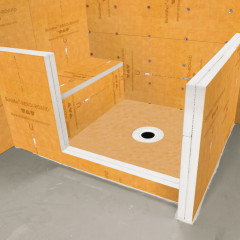
Went to look at my new construction home after the drywall was installed and I noticed that drywall was put in the walk-in shower. I’m obviously no pro but I always thought tiles should go over cement board in wet areas.

I don’t know if they will be putting cement boards over the drywall and then tiling? But it just seems wrong if they just tile over the drywall.

Comments (14)

  • 4 years ago

    From what my understanding is, drywall should NOT be used in a shower, or tub surround.

  • 4 years ago

    They have a new treatment for shower walls. The next time you see this it will be painted a red or i believe I've also seen black. It's a waterproofing material that is painted on making it so that you don't need the green board. 
    Could be wrong, but I'm 99% on this one.

  • 4 years ago

    For my build, my drywall subcontractor will install Durock cement board in the showers and the tile subcontractor will add a waterproofing layer on top of it. I think the idea is that anything that gets through the waterproofing layer will not cause an issue.

  • 4 years ago

    Drywall manufacturers say this is a 100% no go, no warranty from them period.

  • 4 years ago

    "that is painted on making it so that you don't need the green board."


    Greenboard (Moisture Resistant drywall) is was and never is to be used in a shower as waterproofing materials will not adhere properly due to the waxy type finish on it to help make it moisture resistant.

  • PRO
    4 years ago

    You are partially to the destination and most likely worrying needlessly. Find out what the final wall make up detail is and there will most likely show a waterproof membrane over the drywall.

    Do you talk to the builder? They have a lot of answers.

  • 4 years ago
    last modified: 4 years ago

    A liquid elastomeric waterproof coating (like Red Guard) should be applied over a cement backer board not drywall.

    What's in the specifications? Don't wait to see what is used; ask now.

    As Mark suggested, a Schluter Kerdi or similar membrane system is applied over drywall and is a very high end solution.


    https://www.youtube.com/watch?v=9hPMWc22oK8

  • 4 years ago

    Millworkman and All, you're right. It's been too long since one of these projects at my house.
    Green board goes on the walls of the bathroom. Cement backerboard on the shower walls and then waterproofed. 
    My apologies for the misinformation. However, even since our last shower, it seems to me that methods have changed and always are. 
    Yes, talk to your contractor now. Be informed on his intentions to avoid an costly do-overs.

  • 4 years ago

    I would read the contractor the riot act. All regular drywall in the bathroom needs to come out. Use CBU or one of the many waterproof tile backer boards in the shower with an appropriate waterproofing system. Outside the shower and on the shower ceiling use either green board or blue board if you are going to be plastering. Ask your contractor how they will waterproof the shower?

  • PRO
    4 years ago

    Both GC & drywall contractor should know this.


    Also what kind of pan set up?

  • 4 years ago
    last modified: 4 years ago

    Unless you keep your bathroom a steamy jungle--long hot showers and no exhaust fan--there's no need for green drywall.

    As for the shower:

    IRC (International Residential Code), 2018 adopted by many states

    Supposedly, Kerdi on standard drywall works, but that might be up to the local authority to make an exception.

    (The Code I work under simply says "Ceramic and plastic tile installed on walls around bathtubs or showers shall be applied over moisture resistant backing." OBC 9.29.10.4 (1))

    I cannot imagine that a high-end solution will be used in a tract home! On my last custom build, it was hard enough to convince the tiler to use a Kerdi shower tray at the customer's expense.

  • 4 years ago

    The Tile Council of North America first recommended against using drywall behind shower tile in the mid 70's when WonderBoard came commonly available. Rather than rewriting the handbook, TCNA added a stamp saying "NOT RECOMMENDED" across the old shower wall detail.

    In the late 70's I was the job captain for a 6 story luxury condominium building in Minneapolis where the owners, on the advice of their Construction Manager, eliminated the WonderBoard I had specified. When the winning tile sub included installation of WonderBoard at his own expense, they called him into our weekly job meeting and asked why. He said it was cheaper than being called back to replace the shower tile later.

    It took many years for manufacturers and building codes to catch up but I don't know why anyone would use those resources for waterpproofing design standards.

  • 4 years ago
    last modified: 4 years ago

    Modern waterproofing systems are only vapor retarders, but some are better than others. So if you use drywall as a substrate water vapor from the shower will get into the drywall and if the insulation isn't that good you can also get condensation on the back of it. This will lead to mold and disintegration of the drywall and is why drywall should never be used in wet areas either with or without a waterproofing system. CBU and foam tile backer boards are mold resistant and don't disintegrate if they pick up some water vapor.

    Double check with your contractor if the board on the walls is regular drywall and not one of the new MgO type boards which resemble drywall.

Sponsored
Whisler Home Improvement
Average rating: 5 out of 5 stars9 Reviews
Franklin County's Committed Home Improvement Professionals