Software
Houzz Logo Print
nicole_washington30

Have you installed multiple induction cooktops?

I would like to install an induction cooktop but there aren't many that have 6+ burners or room for multiple large pots. (Ideally I would pick a 48" gas, but gas isn't in the cards.) There are plenty of 30-36" cooktops, but most have 3-5 spots, with only one large cooking element. One way to accomplish a larger cooking space would be to install two smaller frameless cooktops side by side... say 2x24" or a 36"+12". The downside to this solution is that there would be a seam between the two that would both disrupt the visual appeal and (even worse) catch cooking junk. Or possibly several of the invisacook elements.

Has anyone done anything like this? If so, can you post pics and comment on your experience (good or bad)? Or do I just go with the 36" and get a plugin element for those times I need an extra?

Comments (15)

  • PRO
    4 years ago

    Nicole:


    Appliance manufacturers forbid the use of pots larger than the burners and for good reason; heat transfer. Keep that in mind please.

  • 4 years ago

    No one ever uses half the eyes on a 48. Your eyes are bigger than your stomach on this.

  • 4 years ago
    last modified: 4 years ago

    For the record (although this record has been played a few times), I have a 36-inch induction cooktop paired with a Cooktek induction wok hob assembly. The installation issues will be similar for dual flat induction cooktops.

    You need to decide on your base cabinets. Generally, the cooktop should span most of a cabinet space, with room for any added support that the stone you put it on needs (if you use stone). This means two cooktops, two cabinets, and likely 4 or more inches between the glass (Ceran) cooktop surfaces. You will need a very large hood, or a pair of hoods with attendant pairs of ducting, blowers, dampers, roof caps (or blower/roof cap combos).

    Two independent electrical feeds are needed with their own breakers. My 36-inch unit uses a 50A supply, but smaller units side by side might only need 30 to 40 ampere circuits each.

    Make-up air may become more complex, depending on the approach used. This is a very big topic and it will be worth it for you to read MUA threads on this forum.

    The heat rejection scheme of the induction cooktops needs to be considered. I used cabinets that are not sealed between cooktops and base, and use wire racks for pans below to ensure a good supply of cooling air. Other schemes are possible. Fully digest (figuratively) the installation directions for any candidate cooktops.

    Cooktek makes a large number of units, many of which can be installed into a counter. You could have three two-hob units spaced on three narrower cabinets. https://cooktek.com/product/two-burner-cooktops/

    The largest hood that Wolf makes, for example, has a 60-inch wide intake aperture, and this somewhat limits how far your layout can extend without going to custom (e.g., Modernaire), or dual hoods.

    Verbo's comment is well worth considering.

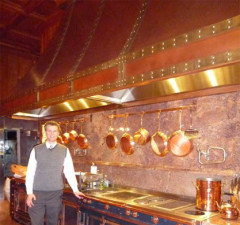
    Where cost is no object relative to most kitchen projects, it is always possible to build something grand. [Image from Handcrafted Metal, Inc.)


  • 4 years ago

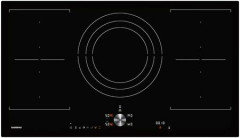
    Gaggenau (and possibly others) has modules so you can create whatever size cooktop you need. See if that'll work for you!

  • 4 years ago

    Gaggenau doesn't have designated burner spots - the whole surface can be used so there is no limitation on pot size.


    It is $10,000 - or was when I was shopping in 2018 so I settled for a Bosch Benchmark which has fairly flexible hobs.


    I don't know if every inch of the surface could be used as I didn't consider it because I didn't want to spend $10,000


  • 4 years ago
    last modified: 4 years ago

    You could install two flush-mount Gaggenau Deals CI292600 36" cooktops ($2K each) side by side and have up to 10 elements in total.


  • 4 years ago
    last modified: 4 years ago

    Gaggenau modular units could be your answer. You can do multiple 15" induction cooktops.https://www.ajmadison.com/b.php/Gaggenau%3BInduction%3BCooktops/N~29+4294962678+4294958390

  • 4 years ago

    I thought there was a small range where the pot can be larger than the hob for induction?

  • 4 years ago

    Pot diameter limits are mainly due to hot pot surfaces extending into areas where electronics might not be adequately shielded from the heat, which for Electrolux and its derivatives is mainly the control area. Even this risk can be somewhat reduced by using silicone pads to raise the pot or pan a mm or so above the Ceran and avoid having much heat transfer to the surface. Of course, only the pan base over the coil will be inductively heated; the rest will be heated by conduction across the base.

  • 4 years ago
    last modified: 4 years ago

    Then add the 10K-15K to upgrade the total electrical service to the home, add a new panel, and all of the new dedicated circuits that all of these individual units will require. Then plan the 72” of vent hood needed, plus the makeup air routing and other logistics. You’re at 20-25K before you even buy the hobs.

  • 4 years ago

    AGA makes 48" induction models. That would solve most of your problems. You might want a separate oven still, to get a full American-sized oven cavity.

  • 4 years ago
    last modified: 4 years ago

    No, sorry, they are induction ranges. So that doesn't quite satisfy OP's search.

  • 4 years ago

    invisacook or gaggenau or fisher paykel

  • 4 years ago

    The 7000 series Miele is full surface. The 36" models control 6 separate pans. Not yet available in the US. Maybe next year.