Software
Houzz Logo Print
countingblessings

radon mitigation in full basement (no sump, no interior drain)

4 years ago
last modified: 4 years ago

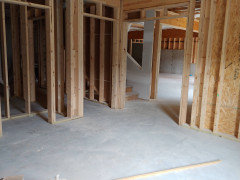
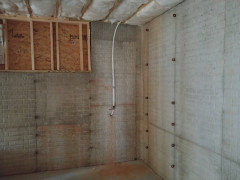
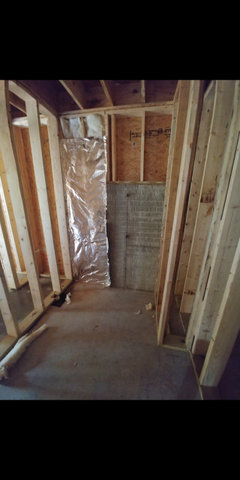
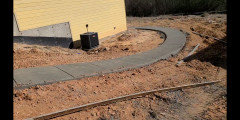
Full unfinished daylight (on rear side) basement. Researching radon mitigation but most articles mention tying into sump pit or interior French drain, which we do not have. There is only bathroom rough-in in the cement floor and main water shut-off through one of the cement foundation walls. Sounds like new, dedicated holes in the floor will have to be made?We have no immediate plans to finish the basement but the space will be occasionally used for percussion practice and exercise. We knew we wanted to hire out or diy the radon mitigation ourselves, rather than have the builder do it and risk the chance of the job being done too cheaply.Was also wondering about side wall venting, as only part of the foundation walls (street-facing side) are surrounded by ground.

Comments (21)

  • 4 years ago
    last modified: 4 years ago


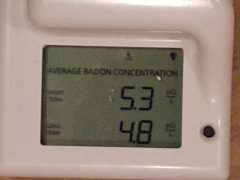
    Current long term radon reading is 4.8, via SafetySiren Pro Series 4.


    Basement is about 1200 sq ft

  • 4 years ago

    “Current long term radon reading is 4.8, via SafetySiren Pro Series 4.”

    What does that mean? How long is ‘long term’? Where was the sensor(s) placed?

    When we had our house tested in 2019 the level below which action was not required (Canada) was 200Bq/m3.

    Maybe you don’t have a radon problem.

    IMPO

    SR

  • 4 years ago

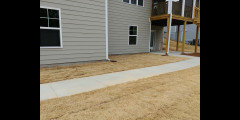
    @fsq4cw this was over 23 days average. The unit was placed in the rear corner of the basement. See photo.


  • 4 years ago
    last modified: 4 years ago

    The risk of radon in people's basements is far overblown. There are many in the scientific field, especially industrial hygienists(scientists who study workplace safety limits for radiation exposure) and cellular biologists, who openly call the EPA's radon guidelines pseudo-scientific nonsense.

    There was a good article from Wired on this a few years ago. While a magazine article is NOT a peer-reviewed scientific journal article and should not be taken as such, it does a good job summarizing some of the absolutely absurd guesswork the EPA bases their assumptions on.

    Personally, at 4.8 I wouldn't do a damn thing to my own basement, but that is your choice.

    https://www.wired.com/story/to-radon-or-radont-that-is-the-question/

  • 4 years ago

    It appears to me that your test procedure is near useless. How can you verify that the calibration of your instrument is even accurate?

    We did 2-tests in our home involving test modules that were hermetically sealed even from UV until deployed, after which they were Fed-Ex’d to a scientific lab in Boston (we’re in Canada) for detailed analysis. The short term test had to be done over a minimum of 90-days, preferably in the winter the windows are closed and the long term test had to be performed for a period of not less than 1-year. All modules while sealed also had clear expiration dates, serial numbers, batch numbers as well as all the lab accreditations and standards.

    While no harm will likely be done by installing proper radon mitigation, it might be a waste of time and money.

    For full disclosure, these tests, including expedited shipping both ways via courier was complimentarily and provided free of all charges to selected professionals as I worked in the geothermal field of design.

    IMPO

    SR

  • 4 years ago

    Do not have the builder come back to do it. It sounds like it's over your heads for DIY as well. Hire a certified radon installer. The discharge pipe has to exit above the roof, not stopped at the wall.

    Also it looks like active water coming in your water service entrance. That needs to be filled. Also also, I can see a daylight crack just to the left of the water line where the wood-framed wall meets the foundation wall step.

  • PRO
    4 years ago

    Radon mitigation is about reducing the concentration of radon in air where humans would otherwise be exposed to it.


    In areas with known radon issues, it's typically to install gravel and perforated piping under a slab connected to a continuously operating fan to minimize the potential for radon to enter the structure. Implementing that at this point would involve cutting and excavating the concrete slab. Another way to reduce the concentration is to implement a ventilation strategy for the basement which keeps the concentration below the target concentration. You'll be well served to discuss alternatives with a local radon mitigation contractor.

  • PRO
    4 years ago
    last modified: 4 years ago

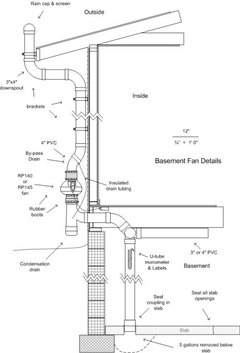
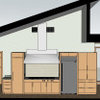
    Most likely they will do a core mitigation system, they will cut the slab dig a hole to create a pit, and install the pipe with a fan and out to the daylight above your roof.

    To give you an example


  • PRO
    4 years ago

    The problem is that radon gas infiltration isn't typically limited to a small area beneath the slab-- which is why a network of perforated pipes is typically installed. A single point collection system would require the installation of a radon-barrier membrane and a layer of gas permeable aggregate to be effective. If those aren't currently in place, the OP is back to an excavation project. If the OP goes the single point route, I recommend they require a performance guarantee with the before and after concentrations determined by a qualitied third party.

  • PRO
    4 years ago
    last modified: 4 years ago

    Charles if I knew how to play the violin when I read your posts I would be the 1st chair in the orchestra and I mean that in a good way. :-)

    The goal is to bring the indoor air quality to a safe level, and the method that I explained is being used 99% of the time, it reduces the sub-slab pressure and it brings the radon to a safe level, in some cases, they will make a 2nd opening (depending on the ground condition) this way the negative pressure field spreads under the slab.

    I build homes in many surrounding areas and most get away with one opening to achieve a safe level. Most surrounding areas are shale-bedrock so radon is common in these soil conditions. All new homes have systems installed or radon-ready and every existing house prior to the sale must install one and this is how it's done all the time.

    Never heard or seen anything being excavated to do this, that would be very costly and too much involved not to mention many homeowners would face hardship if that's the route they must take.

    As testing goes, you can get your own radon test kit and they will have a self-sealed envelope with the address on it who does the tasting.

    Or a company that installs radon systems will handle all that, they mail test kits to a certified radiation testing company to test and issue the data report.

  • 4 years ago

    Every time there is a radon discussion someone will say it's overblown; it's a conspiracy theory; the process did not follow scientific protocol; and weave in their personal politics about government. They'll go into the history of Pennsylvania mining, shoot off statistics about car crashes vs lung cancer, etc etc etc.

    All I do is put it in perspective, which many people cannot grasp. Our civilized world is full of things that might harm us, and we humans may not fully understand them or be able to control them. So what we usually do is take an initial step to reduce our risk of harm; then take incremental steps where we gain knowledge successively. Steps thereafter may be forward or backward based on that current understanding.

    Not just for radon, but think in terms of a broad brush: things like structural calculations; electricity; pandemics. Think about things around your house and how they came to be: why your roof rafter is a 2x8 and requires 7 nails to attach it; why you have GFCI receptacles; why doors have tempered glass. If you didn't have any of these examples, most likely you would still live safely. However, if you do have them, your risk of harm is less.

  • PRO
    4 years ago

    "Never heard or seen anything being excavated to do this,"


    I lived in central PA for 14 years. PA has one of the most serious radon problems in the U.S. Suffice it to say that I have first hand knowledge of both radon testing and mitigation techniques.


    According to the OP, they have a solid concrete basement slab with no radon mitigation measures currently installed. The method suggested by GN Builders requires cutting into concrete and removal of a quantity of subsoil--a minimum volume of five gallons-- as depicted in the drawing. That removal, by definition, is excavation.


    Assuming the disintegration rate indicated by the OP's meter is accurate (it's over EPA's actionable limit of 4 pCi/L,) and given the potential need to control relative humidity in the basement, too, a ventilation strategy should be one of the alternatives considered. It might address both problems at the same time and it can be installed by contractors who are excavation-impaired.

  • 4 years ago

    Tim, words have inherent meanings as you know with your dances with Ray. "Excavation" in most of our minds involves large equipment; I'd bet you even use the term "digging" when you use a shovel by hand, even though it technically is "excavation" ('honey, I'm going out to excavate a fence post?"). The other comments you are reciting pertains to new construction and preventative measures, here the cat's already out of the bag. They will have to "core" and "dig/clear" suction pits, which is more appropriate terminology than "cutting" and "excavation."

    Also, if you are suggesting that a small fan be put into the basement, to exhaust a small amount of air, that would occur after radon may have entered the occupied space. Realize that a ceiling fan, or just walking by radon test equipment, will impair the radon readings. So the habits of radon once it is already within a space are unknown; and how a particle ultimately carries with these air movements is unknown; therefore, as of now, the best risk reduction of radon happens when you mitigate it prior to entering the building envelope.

  • 4 years ago

    Hey, y'all! It is all good. No need to argue.


    I appreciate the advice from all points. I already decided it is worth having radon mitigation, particularly because we have kids and my in-laws might have to come live with us at some point, once we finish the basement.


    I intend on getting quotes from 3 certified radon mitigation companies. It sounds the scope of work can vary widely, depending on how well pressure can be maintained under the slab and/or how much ventilation may be needed above the slab.


    Some of the photos I posted were during construction and before final grading, so, there are no more daylight gaps today and, I am monitoring for water intrusion always. Previous home had a bad mold problem in the basement, which I don't want to repeat here. Thanks for keeping a close eye on the photos, though.


    Anyway, peace to you all, and have a good week.


  • PRO
    4 years ago

    @3onthetree,

    Actually, Greg's statement that the goal is to bring indoor air quality to a safe level is on point. You can do that by either venting radon gas under the slab to keep it from entering the conditioned living space or in the event that's impractical or ineffective, dilute it in the indoor environment. It's been said that "the solution to pollution is dilution." That's the design principle behind a ventilation strategy. The required ventilation rate would be based on the volume of the basement, the pre-ventilation and desired post-ventilation concentrations.


    As for terminology, when I dig a hole with a shovel, I'm digging a hole. When I need to cut concrete to dig the hole, that's excavating soil under a slab.

  • PRO
    4 years ago

    In most cases, "textbook" terminology is not used in a particular field of work, "slang" or "jargon" maybe a better word is understood much better and the same goes for excavating...

    Nobody in the construction industry uses terms like "where is the shovel I have to go and excavate a hole" 100% of the time it will be I have to go and dig a hole or " when are you planning to excavate the basement" 100% of the time it will be "when you planning to dig that basement". etc.

    When you hear the word "excavating" 1st thing that comes to mind is something on a much larger scale, like excavators being used, or other equipment and you relate that to something where you have tons of fill is being removed. You will never hear someone say if there is a guy with a posthole digger and shovel next door who has to dig 20 holes for a fence...someone would say someone is doing excavation work in my neighbor's yard.

    In most cases, you would hear excavating terms when it relates to a field of work like "I'm in an excavating business" etc., or drawing notation like "excavated area" etc.


  • PRO
    4 years ago

    I don't know about the vernacular in Jersey, Greg, but even my plumber uses the term "excavation" for work under a slab and he's no Ph.D. When digging yourself deeper in a hole, it's best to well, put down the shovel.

  • PRO
    4 years ago
    last modified: 4 years ago

    At least I know how to dig and know what the shovel looks like :-)

    You on the other hand probably afraid to leave your office without some sort of "performance guidelines" attached to you.

    You should also look up the definition between "jargon" and "vernacular" (even with a "silver tongue" attached to you, you are not the brightest bulb or you just trying too hard to prove something) because believe me you don't wanna hear "vernacular" used in NJ that would be a bit too much for you to comprehend LOL.

    As your plumber goes, I doubt that very much that he uses the term "excavate" being Ph.D. or not because even a Ph.D. will say I need a few holes dug instead of I need a few holes excavated. :-)

    I'm done with you...

  • 4 years ago

    "it's typically to install gravel and perforated piping under a slab connected to a continuously operating fan to minimize the potential for radon to enter the structure. Implementing that at this point would involve cutting and excavating the concrete slab."

    "If those aren't currently in place, the OP is back to an excavation project."

    Tim, I try to avoid these internet tit-for-tats. But it boils down to this: Your comments put in the OP's head that they have to remove the slab and install a loop of perforated piping in a gravel base. That is not true and not ever a practical option. Apparently you aren't aware of the common method of extraction points. And that's ok. It doesn't negate your obvious intelligence or reduce your extensive experience. Rather than trying to back out of a hole with what you said by parsing words and playing which cup is the ball under, sometimes it's just better to admit you weren't familiar with that system for retrofitting existing homes. I've been wrong before and have misread or haven't thought of things in threads before too. I either correct myself, re-evaluate my answer with new info, or move on, but I don't worry about saving face.

  • PRO
    4 years ago

    @3onthetree,

    At the risk of beating a dead horse, my initial response to the OP's question was:


    "In areas with known radon issues, it's typically to install gravel and perforated piping under a slab connected to a continuously operating fan to minimize the potential for radon to enter the structure. Implementing that at this point would involve cutting and excavating the concrete slab. Another way to reduce the concentration is to implement a ventilation strategy for the basement which keeps the concentration below the target concentration. You'll be well served to discuss alternatives with a local radon mitigation contractor."


    As the saying goes, there's usually more than one way to skin a cat. There is no specification in my above comment whether the perforated pipe is a network under the slab or a single point system. I'm familiar with both. I'm not a, well, fan, of single point extraction systems especially on a retrofit basis because they depend on the permeability of the material under the slab which was not designed for that purpose. I'll reiterate my suggestion that the OP consult with a local radon mitigation contractor.