Software
Houzz Logo Print
webuser_107419837

Good germ, slow growth - help!

4 years ago

hi yall


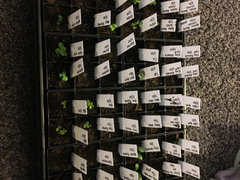
ive started a myriad of seeds one week ago - they have all almost completely germnated. i havent ever had THAT issue. but once germinated, they grow slowww. same as last year. i have them under appropriate shop lights and try not to water until the soil pulls away from cell. ambient temp 68-72. potted in organic mix. no gnats or fungal problems that i can tell and no signs of damping off. help help! tia

Comments (24)

  • 4 years ago

    I did realize a couple days ago that the lights were too far- evident by some stretching in a few. moved closer. they are still under domes N lights are directly sitting atop domes -as close as possible. i like your weight idea. and no fert yet.


  • 4 years ago
    last modified: 4 years ago

    What plants are we talking about? Some seedlings grow a lot faster than others. For example, pepper and eggplant seedlings grow slowly. Tomatoes and squash (large seeded plants in particular) grow very fast. I would water when the surface gets a little dry, not when the soil starts to pull away. At that point, the underlying soil can be quite dry. As noted, proper light and ferts are important as well, especially once past the cotyledon stage.

  • 4 years ago

    Its all basils, flowers like snapdragon and zinnias and cold weather stuff like lettuce cilantro chinese cabbage etc i was teying to think of what else i could have been missing. ill give them a few more days and if no change i will try fert. what would you do? i have liquid fish emulsion and liquid kelp

  • 4 years ago

    Roots looking good and healthy no sogn of rotting

  • 4 years ago

    What I see in your picture is that your plants are well past the cotyledon stage. At this point, the seeds are no longer supplying nutrients to the plants. If your mix has no nutrients, you need to fertilize NOW. Liquid kelp is a pretty unbalanced fertilizer. Fish emulsion is better, if that's what you have. The lights (assuming fluorescents or LEDs) should be an inch or two away from the foliage.

  • 4 years ago

    What ratio do you suggest

  • 4 years ago

    Not sure what you're asking. Fish emulsion NPK is 4:1:1, which is good for developing foliage. Liquid kelp is 1:0:4.

  • PRO
    4 years ago

    If you have instructions on your fertilizers for the ratios for seedlings, use the instructions. If you do not have instructions, start with about a quarter as strong as a regular plant dose. So say you use a tablespoon per gallon regularly, you would do your first feed with a quarter tablespoon. Next watering bump that up to half strength. Dont' go full strength tilll they are bigger plants and need the full strength.

    I would use a bit of both together. Fish emulsion is better for the foliage, but the higher K on the kelp is good for strong and healthy root development, which is good for little plants too.

  • 4 years ago

    Your plants need nutrients just like every other new born multicellular organism, but Many organic mixes are void of nutrients. With organic fertilizers you basically need to feed the microbes first to make the nutrients available to the plants but the potting mix is usually also short on a population of microbes to do the job of supplying the plants with nutrients.

    So you should forget the organic fertilizers and select a chemical liquid fertilizer with nutrients immediately available to the plants and mix 25% what the label states with water. Save the fish emulsion, liquid kelp and blood meal for the garden where there are populations of microbes to convert the locked up nutrients into available nutrients for the plants.

  • 4 years ago

    Thank you to all! all sound like logical ideas to me. ill try to update in a week or 2. if i had compost tea, what wpuld anyones thoughts be on that? i do know some about feeding organisms for soil life

  • 4 years ago
    last modified: 4 years ago

    I've always been a little skeptical of compost tea as a smart source of nutrients. If you want nutrients from compost, then just throw on the compost! But it is true that if the stuff is fresh, it would contain live microorganisms, which could help break down organic fertilizers. However, if your seedling problem is lack of nutrients, you need them NOW, and not when the microorganisms get around to making them. The process of digestion of organic fertilizers by microorganisms isn't a particularly fast one. Most estimates say it happens in 2-6 weeks, depending on temperature and moisture levels.

  • PRO
    4 years ago

    I use compost tea, but not on my seedlings. I catch what comes out of my tumbler and use it outside in my outdoor pots- I figure why not so long as it's there. My other composting does not really get used like can be used in tea. I do a lot of layering on the ground and hugel-composting in cages I top off with growing more than have active composing piles that I turn or distribute out.

    I've used leaf mulch tea when it's there (usually by accident when something isn't emptied before winter and I use in the spring). And I also ferment green tea, when you take green things like weeds or comfrey and let it stew up into a stinky nute-rich broth. This spring I'm starting to play with sugar ferments, and those are interesting. The sugar ferments I can make and store over the winter to start using on my seedlings next year. I do also sometimes use some synthetic granular fertilizers meant to be mixed with water for my seedlings.

    I think it's a bit of a fallacy to state using synthetic chemicals works better or faster than using organic chemicals. They can be handier or easier to use sometimes. But if an organic is really fully composted down, it shouldn't be requiring more breaking down by the microorganisms to finsh it off while being used as fertilizer. If it's not broken down enough for the chemicals to be available, then it needs to compost, stew, or ferment longer. Synthetic fertilizers wouldn't be pulled part way through the process and used, it's finished off too.

    But I guess I'm wandering a bit off topic at this point, and probably starting conversations better off for other threads. Point is with seedlings, if you use a fairly inert medium to start the seeds, you need to start feeding them fairly quickly after they are sprouting. If you choose to use organic or synthetic chemicals/fertilizers for it, or even both, that's a personal choice. But for ratio it's best to rely on a much weaker dose at first and then start giving more. It's far easier to apply whatever fertilizer in a liquid form to seedlings, so use a diluted fert or tea rather than solids to be watered or dug in.

    And a bit back to the OP and the seeds.. basil can dally a bit after popping up and before taking off. I got a great basil mix a couple years back, Italin. Never again. Germination rates were mixed on timing, and the growth spurts or not, yikes.

    I've had it slow with cilantro, and sometimesa wee stall with zinnias- but depends on the kind I think. Some are quicker than others. Been a while since I've seeded snapdragons, those are on their own outside for a few years now. Chinese cabbage should be fairly quick, but that can depend on what kind.

  • 4 years ago
    last modified: 4 years ago

    We're talking about microorganisms digesting uncomposted organic materials to make nutrients. From an NPK perspective, compost itself is a poor fertilizer, though we use a lot of it to make up for that. Compost tea is even less so, because it's just a fraction of what was in the compost. But compost and compost tea do have the microorganisms that can digest organic material, and make nutrients out of it. That being the case ...

    "Organics are slower because they have to be broken down by soil microorganisms in order to feed plants. Organic fertilizer has to essentially decompose before the nutrients are available to plants. This process can take 2 to 6 weeks depending on many factors including soil temperature and moisture levels."

    https://www.burpee.com/blog/organic-fertilizer_article10710.html

    That's true that synthetic chemicals don't necessarily "work better" than organic chemicals. But they do work a lot faster.

  • PRO
    4 years ago

    Also from the article

    "The quick availability of synthetics also increases the chance of burning your plants. Inorganic fertilizers don’t do anything to build natural soil fertility"

    "“Kelp and seaweed are excellent sources rich in nutrients like vitamins and antioxidants. High in potassium,” he said. Micronutrients supplied by organic fertilizers are essential to growth and development of plants. They play a real part in photosynthesis, he said. Potassium is beneficial to the overall health of the plant and beneficial to root crops.

    Silva suggests considering a combination of synthetic and organic fertilizers, relying heavily on organic matter for soil fertility improvement. He would use light synthetic fertilizers when starting seed and give a dose of synthetic fertilizer when transplanting plants into the garden. Give organic fertilizer at the same time so it has time to become available by the time your plants will need their next feeding.

    Which ever method you choose, remember that more is not better. It is possible to harm your plants with too much organic additive. Be sure to follow label instructions."

    So again, it's personal choice of which fertilizers to use, they can all have benefit- but the general wisdom is to use a diluted or lighter dose to seedlings.

    There are also gardeners that don't use fairly inert material to start seeds- they use material that is already fertile so the urgency of having to feed seedlings isn't quite so urgent.

  • 4 years ago
    last modified: 4 years ago

    Yes, synthetics do work fast. That's exactly why you use a half-concentration of chemical fertilizer, as was properly recommended here. The idea that synthetics necessarily burn plants is not what is being said. Of course, if your seedlings don't have any nutrients, it really increases the chance of them dying. It can also be said that having your seedlings survive is a personal choice, but I suspect that isn't what people want.

    No question that organic fertilizers can supply necessary nutrients. The issue here is whether they can do so promptly.

  • PRO
    4 years ago

    Sure organics can do so promptly, or at least promptly enough. The seedlings aren't dying from lack of nutes, they are just hitting the point where something needs to be added to the fairly inert material to start feeding them. Seedlings can survive and even flourish with just organic chemicals. Seedlings can also survive and even flourish using the same chemicals that are synthetically produced. If a fertilizer is a good finished fertilizer, it should have the chemicals availble for the plant to use, regardless on if it's produced by nature or man-made.

    Faster isn't always necessarily better, just like more isn't always necessarily better. Sometimes plants show that on their own when they are growing slow after popping up. Even if they have the faster ferts available, don't mean they are using them up quicker. They are growing at their own rate.

    From the OP's pic, I think they would be fine using organic, synthetic, or both kinds of fertilizers. Since they have the organic stuff on hand and the plants don't look like they are in dire need of instant feed, I don't see why not use the organics instead of going out and getting synthetics. If nothing else, even the organics now can start feeding them till the OP goes out and gets synthetics if they want to use those.

  • 4 years ago
    last modified: 4 years ago

    The concern is also the quality of the growing medium and the size of the container the OP is using. If the potting mix was of low quality then nutrients could be non-existent or low, and the size of a container limits growing medium to the point the nutrients are quickly exhausted by the seedlings.

    A quality potting mix consists of composted organic waste and had the aid of macro and microorganisms to mineralize the nutrients to become available to the plants immediately. Fish Emulsion is organic waste broken down in an Anaerobic digesters and hasn't been composted so no nutrients were mineralized. A cows digestive system is a digester but the end product still needs composted. When a fish emulsion is dumped on a plant it requires time to compost it with the microorganisms in the soil. Correct conditions need to be met for microbes to live such as temperature, oxygen and moisture levels including carbon as a food source for microbes to live and multiply or otherwise they do no existent and you get no decomposition and no Mineralization of nutrients.

    Any Organic waste processed through an Anaerobic digester will have the same properties I stated above whether it's tea, kelp or corncobs. To actually minerialize the nutrients through digestion air pumps are required to aerate the liquid to allow beneficial bacteria to thrive allowing complete composition to take place. It's a long and expensive process and I'm skeptical of anyone who states they have composted tea.

    The supply of nutrients in small growing cells are rarely adequate to maintain the requirements of a plant before up sizing the pot. Therefore additional fertilization is required and if Organically derived nutrients are your choice then the product must also be completely composted to the point nutrients have already been mineralized. Otherwise, with the example of the fish emulsion i gave you're going to wait weeks before the plants will ever benefit for the product or never if the microbe populations can't exist.

    I use a quality potting mix (Espoma) with completely composted organic waste, and add Jobes organics fertilizer which has also been completely composted. But I also use a synthetic liquid fertilizer in the water because of the small cell sizes they must live in. If the plants were in big pots full of fertile soil to supply their needs I wouldn't need to add the liquid fertilizer but my space is limited, and want my plants to thrive.

  • 4 years ago

    Sorry, but we have a disagreement here. Indeed, organics DO contain all the nutrients needed, and plants can certainly flourish with just organic chemicals, but as Kevin9408 states, until those organics are composted and mineralized, those organic chemicals simply are not available in a plant-usable form. Those organics aren't a "finished fertilizer". Doing that microbially takes weeks. So if you start out with digested organics, you're good to go. If you start out with undigested organics, like fish emulsion and kelp, you need to be patient. Faster isn't necessarily better, unless you're growing in a medium that has no nutrients. If that's the case, slow generation of nutrients equals trouble. I agree it isn't obvious that the OP has a nutrient problem, but the fact remains that if there is a nutrient problem, loading on undigested organics is not a useful fix.

  • PRO
    4 years ago

    It's all good, we can be in disagreement. More than one way to garden. It's OK if the majority advice is to not even try using the organics the OP already has and is often noted to be beneficial for feeding seedlings because they won't work and that they should go buy some synthetic fertilizer that is complete and will work instead. There are a variety of synthetic fertilizers out there, many of them meant to be mixed with water before using, OP can just follow the instructions on whatever fertilizer package they decide to buy. Or they could try going with the 25% or 50% dillution suggestions that are commonly touted if there isn't a specific dillution instruction on the package.

  • 4 years ago

    I havent had rhe chance to read through everytging written but i love the sense of understanding in disagreement in this post

  • 4 years ago

    Your tags are casting shade on your seedlings. Plus, when you move them to harden them off and something happens (dogs, wind, stumbling human), the tags can become disengaged. Use a marker to write on the containers instead. Good luck.

  • 4 years ago

    I remembered this post and was watching all my starts sit there. I finally put them outside in the sun and I’m getting my first set of true leaves… whew! I have different kinds of peppers and basil. I think I’ve lost several basil plants, but I’m glad I have what looks healthy from this particular basil. I’m keeping my fingers crossed. 🤞🏻

  • 4 years ago

    Yes, feed them a very diluted fertilizer and put them outside in the sun. You will be AMAZED at how much they grow when exposed to sun even for a few hours. I have Craspedia started and the day after I put it outside for a few hours, it grew over an inch and a half, not kidding, I did a double take when I saw it.