Software
Houzz Logo Print
westes

Selecting Hydrangeas for Zone 9b

4 years ago
last modified: 4 years ago
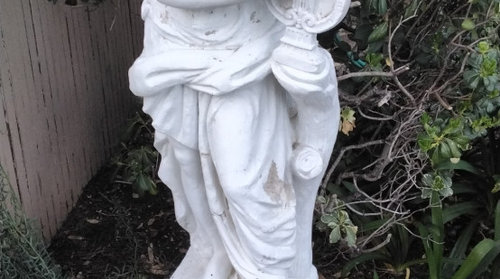
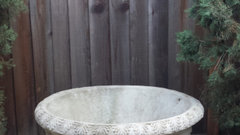
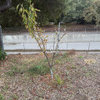
Please make suggestions on Hydrangea selections for a zone 9b garden. I want to put Hydrangeas on either side of the statue shown in this photo. Maybe directly behind the statue, I could put some kind of climbing Hydrangea or a plant that would complement Hydrangea and fill in the bare shrub behind the statue.

I was thinking of "Blushing Bride", which seems to be a species that Dr Michael Dirr - a top Hydrangea breeder - likes and recommends as a prolific bloomer. I definitely want a strain that continuously flowers.

I understand Hydrangea wants a lot of moisture. Should I build a raised bed on top of the clay loam soil and maybe use 50% organic material in that soil to keep the moisture retention of the soil high? Should I put some peat moss into that soil to get the pH to 5.5 or lower, to get blue-colored flowers? I someone has some favorite Hydrangea soil mixes to share, please publish the formulas for making those.

This location gets sun all day long. I understand that Hydrangeas have problems in full sun. Would Blushing Bride require a shaded location?


Comments (21)

  • 4 years ago

    Can you take a picture from further away so we can see the area available.? I can't see any space in the current picture where a hydrangea would fit. As for Climbing Hydrangea, it needs a solid substrate like a wall since it climbs by aerial roots like ivy. It isn't particularly floriferous compared with shrubby Hydrangeas and it is a large, rangy and twiggy plant. It would swamp that shrub (Pittosporum?).

    westes Zone 9b California SF Bay thanked floral_uk z.8/9 SW UK
  • 4 years ago

    Climbing hydrangeas tend to have white flowers. And they tend to be quite aggressive when they take root. Mine requires a metal structure and I prune it to give it shape.

    westes Zone 9b California SF Bay thanked ptreckel
  • 4 years ago

    ANY hydrangea will grow in zone 9b. But full sun will present some challenges for any macrophylla (like Blushing Bride). Even in my cool summer climate bigleaf hydrangeas become stressed in all day sun. A much more sun tolerant variety would be Hydrangea paniculata.

    But I also have questions about the spacing available to grow hydrangeas in that location. Even dwarf or compact forms will get to 3-4 tall and as wide.

    And I just don't see where you could possibly squeeze in a climbing hydrangea. Not only do these grow into massive climbers, they also take significant time to settle in and produce flowers (5-7 years) and require some rather specific support qualities as floral mentioned. They are also not a repeat bloomer and have a relatively short bloom cycle.


    westes Zone 9b California SF Bay thanked gardengal48 (PNW Z8/9)
  • 4 years ago

    @floral_uk z.8/9 SW UK There is very little space behind that statue. I think the idea would be to have a Hydrangea stuffed into a narrow space and exploding out with blossoms.

    Based on what you say, climbing Hydrangea is a poor choice for that area so I should focus on the small shrub form.

  • 4 years ago

    @gardengal48 (PNW Z8/9) I could plant the Hydrangea just on the left side of the statue that only gets morning sun. The space is challenging but I could gut back the Pittosporum when the time comes for that. Climbing Hydrangea is out for now.

  • 4 years ago
    last modified: 4 years ago

    I tried to order "Blushing Bride" Hydrangea from a nursery back East and they refunded the money and said they cannot ship to California. What states are allowed to ship Hydrangeas to California? Apparently, Oregon can, but what others? Are there any Hydrangea nurseries that can ship to California?

  • 4 years ago

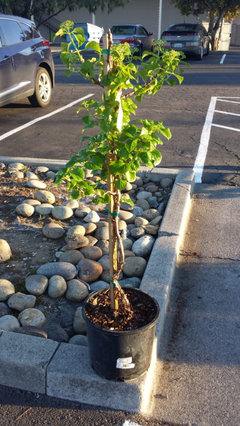
    @gardengal48 (PNW Z8/9) Thanks for pointing out that Home Depot carries Endless Summer plants.

  • 4 years ago
    last modified: 4 years ago

    @gardengal48 (PNW Z8/9) I picked up a climbing Hydrangea to climb a 40-foot Italian cypress from an enormous pot. What other climbing vines might work well climbing a tree on the other side of the same pot? I was thinking of a large Clematis Montana on the other side, and maybe a climbing rose in the middle in the back. The pot is in shade up to the fenceline. The right side where the Climbing Hydrangea would go gets morning sun. The left side gets afternoon sun.


  • 4 years ago

    Don't think pot is large enough to accommodate three plants. Especially when two can grow to a very large size! One would fill that pot adequately.

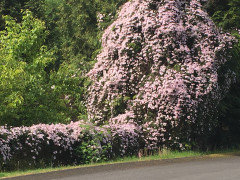
    btw, don't underestimate the size those two climbers can attain. This is a Clematis montana growing near where I live:

    westes Zone 9b California SF Bay thanked gardengal48 (PNW Z8/9)
  • 4 years ago
    last modified: 4 years ago

    A climbing Hydrangea and a Clematis montana will not grow successfully in that pot together, let alone adding a rose. Also, growing climbers up conifers can cause shading which may lead to threadbare branches. You are vastly underestimating the potential of these plants. I don't have a picture of my C montana in flower but it is all the green on the right hand half of my shed roof. You can't see it climbing the conifer behind.


  • 4 years ago

    @gardengal48 (PNW Z8/9) I love that C montana in the photo. Keeping in mind that the size of my plant will be limited by the size of the pot, is there a general rule about the size of the root system relative to the size of the plant? If a Clematis gets up to 20 feet, how large might the roots be?

  • 4 years ago

    @floral_uk z.8/9 SW UK The conifers in question already have bare sections where the plants will climb, and I am willing to sacrifice more of the conifer to get the beauty of the climbing flowering plants.

    It sounds like I will be lucky to have even one of these plants grow to maturity in the pot.

  • 4 years ago

    Clematis montana is probably the largest growing of the cultivated forms of clematis, easily growing to 50-60 feet...or more when fully established (as that photo would indicate :-)) Growing it in a container will certainly dwarf it considerably but I cannot say how much. I have never attempted montana in a container, although other large growing species clems I've tried maybe only got to about a third of their typical size. And that's in pretty good sized containers....15-20 gallons.

    Just like a tree that wants to grow 60 feet tall, a vine that wants to grow 60 feet tall will also produce a significantly large root mass. That's a heck of a lot of top growth to support!

    westes Zone 9b California SF Bay thanked gardengal48 (PNW Z8/9)
  • 4 years ago

    If I wanted different plants on each side of the container, it sounds like I would be better off planting the Clematis and Hydrangea in the ground, and maybe the rose vine could be in the pot on its own. But the problem is our hard California clay will be impossible soil for Clematis or Hydrangea to thrive in. I would need to build raised mounds or build a bottomless container.

  • 4 years ago

    I think you are underestimating the resilience of most plants and overestimating the difficulties of clay soil. Both the clematis and the hydrangea are grown all over the place in NoCal so unless you live on top of some highly unusual soil formation, I think it can be done and quite successfully too.

    FWIW, there are many parts of the country and even individual gardens that have to deal with heavy clay soils so it is not all that unusual an occurrence and gardeners deal with it all the time. Amend entire areas with organic matter if you can and continue to mulch with the same. Otherwise shallow but very wide planting holes, site the plant slightly above grade and mound up to the top of the rootball. Believe it or not, this is a far easier process than attempting to grow plants with massive size potential in a container long term.

    westes Zone 9b California SF Bay thanked gardengal48 (PNW Z8/9)
  • 4 years ago

    "The conifers in question already have bare sections where the plants will climb, and I am willing to sacrifice more of the conifer to get the beauty of the climbing flowering plants."


    You really underestimate the size of a climbing hydrangea!


    It will swamp those poor conifers, and a couple of years of that will kill them.

    Then right when your climbing hydrangea is close to mature enough to finally bloom those dead conifer skeletons are going to collapse under the weight. Then you'll have a huge pile of aggressive vine with nothing to climb. You'll be pruning every week for the rest of your life.


    I get that you have an idea in your head that you are trying to accomplish.

    But you really are setting yourself up for future problems if you insist on using a climbing hydrangea (or other huge plants) in a small space and climbing something impermanent. They need heavy duty, weight bearing support. They're are not that pretty at eye level, either. Their best use is to be viewed from below and at a distance, not up close and personal in a small vignette.


    There are SO many plants better suited to this application that will not set you up for a maintenance nightmare. And I say this as someone who loves pruning plants more than anything- not even I would set myself up for this level of future maintenance.


    IMO that statue calls for delicate little treasures of flowers- a climbing hydrangea would overpower the area and you would lose the focus on the art. It will literally look like kudzu in a few years.


    You have several really great botanical gardens near you- I suggest that you visit one or more to SEE a mature climbing hydrangea.

    You will also see myriad other flowering plants and vines, many of which would be a better choice in a small, residential garden.

    So check out Golden Gate Park, Berkeley, Santa Cruz, or even Hakone Estate or Filoli.

    You have so many choices!


    "I was thinking of a large Clematis Montana on the other side, and maybe a climbing rose in the middle in the back."


    tl;dr You don't have as much room as you think you have.


  • PRO
    4 years ago

    Oakleaf Hydrangea – If you live in an arid part of zone 9, such as California, the oakleaf hydrangea is a good choice. It has thick leaves that retain water well and help it get through periods of drought without having to be watered all the time.Aug 31, 2020

    westes Zone 9b California SF Bay thanked Patricia Colwell Consulting
  • 4 years ago

    Unless there is another spot selected for the hydrangeas other than the original as outlined by the OP, there is not enough room to stuff any hydrangea into that spot. "Stuff" being the operative word :-) And certainly not an oakleaf hydrangea, as even dwarf or compact forms get wide if not tall.

    Trying to insert or shoehorn plants into spaces too small to accommodate them easily at maturity is just going to lead to complications and garden frustrations down the road: overwhelming or overshadowing neighboring plants (or vice versa); lack of easy access to do necessary routine maintenance; lack of air flow and increased disease potential; unnecessary or too frequent pruning needs (and in the case of many hydrangeas, a subsequent loss of flowering as a result).

    If nothing else, this thread emphasizes the benefit of garden design and planning. Seldom does a lush, diverse and healthy garden develop spontaneously or with random ideas or plant purchases - often unsuitable - completed over time. However, even in a heavily planted or mature garden, the advice of a professional landscape designer can help to organize and modify the dream.

    westes Zone 9b California SF Bay thanked gardengal48 (PNW Z8/9)
  • 4 years ago

    @Patricia Colwell Consulting Oakleaf Hydrangea becomes a large, wide shrub. It's gorgeous, and I have other places that might work. But it is a big plant.

    @gardengal48 (PNW Z8/9) I would love to find a designer in my area who could come over for a few hours and give ideas when I need a plant for a corner. As I have said before, I have not found such a person in the South San Francisco Bay Area. Almost everyone I meet wants to do large jobs.

  • 4 years ago

    westes, I would encourage you to contact the Bay Area chapter of APLD, Association of Professional Landscape Designers. This is probably the best resource of skilled landscape designers available and I can't imagine difficulty finding one for just an occasional consultation. I don't know a single designer in my area who does not do consultations. I really like to do them as it is a very quick in and out and there's only so many full scale designs I can handle at a time.

    http://apldca.org/contact-apldca/bay-area-district-apldca/

    westes Zone 9b California SF Bay thanked gardengal48 (PNW Z8/9)
Sponsored
Peabody Landscape Group
Average rating: 3.5 out of 5 stars8 Reviews
Franklin County's Reliable Landscape Design & Contracting