Software
Houzz Logo Print
alliballi84

Kerdi Repair? Help please!

4 years ago
last modified: 4 years ago
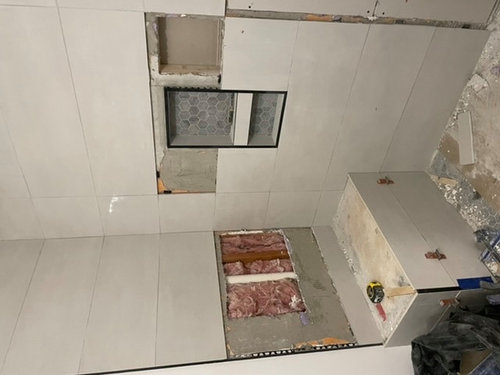
some of the tiles that were installed were chipped, possibly by the spacers they used? in removing them, they ripped off the drywall and kerdi completely up the the adjacent tile. Any thoughts how they should be repairing this so the system is watertight? I'm a bit concerned it wont be a continuous system since its all the way to the next tile with no tail to tie onto. Apologies for the sideways pics, not sure how to fix that..


Comments (16)

  • PRO
    4 years ago

    Not sure what we are looking at. LOTS of questions. Might start with rotating the photos before posting them. What are all those gaps? What are the holes on either side of the niche? And on and on. Did you hire a professional to do this?

  • 4 years ago

    ...also drywall? hopefully not. What's happening on the floor? If the integrity of the Kerdi is broken this much then I think you need to start again and that might be a blessing in disguise.

  • 4 years ago

    It is supposedly a professional. some of the tile had chips that were discovered after they had been installed a week or so. so they chipped out the tile which took the Kerdi and backup drywall(was originally purple board) with it. i came home at lunch and saw this ”patch”. they insisted refular drywall was fine since new kerdi was going over it. i told them to leave off any tile so i could see that for myself. i came home after work and all tile was reinstalled! there is one grout

    line in the corner i can see a void and just now thought id check it with a pipe cleaner and could push it all the way in with no resistance! ugh, im so mad i cant wven cry about it.

  • 4 years ago
    last modified: 4 years ago
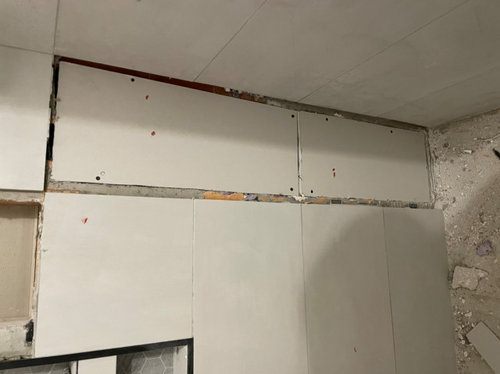
    Fire these guys immediately. Drywall of any color should never be used in a shower even with Kerdi. The voids just compound the problems and lack of quality you are getting, no waterproofing system is supposed to span such gaps in the substrate. Firing them now will prevent thousands of dollars of damage that this shower would have caused to your home.

  • PRO
    4 years ago

    WOW first stop with this idiot and unfortuneatly this is a redo since the waterproofing is now broken and I am not sure it was right to begin with . Do not pay one more penny and maybe even get a lawyer since this is a redo for sure.Drywall is never good in this situation and please get rid of those guys now.The angle of the pics really does not matter it's a mess .

  • 4 years ago
    last modified: 4 years ago

    Kerdi with a gypsum wallboard backing is accepted by the manufacturer.

    Among many others, building expert Martin Holladay of Green Building Advisor, agrees it works.

    However, the large gaps between the drywall are unacceptable. Perhaps the installers filled them in with an appropriate substrate before applying Kerdi.

    Whether the patch was done correctly with appropriate overlaps, KerdiPatch and unmodified thinset is impossible to tell as you have no pictures of it. For their own protection, the installers should have documented their work.

  • 4 years ago
    last modified: 4 years ago

    Drywall is an approved substrate for Kerdi products and so there is "technically" nothing wrong with drywall in the shower. However, there are two real drawbacks and reasons it is usually avoided... (1) waterproofing membranes are often not perfect as small punctures are possible and having a substrate that doesn't fail from insignificant amount of water is good. (2) drywall is not rigid enough to be a good substrate for many tile applications.

    Since they chose to use drywall, there is no repair that can be acceptably done. If the kerdi was appropriately adhered to the drywall removing the tile after a week is going to destroy the drywall. Since they can't get to an undamaged section there is no overlap avaliable for the patch.

  • 4 years ago

    Drywall manufacturers still say their gypsum wall products are not to be used in a shower so from there end it is incorrect. As mentioned above the waterproofing suppliers say it is ok but.........................

  • PRO
    4 years ago

    If you line a cardboard box with Kerdi, you've just made a bucket.

  • 4 years ago

    Since they can't get to an undamaged section there is no overlap available for the patch.


    Indeed! And since the OP can push right through where the Kerdi and drywall are supposed to be, the Kerdi and substrate are apparently missing altogether in that corner.


  • 4 years ago
    last modified: 4 years ago

    When I was working with Kerdi, the manufacturer instructions specifically tell you that to patch any hole in the membrane, you need 2" overlap. The installers have removed the kerdi (and in some cases drywall) right up to the tile. I cannot see anyway that they can achieve that required 2" overlap to maintain a watertight barrier. In my opinion, this needs to be completely torn out and re-done because I don't see any way you can maintain the water tight membrane now.


    https://www.schluter.com/schluter-us/en_US/faq/shower-system-kerdi-hole-repair

  • 4 years ago
    last modified: 4 years ago

    Why even have the argument about drywall in a shower when there are so many alternatives that are approved for use in a shower by their manufactures, that Schluter and all the other waterproofing systems makes say are ok and most importantly meet local and national codes. Anyway the GC in this case hasn't even installed the drywall correctly so be thankful you caught this before you'd taken a year's worth of showers and your joists and studs were rotted.

    With the size of the gaps between the sheets you risk penetration of the membrane and cracking of tile and grout joints. Rip it out and start again with real professionals who will use cement board or one of the many other fully approved tile backer boards.

  • 4 years ago

    @Jeff Meeks asked, "Why even have the argument about drywall in a shower"


    Because when the advice is to fire the contractor the reasons may become important at some point. The OP shouldn't make a counterfactual claim during that process.

  • 4 years ago

    @bry911 my point was that the OP doesn't even have to mention the use of drywall, just that the substrate is applied in an very amateurish way with gaps that Kerdi and tile should not have to span. The proposal to "patch" the Kerdi is another single reason to sack the people doing the work. So there's two reasons that I hope everyone can agree on. I think there is another one in choosing drywall for a shower, but I bet there are many more looking at the quality of the work in the OP's pictures.

  • PRO
    4 years ago

    Not counterfactual. Inquire directly to the drywall manufacturer as to the use of their product in a wet area with waterproofing on it and the response will be NO. Like Joe stated above. "If you line a cardboard box with Kerdi, you've just made a bucket."

    Just don't let the water sit in it to long as moisture will likely migrate through capillary action between the banding. To be fair it's not what Kerdi was designed for.


  • 4 years ago
    last modified: 4 years ago

    For me the availability of tile substrates that are specifically made for showers means that I wouid just not bother with drywall. But I thought about why someone might think to use purple board and Kerdi rather than regular drywall. Regular Kerdi is only a vapor retarder and so some water vapor will get through, also because of the warmth of the shower condensation might form on the backside of the wall board in some circumstances ie cold days, exterior walls, poor insulation. So that might be why mold resistant gypsum board is sometimes used. But given then why not just use something even more water and mold resistant like CBU or one of the waterproofed foam panels. I come back to my contention that I would not want to see paper faced drywall in my shower. When I did mine I had CBU (Durock) and Hydroban on the walls and Durock with a 3 mil poly vapor barrier and insulation on top of it for the ceiling with a finish layer of veneer plaster. In my area walls and ceilings are usually blueboard with plaster, but my GC recommended using CBU with a bonding agent for the plaster if I wanted a painted ceiling in the shower which I thought was a good idea.

    Anyway with modern bathroom ventilation codes, dampness in showers and bathrooms should be far less of an issue than it once was so maybe you can "get away with" waterproofed drywall in a shower, but why would you even try when there are more appropriate manufacturer approved materials available.