Software
Houzz Logo Print
webuser_208727471

Hybrid insulation method for basement walls

4 years ago
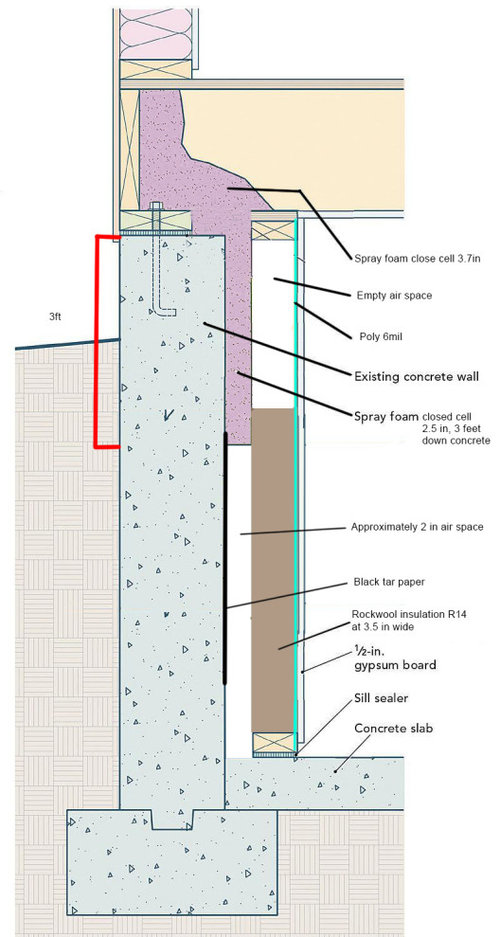
Hello, after some research and cost saving measures., I am thinking of doing a hybrid insulation method for basement concrete walls. Please see attached image I made.

I live in Zone5/6 - cold winters and humid summers.

Basically, I want to spray foam the heads with CC at 3.7in deep but just the top 3 feet of concrete wall with 2.5in of CC.

The bottom half of wall would be the original black tar paper on concrete with RockWool R14 in the 2x4 studs down to the slab.

The whole wall would then get a poly 6mill from top to bottom.


Do you see flaws to this method? Condensation risk? Any opinions are welcome. thanks


Comments (10)

  • 4 years ago

    Yes, there is a condensation problem. The concrete below the spray foam will be cold and wet and you've covered it up with poly. Why don't you just put foam board on the entire wall? That will be more economical than spray foam and rock wool.

  • 4 years ago
    last modified: 4 years ago

    ^^^^

    Or ccspf the foundation wall-top to-bottom. Comparative cost depends if this is diy or contracted. Where I had the time, I used XPS for an entire wall, followed by fg.

    *******

    there is a condensation problem.

    Here's why. And note carefully that if you're using XPS, it's important how you attach it.

  • 4 years ago

    Hi, i get it but im not convinced spray foaming the bottom 2 feet will pay itself off. That area never gets too cold or is always dry. So as an alternative, the added costs of rockwool and poly and time can go into a Spray foam at 2.5in from top sill to 5ft down. Then place left over pink insulation on top to bring up R value and cover the entire wall from top to bottom with NO poly anymore. Would this work?

    i cant do XPS boards anymore because the framing is already up and would be problematic in weaving boards into the back.

    Thanks

  • 4 years ago

    IRC 2018, adopted by most US states, calls for a minimum R15/19 for basements in Climates Zones 5 and 6. So you would be saving money by not meeting current Codes.


    Any water vapour moving into the basement now and dissipating could, after being constricted to a smaller un-insulated area behind the new wall, accumulate and feed mould.


    Asphalt paper should not be used on the interior as it can release toxic vapours.


  • 4 years ago

    just for information: The code also in my area allows for tar paper moisture membrane on the inside concrete. Builders have used in for about 20 years or so. There is R-12 FB the headers and the wall short 1 foot off the slab. Poly over everything short 1 foot again. Apparently this was code - albeit baseline code and is still being used by builders today. Ok about the complicated strategy I drew up, but please humor me on this: Headers spray foam to 3.7in deep, then concrete (with tar paper removed), spray foam to 2.5 in (R-16-ish) short 1 foot off the ground (so 6 feet) and have FB cover over entire wall from top to bottom. No more poly. I should have adequate vapour barrier at sprayfoam with 2.5, plus the additional FB to bring Rvalue up to 20+ ?

  • 4 years ago

    Sure that'll work, as long as it's closed cell insulation. Is this new construction or renovation?

  • 4 years ago

    Whether you're in Climate Zone 4, 5 or 6 the minimum Building Code requirement for new homes is R15 continuous or R19 discontinuous for basements.


    So you're economizing by not meeting Code.


    Once you enclose the concrete wall, any moisture that's normally evaporating into the unfinished basement is now trapped in a small space and will accumulate, possibly feeding mould.


    BTW, it is a safety hazard to use asphalt building paper (tar paper) on the interior as it releases toxic fumes.

  • 4 years ago

    The builders used tar paper, not me. On thousands of home. So I guess they also broke code? They also installed R12 FB, well below standards now, but that was accepted - barely code. They also installed FB on half of foundation on some cheaper homes - that too was accepted. Residential homes already bend codes to make something barely functional at minimal cost.

    What I'm proposing now with 6 feet down at 2.5in , is a light year above what builders provide. I'm still skeptical that 2.5in is needed 6 feet down. In comparison with XPS sheets 2in, that would yield me about R10 which is still less than 2in of close spray foam. At this point, I'm more concerned about functionality, pragmatism at this point and cost savings in these expensive times. Every darn foot is way too expensive. DIY'ers are required to be more creative in their approaches yet get as much guidance as possible.

  • 4 years ago

    The wall studs were already in-place with pink batts by the builder. Framing was pretty good. Its a reno job.

  • 4 years ago
    last modified: 4 years ago

    Building Codes change over the years. Just a couple of decades ago, lead solder, asbestos wrapped heating pipes, asbestos-impregnated popcorn ceilings were standard issue. Lead pipes still supply water in every US State. And I'm sure there's lots of builders who swear by all these things and curse the environmentalists.

    Natural Resources Canada advises not to use tar paper in basement insulation.

    And, in consideration of, among other studies, an exhaustive UN study of asphalt fumes noting its likely toxic effects on asphalt workers, many builders use alternative materials since they're available and no more costly.

    Study Conclusion

    "Despite the uncertainties, limitations, and mixed study results, what is clear is that

    asphalt fume condensates produce malignant skin tumours in mice; and that, when exposed to airborne concentrations of asphalt or asphalt fumes and vapours,

    workers report symptoms of irritation of the eyes, nose,and throat and, in some, lower airway changes and demonstrate metabolism of the chemical constituents of asphalt fumes and vapours.

    Taken as a whole, these results suggest that effects do occur in mammalian

    systems and that the limitations or uncertainties should not preclude taking steps to manage human exposures. Under various performance specifications, it is likely that asphalt fumes and paints contain carcinogenic substances."

    You can always use less expensive EPS (expanded polystyrene) boards for the lower part of the wall, at least enough to avoid condensation.

    You have no obligation to insulate your home to current Code. A 1964 home we moved from last year had zero insulation in any of its walls. The cost to upgrade far outweighed any energy cost savings. (It's now awaiting demolition!)