Software
Houzz Logo Print
cardschiefsillini

This stuff vs weed and feed, etc?

4 years ago
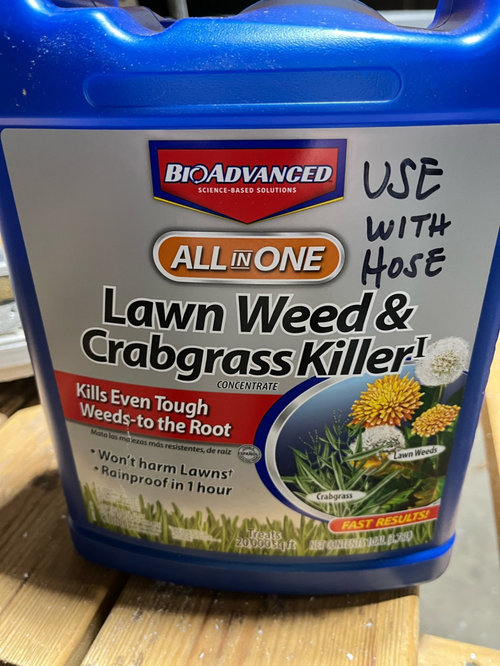
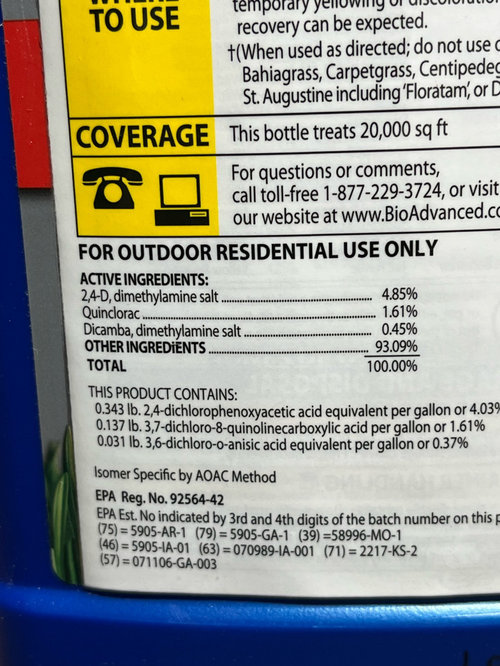
I’ve used this stuff the last couple years to knock out dandelions and other undesirables but I should probably fertilize as well. Any suggestions on what to use to do both? Newbie question I know.

Comments (5)

  • 4 years ago

    Yes, noob, this is a popular topic among your kind. ;-)

    Never use a weed n feed product. They are hard to apply properly, and even if you get it perfect, there are a couple timing issues. The macro timing issue is that spot spraying the lawn with the above product should be done in mid April (2 weeks ago) and your first spring fertilizer (in the north) should go down in late May, six weeks later. The reason for waiting until mid April to spot spray weeds is so that they are up and growing well. Sleeping weeds or unhealthy weeds don't die as well as vigorous weeds, and that leads to spraying again. Now would be fine to use the All in One product assuming you live in the north. The reason they are hard to apply is the grass is supposed to be wet so the product sticks to it. This is backasswards from the way every other product is applied. Keeping the grass wet while also applying the dry product is a 2-person job.

    Around Memorial Day you should put down a dry fertilizer product to carry the lawn through the summer. My favorite fertilizers are organic, but I'm not going to twist your arm on that.

    And since you identify as a noob, here are some other tips.

    Watering

    Deep and infrequent is the mantra for watering. Deep means 1 inch all at one time. Measure that by placing cat food or tuna cans around the yard and turn on the sprinkler(s). Time how long it takes to fill all the cans. That time will become your watering time from now on. Mine is 8 hours with my hose, water pressure, and oscillator sprinkler. Yours will be different. Frequency depends mostly on the daily high temperature. With temps below 70, deep water once a month. With temps in the 70s, water once every 3 weeks. With temps in the 80s deep water once every 2 weeks. With temps in the 90s deep water once a week. Other factors bearing on watering include sun/shade, cloudiness, wind, soil type, and humidity. Start with the frequencies mentioned and adjust by a day or two in either direction depending on conditions. If it rains, reset your calendar. Honestly last year in my part of Texas we had rain timed perfectly so I did not have to water until July. This year we started a month ago. Deep and infrequent also helps keep weeds away, because weed seeds need shallow and frequent watering...like daily watering, to germinate.

    Mowing

    Mow most grasses at the mower's highest setting. This gives the most dense grass and provides the most shade to the soil surface. This helps prevent weed germination and slows down evaporation.

    Fertilizer

    First app of the year in the north is late May (Memorial Day). Second app is in late summer (Labor Day). Third app is in late November after the grass goes completely dormant and stops growing. This is the winterizer application to prepare the lawn for spring awakening. This application is why you don't need to fertilize in early spring. Use a dry product to apply pounds of fertilizer. Liquid fertilizers apply micro ounces of fertilizer and must be repeated every week or two.

    The above are in order of importance and are the condensed wisdom of the Internet forums over 20 years: Watering, mowing, and fertilizing in decreasing order of importance. These following are special topics that everyone should be aware of.

    Insecticide

    If you have lawn damage and discover that a certain insect is to blame, THEN you can apply an insecticide. Otherwise do NOT apply preventive insecticide in anticipation of the problem before it affects your grass. There are millions of insects in the soil and lawn which are important to keeping the lawn healthy. Spraying insecticide willy nilly is a really bad idea.

    Fungicide

    Pretty much the same problem as with insecticide. There are billions of beneficial fungi living in the soil. Don't kill them for no reason. If you water as above you will likely not have a fungal problem. Sometimes Mother Nature does not cooperate and disease can happen. Also, mushrooms are not a problem. They may be unsightly, but they are not a problem that a 9-iron can't fix. They will pop up in a healthy lawn if it gets too wet (ahem, Mother Nature).

    Dethatching and Core Aerating

    If you water and fertilize as outlined above, you should not need to dethatch. Whereas if you water every day and use spray fertilizer, then the grass will 'learn' that it doesn't need deep roots to survive, and it will tend to grow at or above the surface. Thatch happens. As for core aerating, it is extremely unlikely you have compaction issues unless you have the marching band practice on your lawn right after a rain storm. If your soil is harder than you want it to be, try spraying any clear shampoo, like Baby Shampoo, at 3 ounces per 1,000 square feet. Follow it up with 1/2 to 1 inch of irrigation or rain. Give that 3 weeks and the soil will become much softer. Before you get too skeptical, keep in mind that this costs you 50 cents to try. It is not worth your time arguing about it. If it doesn't work for you, you would be in the minority, and it only cost you 50 cents.

    YouTube videos.

    I mean WTF? These guys must be paid by the fertilizer and -icide industry to shill products. Seriously lawn care is not rocket surgery. I have thought about writing a book on lawn care, but the more I think about it, the more the book turns into a 3-fold pamphlet. There is not much more to say than what I've said. How can these guys keep finding stuff to post to YouTube???

  • 4 years ago

    Lots of good info above. I will only throw in this 4 cents:

    I used to use the big name, locally headquartered lawn products with only moderate success. I switched to corn gluten meal, from another semi-local company, as my pre-emergent + fertilizer. When I needed it, which I haven't for the past several years, I used Iron-X to kill weeds that I couldn't easily just pull. Now I only get a few trying to move in around the edges, from the neighbor's lawns and neglected garden, which I just pull when I spot them while mowing.

    My heavy clay (central Ohio) soil was compacted from 80 years of activity, even more when I had to have some heavy equipment to take down a tree and replace the concrete porch on it. So, after those repairs 4 years ago, I decided to till in the existing grass (which was 90% weed free by then) along with some leaves, to loosen the soil, then replanted with a turf-type tall fescue (from the same company as the CGM). Since replanting I have stuck with the corn gluten meal. I've had to treat for grubs in a couple of patches, but that is the only other product I have needed to use. The grass is very thick and uniform. The only drawback is, I have to mow 2x/week at this time of year.

    I have neighbors stop to ask which lawn service I use!

  • 4 years ago

    Illini fan, corn gluten meal (CGM) is a byproduct of corn processing. When corn syrup is made, the left over material is CGM. It was a waste product until they started using as an animal feed. Since it is a high protein material, it makes a good organic fertilizer in the garden. The application rate is 15 to 20 pounds per 1,000 square feet. I can confirm that it is an excellent fertilizer. In my experience it has 0.00 benefit as a preemergent herbicide.

    We used to compare organic material costs way back when, and your area is a great place to buy CGM. In the early 2000s I was paying $12 a bag for it while folks in the Upper Midwest were paying $4 per bag. The price depends on the commodity price for corn plus transportation costs from the source of the corn.

  • 4 years ago

    Thank you all for the advice. I certainly appreciate it

Sponsored
Custom Home Works
Average rating: 4.6 out of 5 stars10 Reviews
Franklin County's Award-Winning Design, Build and Remodeling Expert